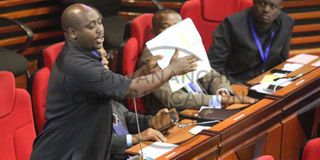
Kigoma North MP, Peter Serukamba gives his contribution yesterday during ongoing Bunge meeting in Dodoma yesterday. PHOTO | EDWIN MJWAHUZI
What you need to know:
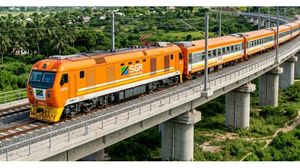
Debating on the 2016/17 Budget framework from Monday evening up to yesterday, the MPs, irrespective of party affiliations, called on the government to come up with a detailed and tangible plan that should be contained in the next annual budget, on how the central railway line will be rebuilt into standard gauge level.
Dodoma. Members of Parliament from both the ruling party and the Opposition are up in arms over what they see as government laxity towards the “urgent need” to upgrade the central railway line to standard gauge level.
Debating on the 2016/17 Budget framework from Monday evening up to yesterday, the MPs, irrespective of party affiliations, called on the government to come up with a detailed and tangible plan that should be contained in the next annual budget, on how the central railway line will be rebuilt into standard gauge level.
Yesterday, MPs whose constituents have a direct stake in the central line running from Dar es Salaam to Kigoma and Mwanza, have formed what they call Parliamentary Railways Caucus, chaired by Mr Ezekiel Maige (Msalala-CCM), with Mr Zitto Kabwe (Kigoma Urban-ACT) serving as secretary, to push for the reconstruction agenda.
The lawmakers have vowed to block the 2016/17 Budget if the government will fail to draw a detailed plan for the project. What displeases the MPs is the fact that the next fiscal year’s budget framework is silent on the project. They are also not happy with the remarks by the Finance and Planning Minister Philip Mpango who, when presenting the framework of the Second Five Year Development Plan (FYDPII) in parliamentary seminar last Monday, said the project, which is worth $7.6 billion (Sh15 trillion), is too costly for Tanzania to finance through local sources.
Mr Kabwe told the Parliament yesterday that it was possible for the project to be financed using local sources. “In the last Parliament, we introduced Railway Development Levy, where 1.5 per cent of import duty is directed to railways projects. If we are to borrow monies for the standard gauge project from abroad, then just like Kenya, we can use the funds generated from the levy to service the loan,” said Mr Kabwe.
In a separate interview, Mr Kabwe told The Citizen that last year the country imported goods worth $8 billion, noting that 1.5 per cent of that amount is around $120 million.
“Usually, loans for such a project have a lifespan of between 20 and 25 years, and if we are to use the railway development levy alone, we can certainly sustain it using our own means,” the MP said.
Kigoma North MP Peter Serukamba (CCM) had this to say: “The construction of standard gauge railway line is a matter of life and death; it is important also to connect the project with neighbouring countries, but that can happen only when the local network is in place.”
Special Seats legislator, Ms Mwanne Nchemba (Tabora-CCM), told the House that the fate of the project was “not a joke” for the residents of central and western regions.
“Our voters depend on it (the railway) for travel and transportation of goods; the economies of these regions have been badly affected since there is no reliable railway service. We want the standard gauge project to begin as soon as possible,” she said.
The Kigamboni MP on CCM ticket, Dr Faustine Ndugulile, was on Wednesday evening the first lawmaker to contribute on the debate and said the standard gauge subject has cropped up time and again in the past to the present and what remained now was for the government to implement the project.
“We cannot sit here and talk of mega economic projects while the construction of central railway line in standard gauge is cut out of the picture. That railway would constitute the backbone of our economy; without it we will be just building castles in the air.” In May last year, the then Transport minister, Mr Samwel Sitta, issued a statement to Parliament, declaring that a Chinese consortium led by China Railway Materials, was awarded a $7.6-billion contract to build a 2,561km standard gauge railway from Dar es Salaam to Burundi, Rwanda and DR Congo.
According to Mr Sitta, the consortium was to finance 10 per cent of the total costs, while financial adviser Rothschild was finalising procedures for sourcing the remaining funds through commercial banks.
Under the original plan, fourth phase President, Mr Jakaya Kikwete, was scheduled to launch the construction project on September 15. However, in November, the Reli Assets Holding Company (Rahco) released a report saying the launch had been delayed due to “the busy campaigning timetable Mr Kikwete and the launch will be undertaken new President, Dr John Mgufuli.”
Since then the matter went silent until the current heated debate in the Parliament.