Government outlines budget priorities as debt servicing hits Sh15.1 trillion

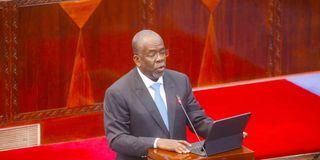
Minister for Finance Khamis Mussa Omar, presents the ministry’s plan and budget priorities in Parliament, June 02, 2026. PHOTO | COURTESY

Dar es Salaam. The government has set out eight key priorities for the Ministry of Finance in the upcoming financial year, focusing on macroeconomic stability, improved revenue mobilisation, debt management and the adoption of digital and data-driven systems in public financial administration.

Presenting the ministry’s plan and budget priorities in Parliament, Minister for Finance Khamis Mussa Omar said debt servicing remained a key focus area, with the ministry expected to allocate Sh15.1 trillion for the payment of matuAAring principal and interest, in line with contractual obligations and efforts to sustain investor confidence in regional and international financial markets.
In addition, the government will set aside Sh100 billion every month to clear arrears owed to public servants, contractors, service providers and suppliers.

“The Ministry of Finance is seeking approval for total expenditure of Sh21.34 trillion for recurrent and development spending across eight ministry votes. Of this amount, Sh19.45 trillion is allocated for recurrent expenditure, while Sh1.89 trillion is earmarked for development expenditure,” said the minister.

He said the government aims to sustain economic growth of 6.3 percent in 2026 while keeping inflation within a single-digit range of between three and five per cent.

He said foreign exchange reserves are expected to remain sufficient to cover at least four months of imports of goods and services, reflecting efforts to maintain external stability.

Among other priorities, the ministry will strengthen fiscal discipline by improving revenue collection, resource allocation, procurement processes and value-for-money oversight, while also minimising budget reallocations between government votes.

On revenue projections, the Tanzania Revenue Authority (TRA) is expected to collect Sh41.01 trillion in gross tax and non-tax revenue in the 2026/27 financial year, including Sh39.64 trillion in tax revenue and Sh1.37 trillion from non-tax sources.

TRA will also intensify voluntary tax compliance through public education campaigns, improved service delivery and enhanced enforcement measures aimed at curbing tax evasion and corruption using intelligence-led audit systems.

The government also plans to enhance systems for managing revenues, grants and loans, with the aim of contributing Sh55.2 trillion to the Consolidated Fund, representing 88.6 percent of the total government budget of Sh62.3 trillion.

The ministry also plans to improve the allocation of financial resources based on research evidence, reduce duplication, and strengthen equity in the distribution of funds between central and local government authorities.

A further priority is the review of programme-based budgeting to assess its effectiveness in guiding public expenditure and supporting potential reforms in budget management systems.

Capacity building for public officials will also be expanded, particularly in environmental compliance, governance standards and the use of artificial intelligence in public finance and economic management.

Despite progress in implementing previous priorities, the minister acknowledged several challenges affecting fiscal operations.

These include rising borrowing costs in international financial markets, weak uptake of electronic payment systems affecting non-tax revenue collection, and global geopolitical tensions that have disrupted supply chains and increased the cost of goods and services.

He also cited shifting development partner policies, which are expected to reduce external grants in the 2026/27 projections, as well as rising domestic arrears and increased demand for capacity building within the public sector.

To address the challenges, the ministry said it will expand domestic revenue collection systems, increase reliance on the local financial market following strong performance in government securities auctions, and strengthen digital platforms for payments, service delivery and revenue administration.

Other measures include improving the investment and business environment, formalising the informal sector to broaden the tax base, and allocating funds to clear outstanding arrears owed to contractors and suppliers.

The ministry also confirmed continued investment in training public servants on environmental sustainability and the application of artificial intelligence in government operations.

The Parliament’s Budget Committee commended the government, led by President Samia Suluhu Hassan, for its strong financial capacity to service public debt on time and as required.

“Although public debt remains sustainable under all international benchmarks, the debt-to-exports ratio currently stands at 13.9 percent against a ceiling of 15 percent.

If export performance is not strengthened, there is a risk of reaching the threshold, which could undermine debt sustainability,” said the committee chairperson Mr Mashimba Ndaki.

“The committee urges the government to invest in sectors and strategies that boost exports in order to contain debt levels and strengthen the value of the shilling.

It further calls on the Government to reduce domestic borrowing so as to create more space for the private sector to access credit at more affordable interest rates,” he added.