How inclusive financial policies can address SMEs’ challenges in Africa

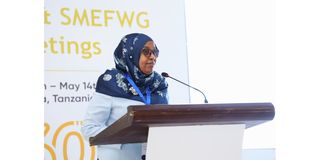
Bank of Tanzania (BoT) Deputy Governor, Ms Sauda Msemo, speaks in Arusha on  Monday, May 11, 2026, during the opening of the global meeting of the Alliance for Financial Inclusion (AFI). PHOTO | JANETH MUSHI
Arusha. Many women entrepreneurs, including small and medium enterprise (SME) operators across Africa and other developing countries, continue to face structural barriers that prevent them from fully participating in economic activities through formal financial systems.

Strengthening proportional policies and expanding the use of financial technology have been identified as key solutions to address challenges facing women, particularly limited access to credit due to lack of collateral and insufficient asset ownership.

The remarks were made on Monday, May 11, 2026, in Arusha by the Deputy Governor of the Bank of Tanzania (BoT) for Financial Sector Stability and Supervision, Ms Sauda Msemo, while opening a global meeting of the Alliance for Financial Inclusion (AFI).

The meeting is discussing ways to improve financial inclusion policies and strategies, with a focus on small and medium-sized enterprises (SMEs), alongside international standards, legal frameworks and their impact on financial access.

Ms Msemo said key challenges facing the group include lack of collateral, absence of formal ownership of assets, weak digital identification systems and regulatory frameworks that do not fully reflect the realities of women entrepreneurs, particularly those operating in the informal sector.

She said many women are unable to access loans due to the absence of formal financial records, lack of acceptable collateral, and limitations in inclusive identification systems.

Addressing these challenges, she said, requires comprehensive policy reforms, stronger digital systems and expanded use of technology in financial service delivery.

Other solutions include greater use of mobile money platforms and digital payment systems to narrow the financial access gap for women and entrepreneurs in general.

“It is important to ensure that laws and regulations do not become barriers to the people we seek to support, especially women entrepreneurs. We know SMEs create a very large number of jobs, including in our country, thereby generating income for many citizens,” she said.

“We will examine the extent to which various laws and international regulations may negatively affect financial inclusion and how guidelines can be developed to assist AFI member countries in managing such impacts while maintaining a balanced approach,” she added.

Ms Msemo said the initiative would help ensure that financial resilience and inclusion are not undermined.

“There are different laws and supervisory systems dealing with anti-money laundering and counter-terrorism financing. While establishing guidelines to ensure countries maintain strong systems for managing these issues, it is equally important to safeguard financial inclusion,” she said.

Earlier, AFI Director for Policy Programmes and Implementation, Dr Eliki Boletawa, said the meeting brought together more than 70 participants from 44 countries.

He said SMEs remain a key pillar of many economies due to their contribution to employment, production and income generation.

“Proportional regulation is important in ensuring we protect financial stability without excluding those we intend to support,” he said.

Dr Boletawa added that financial innovation, including artificial intelligence, digital financial services and instant payment systems, remains critical in reducing costs and expanding access to services.

Bank of Tanzania Director of Financial Development and Inclusion, Mr Kennedy Komba, said Tanzania’s financial inclusion journey shows that strong policies, technological innovation and stakeholder cooperation can transform people’s lives.

He said over the past three decades, Tanzania has made significant progress in expanding access to formal financial services, with reforms beginning in 1991 and laying the foundation for banking sector growth.

He said the most notable progress came through the mobile money revolution between 2008 and 2011, which transformed access to financial services for people living far from bank branches, particularly in rural areas.

Mobile phones became the main channel for accessing financial services, sending and receiving money and making payments.

He said data from 2008 to 2011 showed significant growth in mobile financial services use, with 15.5 percent of adults using mobile phones to pay bills, 14 percent using them to send and receive money, and 21 million mobile money accounts registered.

He said between 2012 and 2013, about 50 percent of citizens had access to mobile financial services, while from 2014 to 2016, the introduction of the National Financial Inclusion Framework expanded access points nationwide.

Formal financial inclusion rose from 57 percent in 2013 to 65 percent, while between 2018 and 2022, the proportion of adults accessing services within five kilometres increased to 89 percent from 86 percent in 2017.

During the same period, adults using formal financial services rose to 76 percent from 65 percent in 2017, while 72 percent used mobile money services, reducing transaction costs and delays.