Government opts for continuity with Sh2.9 trillion transport allocation
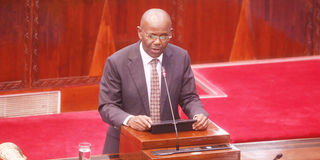
Transport Minister Makame Mbarawa presents the ministry’s budget proposals for the 2026/27 financial year in Parliament in Dodoma on Wednesday, May 13, 2026. PHOTO | SAID KHAMIS.
Dodoma. The government has opted to sustain ongoing strategic transport projects in the 2026/27 financial year, with the sector’s budget rising slightly to Sh2.87 trillion amid continued investment in railways, ports, airports and the national carrier.
Presenting the 2026/27 ministerial budget proposals in Parliament in Dodoma yesterday, Transport minister Prof Makame Mbarawa requested the House to approve Sh2.87 trillion for the coming financial year.
Of the total amount, Sh126.04 billion has been earmarked for recurrent expenditure, while Sh2.74 trillion will finance development projects.
The proposed allocation marks a slight increase from the Sh2.74 trillion approved for the ministry in the 2025/26 financial year.
The Standard Gauge Railway (SGR) project continues to dominate the ministry’s development agenda, taking the largest share of the budget. The government has allocated Sh1.51 trillion in local funds and Sh61.84 billion in external financing for the project’s implementation.
Prof Mbarawa said the funds would support maintenance works on the Dar es Salaam–Makutupora section, completion of the Morogoro–Makutupora stretch and continued construction of the Makutupora–Tabora, Tabora–Isaka, Mwanza–Isaka, Tabora–Kigoma and Uvinza–Musongati sections.
The budget will also finance the procurement of locomotives, wagons, machinery, spare parts and maintenance equipment, as well as environmental management and supervision of the project.
The minister told Parliament that the government had secured a concessional loan worth $1.277 billion to accelerate stalled sections between Makutupora, Tabora and Isaka, which had experienced implementation delays for a prolonged period.
According to Prof Mbarawa, Tanzania expects to have a total of 2,809 kilometres of SGR lines upon completion of both phases of the project.
He said passenger transport on the Dar es Salaam–Dodoma SGR route continued to grow strongly, with 2.51 million passengers transported between July 2025 and March 2026, compared to 2.05 million passengers during the same period in the previous financial year.
“Cargo transportation through the SGR also began during the period, with the Tanzania Railways Corporation (TRC) transporting 102,452 tonnes of cargo between July 2025 and March 2026.”
The minister said the government was continuing with integration works linking SGR and metre gauge railway (MGR) infrastructure at Ruvu and Bahi to facilitate cargo transfer between the two systems and strengthen connectivity with the ports of Dar es Salaam and Tanga.
Beyond railways, the government has allocated significant funds to improve port infrastructure and aviation services.
The Dar es Salaam Port improvement project has been allocated Sh120.74 billion in external financing for further expansion and modernisation works.
The government has also earmarked Sh16.42 billion for the Kigoma Port improvement project, which includes rehabilitation of the access road, passenger jetty and passenger terminal building.
Prof Mbarawa said increased efficiency at the Port of Dar es Salaam had significantly boosted cargo volumes and reduced operational costs.
“Cargo handled at the port increased from 16.27 million tonnes in 2020/21 to 27.76 million tonnes in 2024/25, representing a 70.62 percent increase,” he said.
Monthly container handling capacity rose from 61,000 twenty-foot equivalent units (TEUs) to 102,000 TEUs, while the average waiting time for container ships at berth fell from 10 days to three days.
Meanwhile, the average waiting time at anchorage for conventional cargo vessels dropped from 46 days to seven days.
The government has also allocated funds for airport expansion and rehabilitation projects across the country.
Mwanza Airport has been allocated Sh6 billion for continued construction of a new passenger terminal and related infrastructure, while Arusha Airport will receive Sh3.08 billion.
The government has also earmarked Sh32 billion for rehabilitation works at Kilimanjaro International Airport (KIA), including runway rehabilitation, installation of airfield lighting systems and construction of perimeter fencing and administrative buildings.
At Julius Nyerere International Airport (JNIA), Sh26.75 billion has been allocated for passenger terminal upgrades, runway safety improvements, installation of ICT systems and strengthening airport security infrastructure.
Regional airports development projects have been allocated Sh14.38 billion to support construction, rehabilitation and expansion works.
Prof Mbarawa also highlighted progress in reviving Air Tanzania Company Limited (ATCL), saying the airline’s fleet had expanded from one aircraft in 2016 to 16 aircraft in 2026.
Passenger numbers increased from 107,166 in 2016/17 to 1.17 million in 2024/25, while revenue rose from Sh23 billion to Sh595.7 billion.
During the period between July 2025 and March 2026, ATCL transported 1.07 million passengers, representing a 22.38 percent increase compared to the same period last year.
The airline has been allocated Sh185.32 billion for aircraft acquisition, procurement of spare engines and rehabilitation of maintenance facilities.
Another Sh97.73 billion has been allocated to strengthen ATCL operations, including construction of a new aircraft maintenance hangar, cargo facilities and acquisition of pilot training simulators.
However, the Parliamentary Committee on Infrastructure expressed concern over delays in the release of development funds to the ministry.
Presenting the committee’s views, chairperson Moshi Kakoso said the ministry had received only 67.6 percent of its approved budget by March 2026, below the implementation target of 75 percent.
“The committee was not satisfied with the trend in the availability of funds for development projects in the Ministry of Transport,” he said.
He urged the government to reduce dependence on external financing for strategic transport projects and ensure timely disbursement of development funds approved by Parliament.
The committee also called on the government to accelerate transport infrastructure improvements to boost economic growth and create more employment opportunities for young people.