Dar es Salaam. Water authorities across the country are increasingly demonstrating that controlling water loss is achievable, offering a practical pathway to safeguard billions in revenue and improve service delivery to citizens.
Recent performance trends show that while water loss remains a challenge, several authorities have successfully reduced it to within acceptable levels, proving that targeted interventions and strong management can yield results.
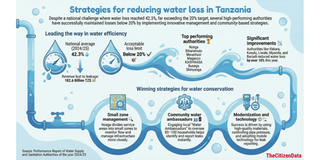
According to the Energy and Water Utilities Regulatory Authority (Ewura), the national benchmark for acceptable water loss is below 20 percent. Encouragingly, authorities in Nzega, Biharamulo, Mwanhuzi, Maganzo, KASHWASA, Busega and Shinyanga have attained this target, significantly reducing revenue losses and improving operational efficiency.
These successes come at a time when the country continues to lose an estimated Sh182.6 billion annually due to water that is produced but not billed or delivered to customers.
Ewura data indicates that overall water loss increased from 36.8 percent in the 2023/24 financial year to 42.3 percent in 2024/25, underscoring the importance of scaling up best practices already working in some regions.
The 2024/25 Water Utilities Performance Report shows that water loss directly translates into uncollected revenue, affecting the financial sustainability of utilities and delaying the expansion of services. However, the experience of high-performing authorities highlights that improvement is within reach.
In Nzega, Executive Director of the Water Supply and Sanitation Authority, Eng Humphrey Mwiyombela, attributes their success to the adoption of District Metered Areas (DMAs), a system that divides the water network into smaller, manageable zones.
He said the approach simplifies monitoring and enables faster detection of leaks and illegal connections.
“By dividing the network into smaller zones, it becomes easier to control losses because each area has fewer customers and can be closely monitored,” he said.
He added that community engagement has also played a key role, with water ambassadors overseeing between 80 and 100 households and reporting issues promptly.
“These ambassadors are linked to technicians. Once a problem is identified, repairs are carried out quickly,” he said, noting that the authority has also invested in rehabilitating ageing infrastructure and ensuring the use of quality materials.
Similarly, Shinyanga Water Authority has recorded positive results through timely leak repairs and measures to curb water theft. Customer Service Director Reuben Mwandumbya said pressure management has also been critical in preventing pipe bursts that contribute to water loss.
“We regulate water pressure to avoid pipe bursts and minimise losses,” he said.
Other authorities, including Ifakara, Kasulu, Liwale, Mpanda and Bariadi, have also made notable progress, reducing water loss by more than 10 percent compared to the previous year. These improvements signal growing momentum in the sector.
While some authorities continue to face higher levels of water loss, efforts are underway to address the situation. In Rombo District, Executive Director Godwin Chacha said strategies have already been submitted to Ewura for evaluation and follow-up, reflecting ongoing commitment to improvement.
Stakeholders from the private sector are also contributing to water conservation efforts. Tanzania Breweries Limited (TBL) has taken steps to reduce water usage in its production processes, targeting further efficiency gains by 2030.
According to TBL plant manager Patel Kilaveli, the company has invested over Sh2 billion in wastewater treatment systems to protect the environment and promote sustainable water use.
He added that the company is also supporting communities around water sources, including residents of Ruvu in Kibaha, by promoting alternative livelihoods such as beekeeping that contribute to environmental conservation.
To strengthen sector performance, Ewura issued guidelines in 2021 requiring all water authorities to maintain water loss below 20 percent and to improve meter management systems to enhance billing accuracy and revenue collection.
Progress is evident, with the number of authorities having approved water loss reduction strategies rising to 28 out of 83 in 2024/25, up from 25 in the previous year. In addition, all 83 authorities have begun preparing water balance reports to better measure and manage losses.
Speaking during World Water Day commemorations, Minister for Water Juma Aweso said the government will now assess the performance of water authority directors based on their ability to control water loss.
He noted that challenges such as illegal connections, ageing infrastructure and delayed response to reported issues still need to be addressed, but emphasised that solutions are within reach.
To accelerate progress, he proposed the formation of dedicated task forces within water authorities and greater use of modern technology to detect and manage losses.
“We need systems that allow citizens to report problems quickly, even by taking photos and sending them. The technology is available; it is time to use it,” he said.
As more authorities adopt proven strategies and strengthen accountability, the growing evidence suggests that reducing water loss is not only possible but essential for protecting revenue and ensuring reliable water services for all.