How Tanzania plans to spend Sh730 billion to mitigate El Niño impacts
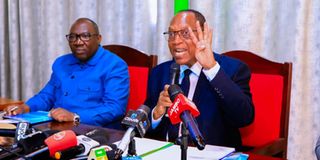
Minister for State in the Prime Minister’s Office (Policy, Parliament, Coordination and Persons with Disabilities), Prof Palamagamba Kabudi, addressing a press conference on Wednesday, September 2, 2026, in Dodoma. PHOTO | COURTESY
Alfred Zacharia is a business reporter for The Citizen and Mwananchi newspapers.
Mwananchi Communications Limitted
Dodoma. The government has clarified that the estimated Sh730 billion required to address the potential impacts of El Niño is not a direct allocation from the 2026/27 national budget, but a projection covering a broad, multi-sector response before, during and after possible disasters.
Addressing journalists on Wednesday, September 2, 2026, in Dodoma, Minister of State in the Prime Minister’s Office (Policy, Parliament, Co-ordination and Persons with Disabilities), Prof Palamagamba Kabudi, said the estimate forms part of the national emergency plan for responding to the potential effects of El Niño.
He said the plan involves government ministries, departments and agencies, regional and local authorities, development partners, civil society, the private sector and communities.
Prof Kabudi said the plan is built around four key stages: preparedness, prevention and mitigation, response, and recovery.
“The preparedness phase involves developing emergency plans, mobilising resources and ensuring institutions are ready to respond. Prevention and mitigation measures include inspecting and strengthening bridges, roads, drainage systems, dams and other infrastructure in vulnerable areas,” said Prof Kabudi.
Should disasters occur, the minister said the response phase would focus on rescue operations, emergency food supplies, shelter and other humanitarian assistance.
According to him, recovery would involve restoring damaged infrastructure and essential services, including roads, electricity, water and communication networks.
“The Sh730 billion is an estimate for all four stages. If the situation does not reach the response and recovery stages, the actual expenditure will be lower,” said Prof Kabudi.
He stressed that the government is currently concentrating on early preparedness and preventive measures, while encouraging stakeholders to use their existing budgets to address risks within their respective areas.
For the 2026/27 financial year, Prof Kabudi said Sh10 billion has been allocated in the government budget for activities related to implementing the emergency plan across sectors.
He said the broader Sh730 billion estimate includes potential resources that could be required if extensive disasters occur and should therefore not be interpreted as money already spent or fully allocated for El Niño preparations.
The strategy brings together efforts across critical sectors, including transport, health, education, energy, water, communications and food security.
“Both central and local government authorities are expected to inspect and reinforce critical infrastructure, clear drainage systems, strengthen riverbanks and dams, improve waste management and identify safe areas that could serve as temporary shelters if communities need to be evacuated,” he noted.
The government also plans to strengthen national food reserves, ensure the availability of rescue equipment and emergency supplies, and improve communication systems for timely disaster warnings.
Prof Kabudi said the Prime Minister’s Office on August 26 directed regional authorities in areas identified through weather forecasts as potentially vulnerable to flooding to intensify preparations.
The regions include Kagera, Geita, Mwanza, Shinyanga, Simiyu, Kigoma, Dar es Salaam, Tanga, Pwani, Morogoro, Mara, Arusha, Kilimanjaro and Manyara.
“Regional authorities should identify high-risk areas early, conduct risk assessments and encourage residents in vulnerable locations to move to safer areas where necessary,” he insisted.
Prof Kabudi also called on communities to use the expected rains for productive activities such as agriculture, livestock keeping, fishing and water harvesting while ensuring safety.
Farmers were encouraged to use appropriate farming methods, suitable crops and quality seeds, while households were urged to maintain adequate food reserves.
He further appealed to citizens to follow daily weather information from the Tanzania Meteorological Authority (TMA) and immediately report disasters to relevant authorities.
“The management of disasters is the responsibility of all of us,” Prof Kabudi said, urging stakeholders to work together to minimise the impact of severe weather on lives, livelihoods and infrastructure.
Register to begin your journey to our premium contentSubscribe for full access to premium content