Dar es Salaam. The major criticism about foreign aid to Africa is that it has led to lead the recipient countries to self-reliance. Many factors are cited for Africa’s continued overdependence on foreign aid, one of them being too much conditionalities that makes the aid difficult to implement sustainably.
But the head of one foreign aid agency says her organisation is determined to make a difference in the Continent to ensure that African countries graduate from aid recipients to donor countries.
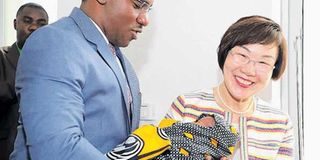
Speaking in Seoul recent the President of Korea International Cooperation Agency (Koica), Lee Mi-kyung told visiting journalists that South Korea’s experience as a former foreign aid recipient give Koica a unique advantage to help African countries help themselves.
“Africa is young and full of potential. It has a big market and is rich in natural resources. These are basics for self-reliance,” Lee noted. One immediate challenge that has be tackled with a sense of urgency is the overhaul of infrastructure and transportation systems to attract investments in various sectors of the economy as well as more tourists. She said Koica’s assistance is based on the win-win philosophy. “We understand frustrations, challenges and aspirations of Africans,” Lee noted.
Between 1945 and 1949 Korea was a major foreign aid assistance recipient mainly from the US and the UN. The inter-Korean war of 1950-1953 left Korea in rubbles, unable to feed, clothe and accommodate many of its citizens. About 500,000 South Koreans died in the war, 610,000 houses were ruined and 760,000 families separated.
This necessitated the creation of the United Nations Korean Reconstruction Agency (UNKRA). From 1950s to 1960s Korea received a total of $460 million out of which $120 million came from UNKRA.
But even as Korea was itself receiving foreign aid it already started some forms of assistance to other poor countries. In 1963 started conducting training programmes for public officials from developing countries. In 1987 Korea established the Economic Development Cooperation (ECD) and in 1989 it dispatched its first volunteers to under the Unesco tutelage.
In 1991 the United Nations Development Programme declared Korea’s transition from aid recipient and in the same year Koica was formed. And in 1996 Korea joined the Organisation for Economic Co-operation and Development. Koica’s beginnings were humble. The agency started with a budget of 17 billion Won (roughly $17 million in the current exchange rates) and an overseas office only in country.
Currently it has 45 offices in 44 countries. Whilst it started with eight projects in eight countries it now has 431 projects in 125 countries with 640 billion Won budget. It started with 37 volunteers in 1991 it now has 6,336.
Koica in Tanzania
Koica established its offices in Tanzania in 2002 and immediately started offering Official Development Assistance (ODA) in health, education, governance and rural development with a budget of $556,000. In 10 years to 2012 Koica Tanzania’s budget reached $10.1 million (Sh22 billion at current exchange rate) making Tanzania the second largest ODA recipient from Korea in Africa.
Koica helps in human resources development giving thousands of Tanzanians an opportunity to participate in training programmes since 1991. Tanzania has also been receiving volunteers, through the Korea Overseas Volunteers programme, in various fields such as medical doctors, nurses, medical technicians, science and ICT teachers, veterinarians and agriculture specialists.
Visiting Tanzania
Lee, who became Koica president in November last year, visited Tanzania in April where she also officiated the Chanika Maternity Hospital on April 19. The Sh9 billion, 150 bed, specialised hospital will go a long way towards reducing maternal deaths in the country.
“I am very proud of the project and what it is going to achieve. I was very much impressed by Tanzania during my visit and I could see the country has great potential,” Lee said.
Lee, who served as an elected lawmaker for five terms in Korea, before her appointment as president of Koica late last year, said after the opening of the Chanika hospital what follows is the constant upgrade of the medical staff.
“We currently fully supporting the training of 80 doctors as part of efforts to ensure the hospital has is well staffed,” Lee noted.
“It is our intention that the hospital runs smoothly,” she added. Chanika, is a semi-urban location roughly 19 kilometres from Dar es Salaam. In order to retain doctors as well as ensure they live nearby Koica built dormitories that are accommodative and comfortable enough, Lee noted.
Innovative growth programme
Koica is poised to take advantage of South Korean government’s new strategies to transform its economy into a people centred one. The most notable one is the innovative growth strategy, which is a framework that Korea wants to use to create processes that boosts innovation and produce technology that addresses social needs. This, according to South Korean government officials, also set to redefines its foreign relations and official assistance with other countries.
Even more important is the new way of engagement with partner states also known as Knowledge Sharing Programme, in which Korea uses to share its experiences of development and growth with an emphasis with locally grown and customized solutions by the aid recipient countries.