Tanzania unveils plan to transform TAZARA into Southern Africa’s leading trade corridor
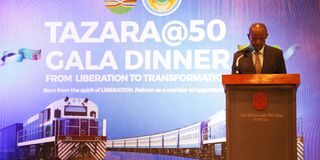
Minister for Transport Prof. Makame Mbarawa addresses guests during the TAZARA 50th Golden Jubilee Gala Dinner in Dar es Salaam, where stakeholders from Tanzania, Zambia and China gathered to celebrate five decades of the Tanzania-Zambia Railway Authority and reaffirm their commitment to revitalising the historic railway.. PHOTO | COURTESY
Dar es Salaam. Minister for Transport Prof Makame Mbarawa has outlined a new vision for the Tanzania-Zambia Railway Authority (TAZARA), centred on modernising infrastructure, introducing new technology and strengthening management systems to restore the railway’s competitiveness.
Prof Mbarawa said the transformation plan is aimed at positioning TAZARA as a strategic transport link connecting the Port of Dar es Salaam with Zambia and the wider Southern African region.
“Our responsibility is not only to preserve TAZARA’s proud history but also to prepare it for the opportunities and challenges of the next 50 years,” he shared during TAZARA’s golden jubilee celebrations yesterday, July 14.
According to him, the revitalisation of the railway should not be viewed as a mere infrastructure rehabilitation project but as a broader investment in regional integration, industrial development and trade competitiveness.
“This is far more than the rehabilitation of railway infrastructure; it is an investment in regional integration, industrial development and the prosperity of our people,” he shared.
Prof Mbarawa said the government’s transformation agenda includes upgrading railway infrastructure, introducing modern rolling stock, adopting new technologies, strengthening institutional systems and improving operational efficiency.
“We are positioning TAZARA to reclaim its rightful place as one of Africa’s premier railway systems,” he said.
He added that the railway should continue to serve as a symbol of regional cooperation by creating economic opportunities and strengthening ties between Tanzania, Zambia and other countries that depend on efficient transport networks.
“Let us continue to build a railway that creates opportunities, drives economic transformation and strengthens the bonds of friendship that unite our three great nations,” Prof Mbarawa said.
Meanwhile, Zambia’s Deputy High Commissioner to Tanzania, Anthony Bwalya, said the expansion of mining, agriculture, manufacturing and trade activities across the region had increased the need for reliable transport corridors.
Mr Bwalya said TAZARA’s revival should focus on restoring infrastructure while also redefining the railway’s purpose in supporting economic growth in the 21st century.
“It is not simply about repairing an old rail; it is about renewing its purpose and positioning it to serve the needs of the 21st century,” he said.
He said a modern TAZARA would provide Zambia with a competitive route to the Port of Dar es Salaam, reduce transport costs and improve access to international markets.
“A modern and efficient TAZARA will support Zambia’s key economic sectors and improve access to international markets,” Mr Bwalya said.
On the other hand, Chinese Ambassador to Tanzania, Chen Mingjian said China would support efforts to promote industrialisation along the railway corridor through the development of industrial parks and the establishment of special economic and free trade zones.
“We will also promote the development of existing industrial parks while planning new special economic zones and free trade zones along the railway,” she said.
Ms Chen said TAZARA’s 50-year journey represented more than transport connectivity, describing it as a symbol of cooperation, self-reliance and friendship among African countries.
“TAZARA has driven economic development and fostered people-to-people ties for half a century,” she shared.
The Director General of TAZARA, Eng Bruno Ching’andu, said the revitalisation programme had provided renewed hope for restoring the railway’s operational capacity and competitiveness.
He said the programme would support infrastructure rehabilitation, introduction of modern technology, and improved management systems and skills development among employees.
“This revitalisation programme gives us a genuine basis for renewed hope,” Eng Ching’andu said.
He added that TAZARA’s transformation would also focus on rebuilding workforce confidence and improving services for users, including traders, farmers, miners, manufacturers and tourists.
“The next chapter of TAZARA must be defined by improved reliability, safety, efficiency and customer care,” he said.
Register to begin your journey to our premium contentSubscribe for full access to premium content