MUHAS–Oxford pact offers new hope for Tanzania’s cancer fight

Dar es Salaam. Tanzania is stepping up its fight against cancer, a growing national crisis, through a strategic partnership that could redefine how the disease is detected, studied and treated in the country.

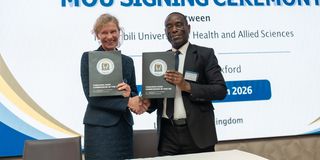
The new memorandum of understanding (MoU) between Muhimbili University of Health and Allied Sciences and University of Oxford-London, places cancer care, research and innovation at the centre of collaboration.
According to estimates from GLOBOCAN 2022, developed by the International Agency for Research on Cancer (IARC/WHO), Cancer has increasingly become a major public health burden in Tanzania.

The report estimates that 40,000 to 45,000 new cases are recorded annually and nearly 30,000 deaths.

Health experts say the situation is worsened by late diagnosis, limited screening services and a shortage of specialised personnel, leaving many patients with limited treatment options.

It is this reality that the MUHAS–Oxford partnership seeks to confront.

Under the agreement, the two institutions will collaborate on clinical training and mentorship in oncology, strengthen research capacity and explore the use of data science and artificial intelligence in cancer diagnosis.

The partnership, anchored under the Oxford Global Cancer Initiative, also aims to generate policy-relevant research aligned with Tanzania’s National Cancer Strategy.

MUHAS Vice Chancellor Appolinary Kamuhabwa said the MoU is designed to move MUHAS beyond traditional teaching into a hub of solutions.

“These partnerships position MUHAS at the forefront of global health collaboration, enabling us to strengthen research, training and innovation to better serve our communities,” Prof Kamuhabwa said.

For Tanzania, where more than 90 percent of cancer cases are diagnosed at advanced stages, experts say improving early detection is critical.

The introduction of advanced diagnostic tools and exposure to global best practices could significantly change patient outcomes.

A public health expert based in Dar es Salaam, Dr Deus Lushiku, noted that collaboration with a globally recognised institution like Oxford provides access to systems that are otherwise difficult to build locally.

“Oxford brings experience in clinical trials, data systems and cancer research networks. This allows MUHAS to accelerate its capacity in ways that would take years if done independently,” he said.

Dr Lushiku added that cancer research increasingly depends on global collaboration, particularly in understanding how the disease behaves across different populations.

“You need shared data, shared expertise and joint studies to develop effective interventions. Partnerships like this make that possible.”

Beyond research, the agreement is expected to influence training. Through mentorship and exchange programmes, Tanzanian doctors and researchers will gain exposure to specialised oncology skills, helping to address the country’s shortage of experts.

The partnership also comes at a time when Tanzania is facing a dual burden of disease, with non-communicable conditions like cancer rising alongside infectious diseases.

MUHAS internationalisation head Maryam Amour said the collaboration reflects a broader strategy of internationalisation.

“This collaboration expands opportunities for our researchers while fostering innovation that directly addresses pressing health challenges in our country,” Dr Amour said.

Experts say such global linkages are no longer optional for universities seeking impact.

“Internationalisation is not just about visibility, it is about relevance,” said Dr Lushiku. “If MUHAS is to lead in cancer research, it must be part of global scientific conversations.”

Currently, Tanzania is pushing to reduce cancer-related deaths and emphasising on research to enhance cancer diagnosis and treatment.

The country is committed to reducing cancer-related deaths by at least 30 and positioning itself as a vital centre for cancer research and treatment.

Speaking at the 30th anniversary of the Ocean Road Cancer Institute (ORCI) in Dar es Salaam, recently, Prime Minister Mwigulu Nchemba urged the Health ministry to develop a comprehensive strategy to reduce new cancer cases while citing WHO projections that cancer rates in Africa could increase by more than 60 percent by 2030.

He emphasised that progress required joint efforts in research to identify potential causatives of cancer, but also feasible ways for prevention and control.

Dr Nchemba also announced a government allocation of Sh18.5 billion that was used for construction and the introduction of PET-CT scan and Cyclotron services.

“This efforts will strengthen early diagnosis and treatment capacity,” he said, adding that they are a major step towards sustaining cancer services through domestic health financing.