Nyalandu: President Samia’s steps will heal Tanzania
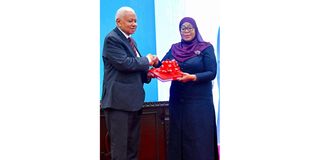
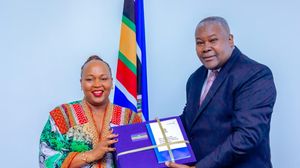
President Samia Suluhu Hassan receives the report of the Presidential Commission of Inquiry into incidents during and after the October 2025 General Election from its chairperson, Retired Chief Justice Mohamed Chande Othman, at State House in Dar es Salaam on April 23, 2026. PHOTO | STATE HOUSE
Dar es Salaam. A few days after the Presidential Commission for Investigating Incidents of Breach of Peace during and after the October 29, 2025 General Election submitted its report, former Minister for Natural Resources and Tourism, Ambassador Lazaro Nyalandu, said steps being taken by President Samia Suluhu Hassan will help unite Tanzanians and keep the country safe.
Mr Nyalandu, who is currently an adviser on diplomatic affairs to President Hassan, said the promise to implement recommendations submitted by the commission, which was chaired by retired Judge Mohamed Chande Othman, gives hope and a new outlook for healing the nation from what happened on October 29, 2025 during and after the election.
Speaking on Friday, April 24, 2026, in an interview with the UK-based Sky News Television, Ambassador Nyalandu said President Hassan has pledged to work on the recommendations submitted by Judge Chande’s commission, while also issuing immediate directives, including treatment at government expense for those injured.
He said the recommendation and the President’s commitment to form a body to thoroughly follow up incidents that went against the law, with those responsible being held accountable, reflects readiness to build a new Tanzania.
“If you listened to President Samia’s speech, you will realise her readiness to bring Tanzanians together after those incidents, which saddened her because they stained our nation,” he said.
“She has promised many things, including accountability for those who will be found involved; therefore, to me it is a good and correct direction. The most important thing is that she be given time to implement what she has started,” said Ambassador Nyalandu.
Regarding strategies for uniting the nation, he said since assuming office, President Hasaan has shown genuine intention to ensure justice and equality prevail among Tanzanians.
He said reconciliation has been her top priority, which is why she has been advancing the 4R philosophy, reflecting reconciliation, and implementing it in practice.
“Since she entered office, the 4R has been emphasised everywhere; therefore, Judge Chande’s commission recommendations on reconciliation align with what our leader has intended for a long time,” he said.
However, in that report, some human rights activists and political parties have expressed reservations, claiming it leans more towards blaming protesters, despite containing key issues which, if addressed, could provide a new direction for rebuilding Tanzania.
Earlier, while presenting the report, Judge Chande said investigations found that demonstrations were planned, coordinated and executed with a high level of skill by trained individuals.
He said that in carrying out the unrest, some youths were promised jobs and a better life, others were paid between Sh10,000 and Sh50,000, while some were kept in camps across various regions where they received training.
“For example, some witnesses explained that children living in difficult environments, motorcycle riders and petty traders informed the commission that they were given between Sh10,000 and Sh50,000, promised employment and a better life, and from October 12 to 28 were trained and motivated to be part of causing chaos that day,” said Judge Chande.
He added that protesters used various methods to achieve their aims, including burning buildings, placing logs and stones on roads, using motorbikes and distributing money to influence participants.
According to the report, five sources and eight triggers contributed to the unrest, including long-term political issues that had not been addressed in time.
He said longstanding demands for a new constitution, strengthening of multiparty democracy systems and reforms to the independent electoral commission were among the causes of the October unrest.
Other factors included economic and social challenges such as the high cost of living, unemployment and administrative issues, including erosion of values.
In addition, Judge Chande said various political and activist statements, including “No reform, no election”, “October We Tick”, “Samia Must Go” and “We have resolved the election will not happen”, significantly triggered the unrest.
“Evidence shows that politicians and activists used challenges raised by citizens to persuade them, including the use of slogans and statements to mobilise support,” he said.
In the interview, Ambassador Nyalandu said President Hassan has already taken steps to address some of the challenges, including those affecting youths, by establishing a ministry responsible for overseeing and coordinating youth affairs.
He added that the political stalemate that existed before President Hassan assumed office, including restrictions on political activities and public rallies, has been resolved through implementation of the 4R philosophy, with all parties now able to operate freely.
The report found that 518 people lost their lives during the unrest, with evidence indicating that some deaths involved the use of bullets and sharp objects.
“Total deaths resulting from the violence were 518, of whom 490 were males and 28 females, with the majority of deaths being unnatural,” said Judge Chande.
The commission also received 323 written submissions and conducted visits in various regions, meeting 170 groups with a total of 2,079 participants.
In Dar es Salaam alone, the commission met 1,436 participants from various groups, including politicians, lawyers, health workers, bereaved families and religious leaders.