Samia launches Tanzania’s first deep-sea fishing vessel, vows to revive fisheries corporation
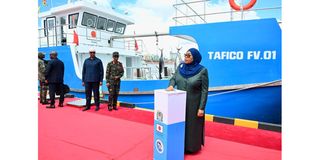
President Samia Suluhu Hassan addresses leaders and members of the public during the launch of Tanzania’s first deep-sea fishing vessel at the Mwalimu Nyerere Memorial Academy in Kigamboni, Dar es Salaam, on April 25, 2026. PHOTO | STATE HOUSE
Dar es Salaam. President Samia Suluhu Hassan said the launch of a fishing vessel marks a significant step in laying the foundation for implementing policies and strategies aimed at increasing the contribution and productivity of the fisheries sector and the blue economy to the national economy.
President Hassan made the remarks on Saturday, April 25, 2026, while launching the first deep-sea fishing vessel of the Tanzania Fisheries Corporation (Tafico) at an event held at the Mwalimu Nyerere Campus in Kigamboni District, Dar es Salaam.
“This step reflects a vision and strategic transformation in the control and management of deep-sea resources," she said.
“We are fully committed to reviving and strengthening our fisheries corporation so that it can effectively participate in managing deep-sea resources,” added President Hassan.
President Samia Suluhu Hassan presses a button to mark the launch of Tanzania’s first deep-sea fishing vessel during a brief ceremony at the Tanzania Fisheries Corporation (TAFICO) headquarters in Kigamboni, Dar es Salaam, on April 25, 2026.PHOTO | STATE HOUSE
She added that for a long time, the harvesting of deep-sea resources has been dominated by foreign vessels and companies, a situation that has limited the country’s ability to fully benefit from these resources in terms of revenue and overall public welfare.
“Therefore, equipping our fisheries corporation with modern equipment and technology is essential and necessary, and we will continue doing so to enable the country and its citizens to benefit from opportunities arising from deep-sea fishing resources,” she said.
She outlined the opportunities as including job creation for young people, increased government revenue, improved nutrition and public health, and strengthening value chains and supply systems across other economic sectors.
Speaking at the event, Japan’s Ambassador to Tanzania, Yoichi Mikami, said the launch of the vessel, which was built in Japan, demonstrates the strong and long-standing relationship between the two countries.
He noted that Japan has supported Tanzania’s livestock sector since the 1980s by facilitating the construction of market infrastructure in Dar es Salaam, Mwanza (Kirumba) and Malindi in Unguja.
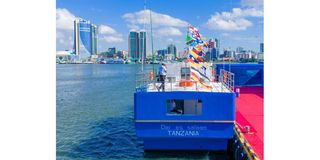
President Samia Suluhu Hassan turns a symbolic ship’s wheel to signal the departure of Tanzania’s first deep-sea fishing vessel during its launch ceremony in Kigamboni, Dar es Salaam, on April 25, 2026. PHOTO | STATE HOUSE
“I am pleased to witness this historic event today. I expect that the capacity of this vessel will improve operational efficiency, including increased fish availability,” said Ambassador Mikami.
Minister for Livestock and Fisheries, Dr Bashiru Ally, said construction of the Kilwa Masoko fishing port in Lindi Region has reached 97 percent completion, with plans for its operation to be handed over to the private sector.
He said the remaining work involves testing equipment before the port is officially commissioned.
Regarding the vessel launch, Dr Bashiru said it reflects President Hassan’s commitment to ensuring the country benefits from deep-sea fishing resources.
He added that the initiative is expected to increase production in marine areas, particularly in deep-sea fishing, improve the availability of high-quality fish for export markets and ultimately boost the sector’s contribution to national economic growth.
Dr Bashiru also said the government continues to make significant investments in capture fisheries and aquaculture through the Tanzania Marine Fisheries and Aquaculture Development Project.
“The project, valued at $117 million, will be implemented over five years from 2025 to 2030 in partnership between the government and the World Bank.
“Its objectives include adding value to fisheries products by developing infrastructure such as markets, landing sites, fish processing plants, and supporting training and research,” he said.