OMO: Seven reforms that could reshape Zanzibar’s political system
ACT-Wazalendo chairman Othman Masoud Othman speaks during a national conference to discuss Tanzania’s political situation, the 2025 General Election and the country’s future in Dar es Salaam on September 8, 2026. PHOTO | COURTESY
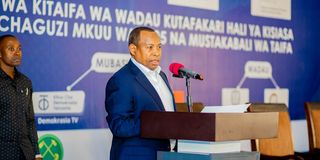
Dar es Salaam. Zanzibar’s political future could hinge on seven proposed reforms ranging from restructuring the electoral system and starting a new constitutional process to strengthening the Government of National Unity (GNU), as political actors seek a lasting solution to recurring election-related disputes.
Former Zanzibar First Vice President and ACT-Wazalendo chairman Othman Masoud Othman outlined the proposals on Tuesday, September 8, 2026, during a national meeting to discuss the country’s political situation following the 2025 General Election and the nation’s future.
Mr Othman said the proposals were developed after political parties assessed the experience of the 2025 election against previous elections, particularly the unresolved problems that have repeatedly undermined trust.
“We got to a point where we identified seven things which, if properly implemented, we believe can take us out of where we are,” he said.
Mr Othman said the first reform is rebuilding public trust, noting that the move was necessary because previous political agreements had failed to produce the promised changes.
He cited commitments reached after the 2020 election, saying the parties had agreed on reforms, but none of the three key issues was implemented.
“This time we said let us go before the people and tell them that we have taken a commitment; we have problems, and our parties are taking a commitment to address and implement them,” he said.
The second proposal is an independent commission of inquiry to examine what happened during the 2025 election and, potentially, previous elections.
“The issue of investigating what happened in the election, and perhaps previous elections, by independent and competent people is important to know the problems and get recommendations on how to correct them,” he said.
The third reform is restructuring the electoral commission, its secretariat, and the way elections are conducted.
Mr Othman described the electoral process as the ‘root of the problem’ in Zanzibar, arguing that weaknesses within the commission and election administration must be addressed if political competition is to become credible.
The fourth is beginning the process of writing a new Zanzibar Constitution.
He said the 1984 Constitution was progressive when introduced but argued that the political environment has since changed, creating a need to review executive powers, checks and balances, judicial authority, and the appointment of public officials.
“Although at that time it may have been progressive, now it needs many things to be reviewed,” he said.
The fifth proposal covers a wider package of governance reforms, including the justice system, public service, local government, electoral arrangements, and the status of Zanzibari identity.
Mr Othman said Zanzibar needed stronger accountability and democratic institutions, arguing that local governments had been weakened by dependence on the central government.
The sixth reform is redesigning the GNU so that it delivers genuine inclusion rather than simply bringing parties together in government.
“Now we have a government of togetherness, not a government of unity,” he said, arguing that the existing arrangement remains weighted towards one side.
He said the seventh reform is perhaps the most critical, establishing a clear implementation framework and timetable.
“We have agreed that their work should essentially be completed before the end of 2029,” he said.
He said the proposed reforms therefore shift the political debate from simply settling the aftermath of an election to addressing the institutions and systems that repeatedly produce political tension.
He said the objective is not merely to secure another political agreement, but to prevent Zanzibar from returning to the same cycle.
“The problem is that we have moved backwards,” he said, arguing that the focus should be on finding a permanent solution rather than concentrating solely on the outcome of one election.