Shift to national water grid takes shape as Samia marks 100 days

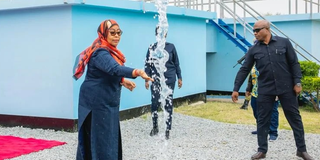
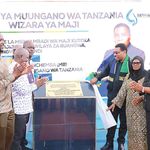
President Samia Suluhu Hassan launches the Lamadi water project on June 19, 2025. PHOTO | COURTESY


What you need to know:

  • The initiative intends to distribute water from large, reliable sources to water-scarce areas via a countrywide distribution network


Dar es Salaam. As President Samia Suluhu Hassan’s first 100 days in office near completion, Tanzania’s water sector is beginning to take a new shape following her pledge to commence the national water grid.

President Hassan was among 18 presidential candidates representing their respective parties during the October 29, 2025 general election. Through the ruling CCM, she promised to establish a National Water Grid which is a new concept for Tanzania.

The country currently relies on various local water sources, but there is no single system to distribute water nationwide, similar to the national electricity grid.

In simple terms, the grid is a government plan to link major water sources, rivers, lakes, reservoirs, and large wells, and distribute to multiple regions, districts, and cities through one unified system, rather than each area relying solely on its local source.

The project aims to supply water from large, reliable sources to water-scarce areas via a nationwide distribution network.

Upon assuming office on November 3, 2025, President Hassan pledged that the grid would be initiated within her first 100 days to ensure reliable water for domestic use, agriculture, livestock, and businesses.

She emphasised that the grid would draw from major sources, including Lake Victoria, Lake Tanganyika, Lake Nyasa, and the country’s main rivers.

Implementation progress

A key milestone so far is the completion of the design for transporting water from Lake Victoria to Dodoma via Singida, known as the Lake Victoria–Dodoma (LVD) Project. The objectives are to reduce water scarcity, enable urban growth without shortages, and ensure water availability even during droughts.

The project will be implemented in phases. The first phase involves constructing and rehabilitating major water sources, building main pipelines, and linking stalled projects.

The second phase will connect neighbouring towns and districts from a single source, distributing water from urban centres to rural areas. The third phase (ongoing) will expand the network to additional locations.

Water minister Jumaa Aweso said the ministry has begun implementing the National Water Grid by preparing major projects to extract water from large lakes and rivers and distribute it through main pipelines to arid areas.

“The project design is complete, and procedures to hire a contractor are underway. This is a major project that will significantly alleviate water shortages in the Central Zone,” said Mr Aweso.

He added that feasibility studies and designs for other projects involving Lake Tanganyika, Lake Nyasa, and major rivers such as the Rufiji and Ruvuma have been carried out in stages, laying the groundwork for phased implementation.


Beneficiaries

According to the Ministry of Water’s Permanent Secretary, Ms Mwajuma Waziri, the National Water Grid will touch various areas across the country.

“As the minister said, the aim is to ensure no region is left behind in accessing safe and clean water,” she said.

The ministry expects the project to assist remote villages not reached by conventional networks by installing main pipelines linked to local distribution systems.

National perspective

Some citizens have expressed differing views, while some describe the grid as a potential solution to the country’s water problems; others feel it will not succeed without the political will to resolve challenges.

A resident of Kimara, Dar es Salaam, Mr Nelson Jumanne, said starting the National Water Grid within the first 100 days shows it is a national agenda, not merely a political idea.

“The implementation must not stall or weaken; it should be properly managed and completed on time to have a real impact. Citizens want water 24 hours a day,” he said.

He added that rural areas face greater challenges than urban centres and must be included to ensure every Tanzanian has reliable access to clean water.

A resident of Dodoma, Ms Jane Jerome, said that if implemented without bureaucracy, the project would reduce water shortages and improve citizens’ lives.

“I hope the government establishes legal, administrative, and financial systems to ensure the grid remains a national project, continuing even when leadership changes,” she said.

A resident of Kisarawe in Coast Region, Ms Anita Sumi said starting implementation within 100 days is a step forward, although she is concerned about sustainability.

“We want to know when water from the grid will start flowing through our pipes. Water scarcity is a big problem, and we don’t know if the grid will solve it or not,” she said.

Plumber’s view

A plumber, Mr Albert Makasi, said the National Water Grid will not only provide reliable water but also create job opportunities for plumbers, many of them young people.

“These days, jobs are scarce, and we plumbers struggle to find work. This will be an opportunity for us to earn a living,” said Mr Makasi, a resident of Gongo la Mboto, Dar es Salaam.