Tanzania mulls national water grid to end recurring shortages

Prime Minister Mwigulu Nchemba presides over the foundation stone-laying ceremony for the Lindi–Ruangwa–Nachingwea water project in Ruangwa District. The ceremony, held yesterday in Chimbila A village, signals the commencement of a strategic regional water initiative.  PHOTO | PMO

Dar es Salaam. The government has announced plans to establish a national water supply grid, a significant policy shift aimed at addressing the ongoing water shortages that have been worsened by climate change.

The Prime Minister, Dr Mwigulu Nchemba, made this announcement yesterday while laying the foundation stone for the Sh119 billion Lindi–Ruangwa–Nachingwea water supply project.
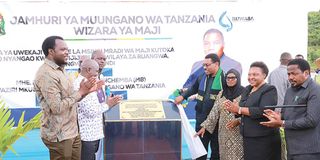
This project will draw water from the Nyangao River and is expected to benefit 57 villages across three districts, significantly improving access to clean and safe water in parts of southern Tanzania that have long faced unreliable supply issues.

During the official visit, Dr Nchemba emphasised that the government’s renewed focus on water infrastructure stems from the growing impact of climate change, which has reduced water availability even in regions previously considered secure.

“Climate change has already affected many parts of the country, including areas with relatively good infrastructure,” he stated. “This is not a matter of negligence; it is a global challenge, and as Tanzanians, we must respond to it decisively.”

The Prime Minister highlighted that the ruling party, Chama Cha Mapinduzi (CCM), has committed in its election manifesto to developing a national water grid, akin to the national electricity grid.

This system will facilitate coordinated planning and interconnection of large-scale and small-scale water projects, allowing water to be redistributed to areas facing shortages during periods of scarcity.

“Our commitment is to establish a national water grid and implement projects in an integrated manner so that no community is left behind,” he affirmed.

This announcement comes in light of recurring water shortages throughout the country, with both urban and rural areas experiencing intermittent supply due to prolonged dry spells, declining river flows, and diminishing water sources.

In recent months, several regions have reported water rationing, while some rural communities continue to rely on unsafe water sources.

Ruangwa, which will benefit the most from the project with 34 villages connected, was the constituency of former Prime Minister Kassim Majaliwa, who chose not to contest the 2025 elections.

Dr Nchemba noted that Majaliwa strongly advocated for this project during his tenure to ensure funding was secured. “I am satisfied with the progress made so far. This is a project that the former Prime Minister championed to ensure the people of this area receive reliable water,” he said.

Minister for Water Jumaa Aweso stated that the project is progressing well, with some villages expected to start receiving water before February 2026.

“This project is designed to provide long-term solutions, not temporary relief,” Mr Aweso added, noting that the government is prioritising climate-resilient infrastructure to safeguard water access in the future.

As climate pressures increase, the government asserts that large-scale projects like the Lindi–Ruangwa–Nachingwea scheme, combined with the national water grid, will be crucial in ensuring water security for households, agriculture, and industry.

As water shortages increasingly impact livelihoods and economic activity nationwide, the success of the proposed national water grid could represent a pivotal moment in how Tanzania manages one of its most critical resources.