SPECIAL REPORT : Kahama: Doyen of politics who served nation faithfully
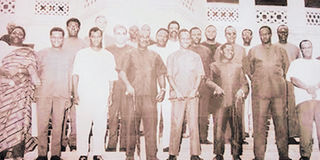
A group photo of the first Union Cabinet taken in 1964. The Cabinet included members from Zanzibar and Tanganyika. PHOTO/FILE
What you need to know:
‘Sir’ George, who died at 88, was the second last surviving member of that Cabinet. The only surviving member is Mzee Job Lusinde, who, since his retirement, lives in his home town of Dodoma.
The first Cabinet, formed after a bruising independence struggle, was credited with steering the post-independent Tanganyika towards a stable, cohesive, multiracial and multi-ethnic state that earned respect from the international community.
Dar/Dodoma. The demise of ‘Sir’ George Kahama last Sunday rekindled memories of the first Cabinet that was formed on Independence Day on December 9, 1961 and of which he was a member.
‘Sir’ George, who died at 88, was the second last surviving member of that Cabinet. The only surviving member is Mzee Job Lusinde, who, since his retirement, lives in his home town of Dodoma.
The first Cabinet, formed after a bruising independence struggle, was credited with steering the post-independent Tanganyika towards a stable, cohesive, multiracial and multi-ethnic state that earned respect from the international community.
The nature of the Cabinet was quite different from other post-independent African states that were gaining independence at the time.
The Cabinet was multi-racial; all Cabinet members were elected members of Parliament with the exception of Finance minister Ernest Vasey, who was a nominated MP; it was a young Cabinet. In fact with the average age of the 12 ministers being 37 years it was considered the youngest in the history of the Commonwealth, argues Taylor; it was lean, consisting of only 12 members, including Prime Minister Julius Nyerere.
Cabinet members
The first Cabinet was sworn in on December 9, 1961. In an interview with The Citizen in Dodoma on Tuesday Mzee Lusinde named the members of the first Cabinet as including Mwalimu Nyerere who was Prime Minister; Rashidi Kawawa (minister without Portfolio), Abdallah Said Fundikira (Agriculture), Sir Ernest Vasey (Finance), Amir Jamal (Industry), Asanterabi Nsilo Swai (Trade), Tewa Said Tewa (Lands and Surveys), Paul Bomani (Co-operatives), Oscar Kambona (Education), Derek Bryceson (Health), George Kahama (Home Affairs) and Job Lusinde (Local Government).
Other accounts, include that of James Clagett Taylor in his book The Political Development of Tanganyika, claim Fundikira was the minister for Legal Affairs and that the Agriculture docked had been given to Bomani.
The Independence Cabinet was a carryover of the Council of Ministers formed after the 1960 General Election. Only two members had been added to the Independence Cabinet: Lusinde and Tewa.
The Cabinet after Tanganyika becomes republic
In January 1962, just after Tanganyika became a republic, President Nyerere made some changes in the Cabinet. He abolished the Prime Minister post and created the Vice Presidency as the Constitution required. Kawawa became Vice President. Chief Fundikira was appointed minister of the newly formed Justice docket but had to resign the following year after being implicated in a corruption scandal. Kambona took over the Home Affairs docket from Kahama.
In 1963 Kambona became minister for Foreign Affairs and Defence. Before March 1963, that ministry was under the President’s Office. Kahama became minister of Commerce. Bomani took over from Sir Ernest as minister for Finance. Sir Ernest had been Finance minister in Kenya prior to becoming Finance minister in Tanganyika. Nyerere also brought in more members. They were Sheikh Amri Abeid, Jeremiah Kasambala, Saidi Ali Maswanya, Michael Kamaliza, Austin Shaba, Lawi Sijaona and Solomon Eliufoo. By 1963 the Cabinet was as follows, according to Dr Azaria Mbughuni, a US-based historian;
Sheikh Amri Abeid (Minister of Justice), Bryceson (Agriculture), Kahama (Commerce), Kambona (External Affairs and Defence) and Lusinde (Home Affairs). Others members were Jamal (Communication), Bomani (Finance), Tewa (Lands), Kasambala (Co-operatives and Community Development), Eliufoo (Education), Maswanya (Health) and Kamaliza (Labour). And yet others were Shaba (Local Government), Sijaona (National Culture and Youth), Swai (Development Planning). The post of the Prime Minister was restored in February 1972 and Kawawa became the Prime Minister again till 1977 when Edward Sokoine took over from him and Kawawa then became minister of Defence.
Cabinet after the union with Zanzibar
After the April 26 Union Zanzibaris were brought in the Cabinet. Nyerere remained President Abeid Aman Karume became First Vice President and Kawawa became Second Vice President.
The new Cabinet members, according to an April 28, 1964 news account by the New York Times, were as follows;
Oscar Kambona (External Affairs), Job Lusinde (Home Affairs), Hassin Nassor Moyo (Justice), Abdulrahman Babu (Planning), Rashidi Kawawa (Defence) and Idris Abdul Wakil (Information). Others were Abdullah Kassim Hanga, (Industry, Mines and Power), Said Maswanya, (Agriculture, Forests and Wildlife), Jeremiah Kasambala (Commerce and Co-operatives), George Kahama (Communications and Works), Paul Bomani (Finance), Tewa Said Tewa (Lands), Solomon Eliufoo (Education), Derek Bryceson (Health), Michael Kamaliza (Labour), Sheik Amri Abedi (Community Development and National Culture) and Austin Shaba (Local Government and Housing).
Ministers who were appointed to junior positions (ministers of State in the President’s Office) soon after the union, according to some other accounts, included Aboud Jumbe (minister of State in the President’s Office — Union Affairs) and Amir Jamal and Nsilo Swai who together with Babu were appointed ministers of State in the President’s Office (Directorate of Planning).
Fate of members of the first Cabinet
Kambona resigned and fled the country in 1967. He lived in exile in the UK and came back to Tanzania after the re-introduction of multi-party politics in 1992. He formed an opposition party Tadea. He died in 1997 in London. When Bomani lost the parliamentary election in the 1965 General Election Jamal took over the Finance portfolio. But Nyerere nominated Bomani as MP and made him minister of the newly established ministry of Economic Affairs and Development Planning. He later became Tanzania’s ambassador to the US. He continued serving the country as a Cabinet minister till 1990. He died in 2005. Bryceson left the cabinet in 1968 to become the head of National Parks. He died in 1980.
Lusinde and Kahama continued to hold office beyond Nyerere’s retirement in 1985. Lusinde became Tanzania’s ambassador to China from 1976 to 1984 when he became Tanzania’s High Commissioner to Kenya. Kahama was also sent to Tanzania’s foreign missions. First as ambassador to the German Federal Republic (1964-1966). He later took over from Lusinde as ambassador to China (1984-1988) and later High Commissioner to Zimbabwe (1989-1990).
He was the first director of the Capital Development Authority between 1972 and 1984. He was appointed by President Mkapa during the third phase government as Minister of Co-operatives.
Jamal became minister of Finance in 1965 and continued to serve in other Cabinet positions until when he retired from politics as the MP for Morogoro in 1985 after serving the constituency for 25 years continuously.
He was, soon after that, appointed by President Ali Hassan Mwinyi as Tanzania’s ambassador to the United Nations in Geneva till 1993. He died in Canada two years — later in 1995.
Tewa was also appointed ambassador to China in 1965 but he soon resigned and came back to contest the 1965 General Election. He lost and got more involved in religious issues. He died in 1998. Eliufoo stayed as minister of Education till 1967. He died in 1971.
The court failed to charge Chief Fundikira of corruption. He went into private business. In 1967, he was appointed as board chairman of the then East African Airways until 1972 when his term of office came to an end. He continued his private business till 1992 when he re-joined politics after the re-introduction of multiparty-politics. He co-founded NCCR Mageuzi but later left and formed the UMD party. After the 1995 General Election he re-joined CCM and was nominated as MP by President Benjamin Mkapa. He died in 2007.
Why multiracial Cabinet?
The first Independence Cabinet had nine African members, two Europeans and one Asian.
Forming a multiracial Cabinet soon after independence was odd enough in Africa in the early 1960s considering the strong nationalist, anti-colonial wave that was sweeping the continent at that time.
And it was certainly a great risk on the part of Nyerere what with the push and pull for immediate Africanisation of the government bureaucracy from radical elements both within the civil service and within Tanganyika African National Union (Tanu).
But by taking the risk of forming the multiracial Cabinet Nyerere wanted to send signals to settlers in countries such as Kenya and Rhodesia who were pressuring the colonial governments against granting independence to Africans that it was possible to form a “multiracial” post-independent government.
Mzee Lusinde, says at independence there was a considerable number of white settlers and Asian businessmen who had supported the independence movement.
“It would not be wise to leave all these people who had worked hard for the independence of Tanganyika out, notwithstanding their race,” Mzee Lusinde said. “And in fact we took Tanu’s creed on human equality and dignity very seriously.”
Mzee Lusinde says one month after the first Cabinet was sworn in, in January 1962, Nyerere resigned from his position as Prime Minister and went back to build the party and educate party members on the responsibilities of the party after independence.
“He saw that gaining independence came with even more responsibilities and that the people’s expectations had to be realistic and that they had to understand that they had to work even harder to build their own country,” Mzee Lusinde says.
Kawawa took over from Nyerere as Prime Minister and the rest of the members remained with their portfolios. “It is like Nyerere had planned the whole thing from the beginning and that is why probably he gave Kawawa a Cabinet position without portfolio,” Mzee Lusinde says.
“The rest of us continued with our respective positions till the end of 1962 when Nyerere ran for President and was elected,” Mzee Lusinde adds.
According to Mzee Lusinde, after December 1962 President Nyerere made an assessment of where the country was and where it was heading.
It was discovered that colonialists had done so little and strategies had to be created about what to do in 10 years more than what colonialists did in 70 years.
A 10-year development plan was drawn up. The construction of schools, dispensaries, higher learning institutions started.
“I remember we built the first University College at Lumumba Street where we started with the Faculty of Law,” said Mzee Lusinde.