SPECIAL REPORT : Why govt should invest in education in natural resources rich areas
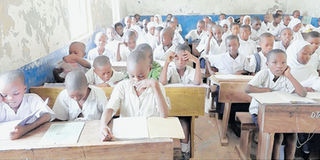
TOP: Songo Songo Primary School pupils as they were found by The Citizen recently. The Pan African Energy company has suspended sponsoring education to Standard Seven leavers to Dar es Salaam-based schools.PHOTO|LUIS KOLUMBIA
What you need to know:
But now all that is gone. They are back to square one as they now face the shortage of teachers and have inadequate teaching materials.
This is the story of Songo Songo Nursery School which was built and managed by Pan African Energy, a company involved in natural gas production in a Songo Songo village in Kilwa District, Lindi Region as part of the company’s Corporate Social responsibility (CSR).
Songo Songo, Kilwa. They had all the teachers in their disposal. They couldn’t miss any lesson in class. They were among a few lucky public school students who enjoyed quality education through the support of natural gas companies operating in their area.
But now all that is gone. They are back to square one as they now face the shortage of teachers and have inadequate teaching materials.
This is the story of Songo Songo Nursery School which was built and managed by Pan African Energy, a company involved in natural gas production in a Songo Songo village in Kilwa District, Lindi Region as part of the company’s Corporate Social responsibility (CSR).
The nursery school was built as part of the company’s move to improve the quality of education in the village but due to changes in CSR priorities the school was handled over to the government leading to challenges in staffing and facilities.
The failure of the government to keep up with funding the school leading to its decline has revived the debates of how the government could engage investors while still fulfilling its responsibility of improving social services in resource-rich areas in order to leave behind a mark after the resources are depleted.
As the natural gas continues to be extracted in the Songo Songo Island situated in Kilwa District, one would have expected that the village would have better schools that impart quality education.
But with low government investment and regular changes in corporate social responsibility priorities by the natural gas firms, pupils have found themselves testing sweet and bitter life at schools in different periods of time.
Even areas where the natural gas companies are stretching their muscles to support the schools in selected education inputs, the government is still sluggish in investing in other demands, disadvantaging children in quality of learning.
Natural gas production in the Songo Songo Island started in 2004, after the completion of the construction of a gas pipeline network. A processing plant and a pipeline belong to Songas Ltd, a local joint venture among CDC Globeleq, Tanzania Electric Supply Company (Tanesco), Tanzania Petroleum Development Corporation (TPDC) and Tanzania Development Finance Company (TDFL).
CDC Globeleq has the controlling interest in the project, and the gas plant and wells are operated by Pan African Energy Tanzania Ltd (PAET) on its behalf.
Processed natural gas is transported to Dar es Salaam through a pipeline and get used for generating 190 MW electricity at Songas Ubungo plants. The electricity is then supplied to Tanesco who supply it to the national grid for industrial and domestic consumption.
Firms extracting natural gas provide social services to the village, being part of their CSRs. The projects include the provision of clean and safe water, supporting education development, improving healthcare and security of the area. The Citizen understands that companies had been supporting education in the village including hiring and paying more teachers. But some of the firms changed their priorities affecting the quality of education due to the shortage of teachers that ensued as the government failed to fill in the gaps.
The story of a desperate nursery school
The Citizen can exclusively reveal today that PAET built and operated a nursery school which was well equipped and had enough, well-paid, competent teachers.
By March this year, the nursery school had 97 pupils and four teachers. Its capacity is to enroll more than 100.
But the facility has now been returned to the district council which has ordered the village to take care of it. Before handling over the nursery school to the village the council combined the nursery school with the only public primary school in a village, Songo Songo, making it one institution.
The withdrawal of PAET from funding the school lead to a complete dilapidation of the nursery school, which now has to depend on staff from the primary school who are already less paid and demoralized.
Villagers and other stakeholders who spoke with The Citizen said what happened to Songo Songo nursery school that was being full supported by PAET was a vivid example of how unsustainable it was to rely on social corporate responsibilities projects.
The Songo Songo Primary School Head Teacher Mohamed Mwalimu told The Citizen recently that by March this year his school had 607 pupils who and eight teachers. This translates to a ratio of 1:78 ratio contrary to standard norm described by the government of one teacher per 40 pupils.
Additional teaching workload to the school, he said, was a thorn in the flesh of academic development in the village as teachers have been overworking themselves denying them with enough time to prepare for lessons they teach. “They teach Standard Four and Seven on weekends especially Saturdays in order to compliment what couldn’t be taught during class hours” he said.
Statistics from the school shows that almost all standard seven pupils have been admitted at a ward secondary school regardless of their examination performance in a bid to fulfil the school student’s demand. According to Mr Mwalimu, 32 pupils out of 33 who did Primary School Leaving Examinations (PSLE) in 2014 were admitted in a secondary school.
The following year, he said, the whole class of 40 pupils joined form one and that 38 out of 40 pupils in 2016 joined secondary school education.
The National Examination Council of Tanzania (Necta) data confirm on how unqualified pupils joins form one. Necta results shows that 18 candidates out of 40 who sat for the exam in 2014 were not qualified to join form one as they had average of D. PAET has also abruptly stopped sponsoring students to better schools in Dar es Salaam after completing primary school, a scholarship aimed at ensuring the children in village gets quality education that can shape their better future.
Such decision makes students in the area to depend on Songo Songo Secondary School, the ward school that is also poorly facilitated.
Poor investment in the education sector at the grassroots has strongly affected education prosperity in the Island with Certificate of Secondary Education Examinations (CSEE) results showing that the school has no history of division one and two since establishment five years ago.
The school headmaster, Mr Said Halfan said the first form four students in 2015 had one division three, 18 division four and 14 failed. The class had 33 students who sat for examinations. Last year, 61 per cent of the students who did CSEE failed and the rest got division three and six others got division four.
“Despite the assistance we receive from natural gas firms in developing learning infrastructures in our school voluntary we still face the challenge of admitting students who can’t read and write. We also face shortage of teachers, as we have eight teachers with only six of them actively participating in the job as two others are attending studies,” he said. The headmaster asked the government to provide the school with more teachers after opening recruitment window, suggesting that the school should admit students from other schools depending on their performance.
“The government should review teaching systems at grassroots level to avoid getting students who couldn’t read and write and identify how such students got admissions to the school,” he said.
“Also, the community should be educated on the value of education in order to reduce school drop outs, absenteeism and build a culture of reading,” he added. According to him, Songas provides the school with Sh100, 000 to every student to cover meals expenses. This year, the company will remit Sh11. 2 million to feed 112 available students.
Mr Halfan said the companies have also built a hostel that could accommodate 58 girl students. Also, they have constructed a laboratory and renovated classrooms and teacher’s houses.
According to him, PAET has authorized the school to recruit a science teacher specifically for Physics, Chemistry and Mathematics and the firm is responsible for payment of salaries and other remunerations. But the sustainability of the assistance, which is supposed to be catered by the government, remain in question.
Parents in the island doesn’t understand how CSR works. What they want is their children to get quality education that would help them be good leaders of the community as well as financial independent in the future. Ms Rahma Mtumbi said companies should reinstate programs providing students with opportunity to study in best schools to enable them acquire quality education as part of benefit from the natural resource they host.
According to Ms Rahma, sponsorship to a nursery school in paying teacher’s salaries, provision of learning materials and infrastructure development should also be returned.
“Companies extracting natural gas in the Island should invest in education of our pupils. Citizens should be provided with entrepreneurial trainings because through education people’s life will be liberated, especially after resource depletion,” she said.
Renowned economist, Professor Samuel Wangwe said the sustainability of Corporate Social Responsibility projects would be assured if villages where the projects are implemented and respective LGAs were the ones choosing the type of projects to be implemented instead of investing companies.
“The central government may request capacity building special subsectors like the Oil and Gas that require higher professionalism. Under sponsorship of respective companies motivated Tanzanians may be sent abroad for studies, the country will be left with professionals even after the companies contracts have expired,” he said. However, education stakeholder, Mr Mahmoud Mringo said CSR shouldn’t be used to replace the government’s role in providing services to its citizens.
“The government should fulfill its responsibility especially to provide education to citizens. It shouldn’t be intimidated by number of buildings of government schools.
“A voucher system should be introduced to allow children choose for better schools the same people with health insurance choose best hospitals,” he said, adding. When the companies announce their support, he said, the general public should be thankful and remember that was a help which will come to an end and avoid total reliance on them.
Pan African Energy officers couldn’t cooperate by neither responding to an email though acknowledged to have been received. They could not even meet this reporter when he visited their Dar es Salaam headquarters. Songas Community Relations manager, Nicodemus Chipakapaka said the company has been supporting education of students pursuing higher learning education from Songo Songo, Rufiji, Somanga and Mkuranga.
Among the three students admitted for university studies, he said, one is coming from Songo Songo Island and 33 others have been enrolled for vocational education trainings at a college in Kilwa Masoko. “While the company is expected to assess the kind of support to tertiary education we provide to students, VETA graduates will be provided with startup capitals including working tools to enable them directly enter into employment industry,” he said.
Kilwa Masoko District Executive Director, Mr Zablon Bugingo said the council was thankful to efforts extended by PAET and Songas in developing education in the Island, adding that they are aware no support could exist forever.
He confirmed that Songo Songo primary school has been tasked to take care of a nursery school after it was handled over by PAET and that shortage of teachers was a challenge facing almost all primary schools in the district. He said the council faced a shortage of 500 teachers out of 1,300 needed. Regarding shortage of teacher’s houses, he said, almost all 108 primary schools built in 90 villages faced the same challenge.
He said during the 2016/2017 fiscal year, the council has endorsed Sh3.1 billion in its budget with 60 per cent equivalent to Sh1.86 billion allocated to development projects. The 20 per cent of the total budget equivalent to Sh620 million expected to be remitted to villages as development catalysts. “This money is the one expected to build classrooms, latrines, dispensaries, houses for teachers, supply of clean and safe water and rehabilitating roads in the whole district” he said. “Challenges could not be settled overnight. They will be taken care in phases depending on the availability of funds.”