Tanzania highlights milestones in Kiswahili’s global recognition

Deputy Permanent Representative to the United Nations Office and other international organisations in Geneva, Ambassador Dr Hoyce Temu (left), speaks with Geneva Mayor Christina Kitsos on the sidelines of the International Day for People of African Descent in Geneva recently, reiterating the importance of Kiswahili in uniting Africa and the world. PHOTO | COURTESY
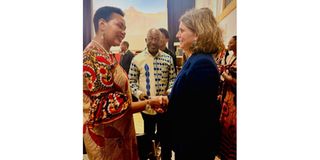
Geneva. Tanzania has urged the international community to accord Kiswahili its rightful status as a global language of unity, inclusion and cultural identity.

Deputy Permanent Representative to the UN Office and other international bodies, Dr Hoyce Temu, made the call on Sunday, September 6, 2026, in Geneva, Switzerland.

She was speaking during the commemoration of the International Day for People of African Descent, organised by the Université Populaire Africaine en Suisse (UPAF) alongside key partners.

The event fell within the Second International Decade for People of African Descent (2025–2034).

Dr Temu commended UPAF for promoting African culture through

initiatives such as its Kiswahili Project.

Addressing delegates, Dr Temu stressed that language remains central to preserving African heritage, dignity and justice, noting that Kiswahili goes beyond mere communication for Tanzania.

“It is a language of African unity, identity, peace and regional integration. It connects millions across borders and increasingly serves diplomacy, education, culture and international cooperation,” she said.

She added that celebrating Kiswahili complements Africa’s wider linguistic diversity, including Hausa, Yoruba and Oromo, which embody the continent’s rich knowledge systems.

Promoting Kiswahili forms part of a broader push to ensure greater global respect for African heritage.

Highlighting achievements under President Samia Suluhu Hassan’s leadership, Dr Temu outlined key internationalisation milestones.

Unesco declared July 7 World Kiswahili Language Day in 2021, followed by African Union recognition in 2022.

The UN General Assembly formally adopted Resolution A/RES/78/312 proclaiming World Kiswahili Language Day in 2024, while the Unesco

General Conference designated Kiswahili as its seventh official language in 2025.

“Tanzania subsequently called upon the UN General Assembly to explore recognizing Kiswahili as the seventh official language of the United Nations,” revealed Dr Temu.

“How much longer must Kiswahili wait, and what more is required before a language spoken by over 200 million people, and recognised across major African and global institutions, takes its place as an official UN language?” she asked, challenging the global body.

She emphasised that this represents a fundamental quest for inclusion, representation and African dignity within multilateral institutions.

Furthermore, she urged the AU, UN member states, civil society and academia to build momentum towards elevating Kiswahili into a global diplomatic language.