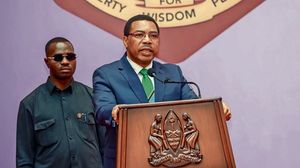
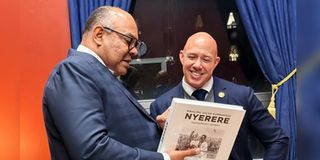
Minister for Foreign Affairs and East African Cooperation, Mr Mahmoud Thabit Kombo (left), with the Chairman of the United States House Foreign Affairs Committee and Republican Congressman for Florida, Mr Brian Mast. PHOTO | COURTESY OF THE MINISTRY OF FOREIGN AFFAIRS AND EAST AFRICAN COOPERATION
Dar es Salaam. As Tanzania navigates the diplomatic aftershocks of the October 29 General Election, the government has intensified high-level engagement with key international partners, with the United States emerging as a central focus of its outreach.
This week, the Minister for Foreign Affairs and East African Cooperation, Mr Mahmoud Thabit Kombo, began what the government has described as an official working visit to Washington, a move widely seen as part of a broader strategy to steady relations and sustain dialogue amid heightened international scrutiny.
In a statement issued on December 16, 2025, the Tanzania Embassy in Washington, DC, said the visit aims to engage “various important stakeholders in strengthening relations between Tanzania and the United States.”
The phrasing reflects Dodoma’s intent to keep diplomatic channels open and reassure international partners following a politically sensitive post-election period.
While in the United States, Mr Kombo is expected to hold a series of high-level engagements, including meetings with American lawmakers.
“Among other issues, the Minister will also meet and hold in-depth discussions with the government and various Members of the United States Congress,” reads part of the statement, adding.
“The emphasis on Congress is significant. In the aftermath of the October 29 polls, international partners, particularly Western governments, have closely followed political developments in Tanzania, with legislative bodies playing a critical role in shaping foreign policy positions, aid allocations, and oversight of bilateral relations.”
One of the most notable engagements so far has been Mr Kombo’s meeting with Congressman Brian J. Mast of Florida, a senior Republican lawmaker and Chair of the US House of Representatives Foreign Affairs Committee.
The embassy confirmed that the minister has already met “the outspoken Republican Congressman, Brian J. Mast of the State of Florida, who is the Chair of the Foreign Affairs Committee of the US House of Representatives.”
According to the statement, discussions focused on strengthening bilateral ties, with both sides agreeing on several areas to enhance cooperation between Tanzania and the United States.
In what diplomats view as a significant development, Congressman Mast also extended an invitation aimed at deepening parliamentary engagement between the two countries.
The statement noted that Mr Kombo received “an invitation from his committee of the US Congress to make an official visit to Tanzania as soon as possible.”
If it materialises, such a visit would offer Tanzania an opportunity to engage US lawmakers directly on governance, economic cooperation, and regional security at a time when narratives around the country’s political direction are being actively debated abroad.
Diplomatic observers say the timing of the Washington visit appears deliberate.
Following the October 29 election, Tanzania has faced questions from some international partners over political stability and democratic processes.
By engaging senior US officials and legislators, the government appears keen to present its position firsthand, rather than allow external assessments to dominate the discourse.
The United States remains one of Tanzania’s most important partners, with cooperation spanning health, education, trade, security, and development assistance.
Maintaining stable relations is therefore critical, particularly as Tanzania seeks to safeguard investor confidence and sustain ongoing development programmes.
Although the embassy statement did not detail all items on the agenda, its repeated emphasis on “in-depth discussions” and “strengthening relations” suggests a focus on reassurance, continuity, and mutual understanding.
For Dodoma, the Washington engagement is not only about diplomacy but also about managing perceptions during a sensitive post-election period, as the government seeks to reinforce confidence among strategic partners and reaffirm its place on the international stage.
Register to begin your journey to our premium contentSubscribe for full access to premium content