Dar es Salaam. For decades, universities trained graduates, employers recruited them, and the skills gap in between was treated as an unfortunate inevitability. But a quiet shift is taking place in Tanzania’s higher education and business landscape, one that suggests that the era of “wait-and-receive” is coming to an end.
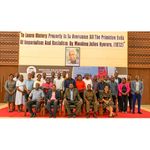
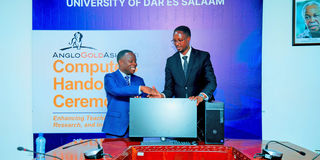
The collaboration between the University of Dar es Salaam (UDSM) and AngloGold Ashanti, marked by the handover of 10 specialised computers to the School of Mines and Geosciences in January 2026, offers a clear signal of this transition.
It is not merely about corporate social responsibility or equipment donation. It is about redefining who is responsible for preparing Tanzania’s future workforce, especially in strategic sectors such as mining.
Speaking during the handover ceremony, UDSM Vice Chancellor Prof William Anangisye emphasised that modern higher education can no longer operate in isolation from the economy it serves.
“These facilities will significantly enhance teaching, learning and research,” he said, adding that partnerships with industry are now essential for universities seeking to remain relevant.
AngloGold Ashanti’s Vice President for Africa, Mr Simon Shayo, was even more direct. “The days when universities were left alone to prepare workers are over,” he said. “In specialised and fast-changing sectors like mining, the private sector must be part of the training process.”
That statement speaks to a broader employability challenge facing Tanzania. Each year, thousands of graduates enter the labour market, yet employers, particularly in technical fields, often complain about skills mismatches.
According to government labour statistics, graduate unemployment remains disproportionately high, even as sectors such as mining, construction and energy continue to expand.
Mining alone contributes nearly 10 percent of Tanzania’s GDP and remains one of the country’s largest sources of foreign exchange.
The sector’s growth, driven by gold, gemstones and critical minerals, has created demand for geologists, mining engineers, mineral processors and environmental specialists. Yet companies frequently invest heavily in retraining new recruits to meet operational standards shaped by advanced technology.
This is where the UDSM–AngloGold Ashanti partnership becomes instructive. The donated computers are installed with specialised software for mining engineering and mineral processing-tools that mirror what students will encounter in modern mines.
According to Professor of Geology and Dean of the School of Mines and Geosciences, Prof Elisante Mshiu, this changes how students learn. “These are not ordinary computers,” Prof Mshiu said. “They carry programmes used in real mining operations. This will help our students become experts who meet global standards.”
More importantly, the collaboration goes beyond hardware. AngloGold Ashanti has committed to hosting students and academic staff for industrial exposure, ensuring that teaching is informed by real operational needs.
“We have opened our doors to students and lecturers,” Mr Shayo noted. “Many of those who train with us end up being employed. That is how you close the gap.”
From a business perspective, experts say, such partnerships make economic sense. Companies benefit from a pipeline of work-ready graduates, reduced training costs and stronger local expertise.
“Universities, in turn, improve graduate outcomes and research relevance. For the country, the payoff is a skilled workforce capable of maximising value from natural resources rather than exporting raw potential,” said economist, Ms Juliana Moshi.
UDSM has already positioned itself as a leader in this approach. In recent years, the university has strengthened ties with players in energy, ICT, agriculture and transport, embedding industry input into curricula and research agendas.
Lecturers are increasingly spending time in companies to understand emerging technologies and skills demands, a move Prof Mshiu says has reduced the mismatch between graduates and employers.
Experts argue that other universities should follow suit, particularly those offering science, engineering and technology programmes. With rapid advances in automation, data analytics and artificial intelligence reshaping industries, no academic institution can keep pace alone.
“Technology is moving too fast for universities to update curricula without industry involvement,” said a Dar es Salaam–based mining policy analyst, Juma Mmari. “Partnerships ensure that what is taught today is still relevant tomorrow.”
The call by UDSM leadership for other mining companies to join the academia–industry partnership is therefore timely. Tanzania’s mineral wealth, from gold to graphite and rare earths, demands local expertise not just in extraction, but in processing, environmental management and value addition.
Register to begin your journey to our premium contentSubscribe for full access to premium content