Unclaimed bodies: Dar morgues grapple with the rising numbers

What you need to know:

  • Everybody hopes to be accorded a respectful burial after his or her last breath. Nonetheless, not all are lucky.

Dar es Salaam. We will all die one day. This is a sad reality, but the only option is to get used to the fact.

Everybody hopes to be accorded a respectful burial after his or her last breath. Nonetheless, not all are lucky.

Indeed, those devout in their respective religions expect nothing less than the religious rituals before being lowered into their graves.

Normally, sombre crowds gather, flowers are laid on the deceased’s coffin, hymns sang, candles lit and eulogy read, all meant to wish the departed an eternal piece.

However, everyone has his or her own route to the grave. Hundreds are abandoned and forgotten as soon as they die.

Latest statistics show that some 1, 206 corpses had to be buried by the Dar es Salaam City Council (DCC) in the past three years for nobody showed up to claim them.

The data released by the DCC shows an increase in the number of unclaimed dead bodies, which stay in public hospital’s morgues for weeks with no relatives coming to claim them.

DCC’s Health Administrator Benson Mallya whose office coordinates burial services for the unclaimed bodies said about 371 bodies were cleared for burial by the city authorities after overstaying in morgues.

The bodies were collected from the Muhimbili National Hospital (MNH), the Ocean Road Cancer Institute (ORCI), Vijibweni Health Centre and Temeke, Mwananyamala, and Amana referral hospitals.

The number went down slightly in 2016 when 334 unidentified bodies were buried by the city authorities. The number rose considerably in 2017 when 447 bodies remained unclaimed and the city fathers opted to bury them.

The DCC had already buried 54 people by March this year.

On the other hand, data collected by The Citizen from three major hospitals – the MNH, Temeke and Mwananyamala - shows that some 690 unclaimed bodies were buried by the DCC between January 2015 and December 2017.

According to data released by the MNH Public Relations Officer, Mr Aminieli Eligaesha, 259 bodies came from the national hospital--MNH.

Some 188 unclaimed bodies were collected from Mwananyamala Referral Hospital while Temeke Referral Hospital cleared 243 bodies for burial over the same period.

Where they come from

There are many reasons why relatives do not claim the dead bodies despite staying in the morgues for weeks or months.

He said most of the unclaimed bodies are those whose deaths were caused by either road accidents or some other kinds of violence, including lynching.

According to him, majority of the unclaimed corpses are brought in mortuaries by the police and some of them are not recognised because of decomposition.

Mr Eligaesha says a big number of unclaimed dead bodies reaching the hospital are those whose deaths were caused by road accident.

He says there are also those killed as a result of mob justice and a few of the cases are those who drown or found dead on beaches.

Mr Mallya says majority of the cases they have been dealing with are of destitute persons who migrate to Dar es Salaam from upcountry to earn a living as hawkers or beggars.

“One of the major causes is the movement of people for upcountry to Dar es Salaam. Most of them are poor. They migrate to cities without formal identification,” he says.

Assistant Medical Officer at the Temeke Referral Hospital, Dr Alex Shuli admitted that there were a number of unclaimed bodies, but disclosed that most of them died because of mob justice.

“In this situation, neither attackers nor the dead can easily be identified,” he says, adding that a road accidents contribute lesser number of the unclaimed bodies.

He added: “In the past people did not travel to Dar es Salaam without having a host, but things have changed, young men travel to major cities without any idea of where they will be staying.”

Why Maasai abandon their dead

Mr Mallya gave an interesting revelation that cases of the Maasai, a tribe well known for not burying their dead, are also contribute to the rise in the number of unclaimed bodies.

According to their traditions, the Maasai abandon the bodies of their beloved in the forests for scavengers. They believe that burying the dead has an adverse impact on soil.

“Cases of dead bodies of Maasai abandoned in morgues and other places are common. Once these people die no one would come and claim the dead. Their relatives abandon them in hospitals and homes. They are averse to dead bodies,” he says.

No database

Lack of a specific law for management and disposal of unclaimed or unidentified corpses complicates the situation.

Many countries today have laws that provide for the management and disposal of dead bodies that are unclaimed by relatives for burial.

Had it been there, the law would have stated clearly about things like the establishment of a database for unclaimed bodies or a special unit to deal with such cases.

Dr Shuli says there is a critical need for the establishment of a database, not only for the unclaimed dead bodies, but for all citizens. “DNA analysis is the best way of identifying the unclaimed dead bodies, if you have a national database you just enter the results and it tells everything about the body,” he says.

Mr Mallya says the idea of keeping DNA samples of the unclaimed bodies is ideal for now, but was concerned with a huge cost of doing so.

Police and DNA samples

Inquiries by The Citizen also established that there is no specific law or arrangement that compel the police or hospitals to keep DNA samples of the unclaimed dead bodies.

Police spokesperson Barnabas Mwakalukwa says that they were working on the idea of establishing a database for the unclaimed or unidentified bodies.

“The idea is there, once there is a policy and a specific law for that purpose, we will keep the samples,” he says.

He says, however, that the police have been keeping records of all cases reported to the various stations including DNA samples of the dead for specific cases.

Laws yet to be formulated

In Dar es Salaam, the duty of the funeral and burial of the unclaimed dead bodies rests with the DCC for many years and has remained with the council even after the formation of municipal councils.

The DCC has the duty of collecting all unclaimed bodies from the mortuaries for burial.

According to Mr Mallya, the city authority spends an average of between Sh11.5 million and Sh13.5 million annually for burials of the unclaimed bodies.

The amount is spent on purchase of fuel, maintenance of hearses, allowances for caretakers of gravesites and preparation of the burial places.

What Muslims, Christians say

It is undisputable that most of the unclaimed bodies who are buried by city authorities that to a certain religion.

Moslems and Christians expressed concern over the fate of the unclaimed dead bodies and advised the authorities to consider consulting religious leaders so that they attend such burials.

Sheikh Khamis Mattaka, the chairman of the Executive Committee of the National Muslim Council of Tanzania (Bakwata), says Islamic teachings have laid special emphasis on the value of a human body, saying it deserves respect when alive or dead.

He admits that it is a big challenge to involve religion in such circumstances, but insisted that the city fathers still organise a meeting with clerics to discuss better ways of burying the unclaimed bodies.

“The issue should be to bury and not to fill up the grave. These are two different things because a human body deserve respect before and after death,” says Sheikh Mattaka.

He urged people to carry their identity cards wherever they go to make identification easy in case death occurs.

Auxiliary Bishop of the Bukoba Catholic Archdiocese, Methodius Kilaini says dealing with unknown dead has always been a challenging issue for the church because they are not aware of whether or not the deceased was baptised.

“In our religion, the most important thing is not the burial, but going to heaven and the issue of going to heaven is about the person himself. You can give spiritual support to someone, but when he dies without repenting, he will certainly not go to the heaven,” says Bishop Kilaini.

The Bishop said the Catholic Church and other denominations have a tradition of praying for the dead, but stressed that it was almost impossible to pray for a dead person whose religious affiliation is unknown.

“We cannot hold a special prayer for unknown bodies. If we don’t recognise the dead person’s religion we normally don’t get involved in the funeral,” says the bishop.

Dwindling burial space

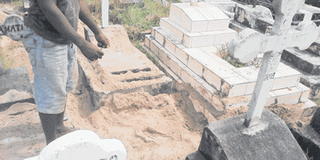
Inquiries by The Citizen at the Mwananyamala kwa Kopa burial site show that the DCC faces a challenge of burial spaces for the unclaimed bodies.

All the traditional burial sites at Mwananyamala, Kinondoni and Temeke which are known for the burial of the unclaimed bodies have already run out space.

This lack of space has given the caretakers a tough time to identify appropriate spaces for burying them. They often end up using abandoned used graves to bury the corpses.

“Frankly, these gravesites are full. What people do is to look for an abandoned grave and bury their dead there,” says one cemetery caretaker who sought for anonymity.

Mr Mallya neither confirmed nor denied of the burial space crisis, but admitted that there was a challenge of spaces for burying the unclaimed dead bodies. “There is a challenge of space for burying them. We already know about it and we every municipality has been directed to set aside specific areas for burial of the unidentified and unclaimed bodies,” says Mr Mallya.

Investigation by The Citizen also revealed that no mark like headstone is placed on the graves of the unclaimed bodies, making it difficult to identify them.

Information to public

Another challenge facing the authorities is lack of a proper system to inform the public of the presence of the unknown dead to help mitigate the problem.

The police usually ask the leader of a locality where the unidentified body was collected to inform people to come forward to identify it. This means that if the dead is not known in the locality, the chances of identifying him or her becomes small.

Mr Eligaesha says: “Most of these bodies are brought in by the police. We encourage those who have lost their relatives to visit our mortuaries whenever they lose contact with their beloveds.”

He say days for which the unclaimed body stays in morgue depends on several factors. “It depends on the state of the body on the day it was received. Ideally, they should stay for 14 days. However, some bodies do stay less than 14 days because of decomposition,” he says.

According to Mr Eligaesha, some bodies, particularly those brought in good condition, stay more than 14 days to allow relatives to show up and claim them for burials.

For those unknown bodies not brought by police and are in good condition, he says, the hospital can extend duration of stay in mortuary for up to 30 days with a hope that relatives will come forward to identify them.

He says bodies of foreigners can also stay more than 14 days as relatives in the native country have to be informed or searched in order to give advice on how the body should be disposed or if they will transport the body back home for burial.