Why Tanzania must rethink trade strategy as global funding shifts
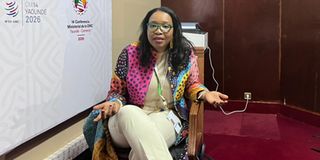
“Executive Director of the Enhanced Integrated Framework (EIF), Ms Aissatou Diallo, speaks during an exclusive sideline interview at the 14th Ministerial Conference (MC14) of the World Trade Organization. PHOTO | COURTESY
Josephine Christopher is a senior business journalist for The Citizen and Mwananchi newspapers
Mwananchi Communications Limitted
Yaoundé. As the global trade landscape grows more fragmented and development financing tightens, Tanzania and other least developed countries are being pushed to fundamentally rethink their trade strategies—shifting from aid dependency to investment competitiveness.
In an exclusive sideline interview during the 14th Ministerial Conference (MC14) of the World Trade Organisation, Executive Director of the Enhanced Integrated Framework (EIF), Ms Aissatou Diallo, said the era of unconditional trade-related aid is steadily giving way to a more demanding, results-driven model.
“Before, it was aid for trade—support provided without expecting returns. Today, the paradigm has changed,” she said.
For over two decades, the EIF has supported least developed countries, including Tanzania, to integrate into the global trading system. Its early focus was on helping countries understand trade rules and participate in negotiations before shifting towards developing sector-specific value chains that could create jobs and expand exports.
Now, under its third phase running from 2025 to 2031, the programme is pivoting towards linking trade directly with investment. The goal is to mobilise $200 million to help countries strengthen their business environments, grow their private sectors and connect local enterprises with global investors.
The shift reflects a broader squeeze on development financing, as many traditional donors redirect resources towards domestic priorities, security and geopolitical concerns. Support for trade is still available, Ms Diallo noted, but it is increasingly tied to performance and impact.
For Tanzania, the evolving model places renewed emphasis on improving the business climate. Investors are increasingly looking for transparency, predictability and regulatory stability before committing capital, making reforms in these areas more urgent.
At the same time, the new approach underscores the importance of industrialisation in shaping trade outcomes. According to Ms Diallo, countries that remain reliant on raw commodity exports risk being left behind in a system that increasingly rewards value addition and competitiveness.
“If we are not industrialised, we cannot trade,” she said.
She noted that while sectors such as agriculture remain critical for livelihoods and food security, not all of them attract equal interest from international investors.
Crops such as cassava, for instance, play a vital role within African economies but may generate limited external investment compared to higher-value industries.
This, she explained, requires countries to strike a balance between supporting domestic priorities and positioning themselves to attract foreign capital.
Ms Diallo also pointed to the central role of the private sector, particularly micro, small and medium enterprises, in driving this transition. She said the EIF’s new phase will focus on improving product quality, strengthening market access and expanding financing opportunities, especially for women entrepreneurs.
A key component of the programme will be a platform designed to connect local enterprises with potential investors, helping to address persistent financing gaps.
She further highlighted the importance of regional integration through the African Continental Free Trade Area, noting that least developed countries must be supported to fully utilise its provisions.
According to Ms Diallo, initiatives such as the EIF are intended to ensure that countries such as Tanzania can better understand trade agreements, build competitive sectors and take advantage of opportunities within the African market.
She said that the changing global environment, marked by constrained funding and shifting priorities among development partners, means countries must now compete more actively for investment.
In this context, Ms Diallo emphasised that strengthening institutions, improving the business environment and building productive capacity will be critical for countries seeking to benefit from global and regional trade opportunities.
“The objective is to make sure that countries have the right environment to attract investment and develop their value chains,” she said.
Her remarks come at a time when broader debates about the future of the multilateral trading system are intensifying.
Speaking separately, a distinguished fellow at the Centre for Policy Dialogue, Mr Mustafizur Rahman, cautioned that while reforms at the WTO are necessary, there is growing concern among developing countries about the direction those reforms are taking.
He noted that foundational principles such as the Most Favoured Nation (MFN) rule and special and differential treatment for developing countries are increasingly being questioned by major economies.
At the same time, the dispute settlement system has remained weakened for years, raising concerns about fairness and predictability in global trade governance.
Prof Rahman warned against efforts to shift the WTO towards a more plurilateral system, where smaller groups of countries drive agreements, arguing that such an approach risks sidelining poorer economies.
While acknowledging the need for flexibility, he stressed that preserving a rules-based multilateral system remains critical for countries such as Tanzania.
Register to begin your journey to our premium contentSubscribe for full access to premium content