World Bank envoy hails Tanzania gains, successor outlines growth plan

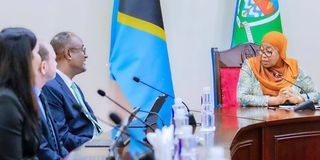
President Samia Suluhu Hassan holds talks with outgoing World Bank Country Director Nathan Belete at State House in Dar es Salaam.  PHOTO | STATE HOUSE

Dar es Salaam. Outgoing World Bank Country Director Nathan Belete has praised Tanzania’s macroeconomic stability, reform trajectory and implementation capacity, describing the country as one of the region’s stronger performers in economic management.

Mr Belete made the remarks on May 18 when he paid a farewell call on President Samia Suluhu Hassan at State House in Dar es Salaam, where he also introduced the his successor Firas Raad, according to information availed to the media at the weekend by the Directorate of Presidential Communications at the Dar es Salaam State House.
He said his four-year tenure in Tanzania had been one of the most rewarding periods of his professional career, citing close collaboration with government institutions, development partners and citizens across mainland Tanzania and Zanzibar.

Prudent economic management

Mr Belete said Tanzania had established itself as a model of prudent economic management in the region, particularly in debt management and fiscal discipline.

“When you look historically at the fundamentals of macroeconomic management on the continent, Tanzania has positioned itself as one of the leaders,” he said.

“It’s got stability. It’s very diligent on debt management. It’s very prudent on spending.”

He noted that the World Bank had supported a broad programme in Tanzania spanning multiple sectors, with strong emphasis on human development, including education, health and social protection.

According to him, key reforms during his tenure included improvements in universal health insurance, curriculum reforms in primary and secondary education and expanded focus on vocational training.

“We are very proud of the engagement on the reforms in the health sector, universal health insurance, on education and the reform into improving the curriculum at primary and secondary level and the establishment of emphasis on vocational education,” he said.

Mr Belete also highlighted progress in infrastructure development, particularly in the energy sector, saying improvements in electricity access over recent years had been significant.

“The investments and what we’ve seen in energy access rates over the last several years has been very profound,” he said.

He added that improvements in rural water supply and sanitation services also stood out as important achievements of the partnership between the World Bank and Tanzania.

Reflecting on his experience, Mr Belete said Tanzania had demonstrated that effective implementation is possible when there is strong political will and institutional coordination, pointing to the energy and water sectors as examples where delivery had been particularly strong.

“Tanzania has shown that you can implement in critical sectors to deliver to the citizens of the country,” he said.

Looking ahead, Mr Belete said Tanzania’s forthcoming Vision 2050 framework presents an important opportunity to accelerate inclusive growth, particularly through youth empowerment and private sector participation.

He said the government’s focus on youth, jobs and private capital would be central to achieving long-term transformation goals, adding that Tanzania’s macroeconomic stability provides a strong foundation for attracting private investment into large-scale infrastructure projects such as the Standard Gauge Railway (SGR), ports and the Central Corridor.

He also noted that Tanzania’s natural resource base and geographic position, bordering eight countries, give it a strategic advantage in regional trade and connectivity.

However, he cautioned that sustaining inclusive growth would require continued reforms to improve governance, transparency and citizen participation in development programmes.

“There needs to be much more diligence in engaging citizens in the design and implementation of programs,” he said, adding that improved transparency in private sector engagement and broader governance reforms remained essential.

Incoming Country Director’s take

For his part, incoming World Bank Country Director Firas Raad said Tanzania’s strong growth performance and macroeconomic stability provide a solid foundation for the next phase of development, but stressed that growth must translate into jobs and poverty reduction.

He said the World Bank’s engagement going forward would focus on what he termed the “growth and jobs agenda”, arguing that economic expansion must directly improve living standards.

“To really get at poverty alleviation, you really need to promote not only growth, but the jobs agenda,” he said.

Three key pillars

Mr Raad said Tanzania’s development strategy should rest on three key pillars: strengthening foundational infrastructure, improving the business environment and mobilising private capital.

He said foundational infrastructure includes both physical systems such as energy and transport and human development systems such as education, health and social protection.

“These are education, social protection and health, but it’s also energy, transport and so on,” he said.

He added that improving the business environment remains essential for attracting investment, noting ongoing reforms in Tanzania aimed at enhancing the investment climate.

Mr Raad said Tanzania would increasingly need to rely on private capital to finance development as global public resources become more constrained, stressing that private investment should complement public finance in delivering transformative projects.

“We need to do more to support Tanzania to really attract private capital to invest in critical areas that will transform the economy,” he said.

On human capital development, he said education, health and social protection remain critical for preparing Tanzania’s workforce for the future economy, noting that education investments often take several years to yield results in learning outcomes.

Human capital systems

He said the World Bank would continue supporting Tanzania in strengthening human capital systems to improve skills and productivity, warning that no country can achieve sustained growth without investing in its workforce.

“We will not be able to help countries grow their economies, tackle poverty and raise living standards without improving the learning outcomes and the skills of their workforce,” he said.

In the short term, Mr Raad said priority should be given to strengthening healthcare systems and social protection to protect households from external shocks, including climate-related events and global economic instability.

He said resilient economies depend on resilient households supported by effective safety nets and access to quality health services, noting that African countries are increasingly exposed to external shocks.