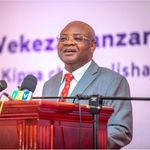
Tanzania’s High Commissioner to South Africa, Ambassador Radhia Msuya PHOTO | FILE
What you need to know:
The Citizen on Sunday Reporter Sylivester Ernest had an interview with Tanzania’s High Commissioner to South Africa, Ambassador Radhia Msuya in Pretoria where she said the two countries continue to exchange information on different issues, including on how to tackle the now rising drug trafficking vice. Excerpts:
Tanzania and South Africa have, for several years, enjoyed a cordial relationship that dates back to the liberation struggle with Tanzania playing a big role in the Southern African country’s quest to get rid of the apartheid system.
The Citizen on Sunday Reporter Sylivester Ernest had an interview with Tanzania’s High Commissioner to South Africa, Ambassador Radhia Msuya in Pretoria where she said the two countries continue to exchange information on different issues, including on how to tackle the now rising drug trafficking vice. Excerpts:
How do you describe the bilateral relationship between Tanzania and South Africa?
Tanzania’s bilateral relationships with South Africa are excellent and have been improving by the day. We have now embarked on what we call bi-nation commission which is the highest level of co-operation amongst ourselves. It covers all the areas involved in our co-operation. They are implemented through a joint permanent commission to work on economic issues, trade, diplomacy, and tourism, social and political issues. There are a group of South African youth who would go to Morogoro every year to learn of the relationship between the two nations. I wish the youth of Tanzania could also do the same. I would really want young people coming to South Africa to learn and not to loiter and become destitute.
Would you say this relationship has been benefiting our country?
It is benefiting both sides and you will know that Tanzania’s foreign policy is anchored on promoting independence, self-determination, regional integration and subsequently, socioeconomic development. So our bilateral relationship is very good. And having participated in the struggle against the apartheid system, we can only say that our relationship is very good because we continue to achieve different milestones in our relationship.
Do you have Tanzanian investors in South Africa?
I don’t have statistics, but there are businesses involving Tanzanians here. There are business opportunities in South Africa as much as there are business opportunities in Tanzania but due to the advancements South Africans have made, there are more investors in Tanzania than there are here. We all know how these opportunities back home have been benefiting our people in terms of employment opportunities, tax and others.
What is your office doing to raise the profile of Tanzania here in South Africa?
That is what we do every day…in fact, that’s our main responsibility. We promote investments and tourism. But most important which might not have tangible benefits, we promote people-to-people interaction and that’s paramount because when people work together, exchange contacts and do business together, then the government has no option but to facilitate such interaction. So, those are the areas that we focus on, but particularly looking into promoting people-to-people co-operation especially among the young people because they are the ones who are going to carry forward all that has been planned and agreed on.
South Africa is not yet considered among the first world nations but it is way far ahead of Tanzania economically. This is so despite the wealth that Tanzania boasts having. What can Tanzania do to reach where South Africa is?
I don’t think that South Africa is ahead of Tanzania. This depends on the angle from which you are looking at the differences. Remember what Mwalimu Julius Nyerere said; the aim of development is the human being. Even if you have those infrastructures and buildings, the important thing is…though I don’t want to belittle economic development and infrastructures that South Africa has attained, we have to consider how human beings benefit from that development before we can compare whether this country has developed or not. We have a lot to learn from our friends here…but this country has gone through a very difficult past and you can see it in human beings here. The attitude is very different among people here. So I would not say in any way that South Africa is more developed than Tanzanian. However, there are things we can learn from South Africa…they have made enormous achievements; they have made very big agricultural achievements. So we cannot take it as a blanket copy cat and do what they did. Because we did not go through Apartheid System, violent society as it is here; so we have a lot to learn just as much as South Africa has a lot to learn from Tanzania.
You were the director of Europe and America at the ministry of Foreign Affairs and International Co-operation prior to your appointment to this post. What do you consider your highest moment here?
I would rather say of my achievements personally. Being appointed ambassador when I became the Director of Europe and America was a very big achievement to me. Equally important, my appointment as Tanzania’s representative here was a milestone to me because any ambassador would want to be posted as a head of mission and this was the first post for me. This was a milestone in my life, mind you I’m the first female ambassador to South Africa.
There are many Tanzanians who come here thinking that there is good life. Do you have records of how many Tanzanians cross borders every year? How many Tanzanians are living here?
We don’t have records of how many of them cross borders…I say borders because they come from different parts with some coming through Mozambique, Zambia, and Zimbabwe. We don’t have statistics largely because the young people coming over don’t come with proper documentation…so they don’t cross borders legally.
Therefore it is very difficult to specify the numbers…it is a very difficult task. But I have been working very closely with the department of Home Affairs here, and we recently signed a Memorandum of Understanding so as to exchange information regarding different issues…this was just signed last week. You know we have a large number of destitute Tanzanians here…we have about 100 young Tanzanians walking into the embassy seeking assistance, per month, that is a large number. When we renewed passports we registered about 5,000 Tanzanians. You know here, it is normally one out of five Tanzanians who register, so I think we have at least 20,000 Tanzanians living in South Africa. Many of them are legal immigrants holding formal jobs. We have a lot of students who sometimes do not register with our office.
What programmes, initiatives or strategies are there to bring together Tanzanians living in South Africa?
We hold meetings with Tanzanians in general. Since I came here we have had at least three meetings. I have held meetings with Tanzanina students. We have held meetings with an organization called TWIGA (Tanzania Women In Gauteng) which last year celebrated ten years of its existence. It is one of the dynamic groups that exist here. There is also an association of Tanzanians living in Cape Town and they are quite organized. Last year we were able to hold Nyerere Day where we had church service and a sports bonanza. These are things that bring Tanzania together, particularly the young people.
When and how did you know of drug trafficking problems involving Tanzanians and how has your office dealt with the problem? What has been the impact of this problem on the bilateral relationship between the two countries?
This is a criminal activity. So it is the police, immigration and narcotic control authorities which take the matter up. Normally when a Tanzanian is detained for any reason, the Tanzanian office is informed. So they would inform us as soon as these people are detained. But you know that illicit drug trafficking is global and we read and hear about it all the time. I wouldn’t say when exactly I hear. But I get information.
Were you involved in any way to help the two Tanzanian female artistes who were being held in South Africa for smuggling drugs?
How do you help or rescue a suspect? As I told you, we always get information and inform our headquarters but we always leave the legal processes to take its course. There is nothing like intervening. What we do is to assist if someone has been wrongly arrested. In any normal situation, no one would help a person who has been caught in a criminal act. Proof of whether this person was indeed involved in that act would only be done through the court. So I cannot say for sure whether they did it or they didn’t. It was for them and the lawyers to tell the court if they were arrested with the cargo and which kind of cargo.
Does your office have records of how many Tanzanians are in South African jails on drug trafficking-related offences?
That is one of the issues we just discussed with the Home Affairs department. We want them to give us a comprehensive list of Tanzanians being held in South African prisons. You know unfortunately many young Tanzanians who get caught in criminal activities sometimes don’t identify themselves as Tanzanians or they don’t give their real names. So it is difficult. You know South Africa attracts people from different parts of the continent.
So sometimes people who are not Tanzanians present themselves as Tanzanians and some Tanzanians sometimes present themselves as from other countries.
However, in the MoU we have just signed we will have closer co-operation in exchanging information on Tanzanians incarcerated in South African jails.