Zanzibar ‘revolution girls’ reunite after 50 years
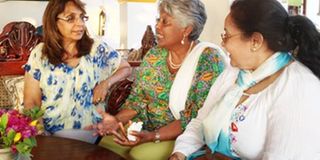
Kaline Selden (centre) speaks as Hasina Ali (left) and Rasila Acharya listen during an interview with the The Citizen on Saturday reporter in Zanzibar. The three women are bosom friends who were visiting their childhood home -- Zanzibar -- after 50 years of separation. PHOTO | ATHUMAN MTULYA
What you need to know:
The re-union brought together Kaline Selden, Hasina Ali and Rasila Acharya who were separated in 1964 during the revolution that overthrew the sultanate leadership in the Isles.
Zanzibar. For these three women, nothing would stop in the way of their childhood friendship.They have conquered age, distance and cultural barriers to be together again in a nostalgic re-union in Zanzibar last month after 50 years.
The re-union brought together Kaline Selden, Hasina Ali and Rasila Acharya who were separated in 1964 during the revolution that overthrew the sultanate leadership in the Isles.
Currently living and working in Europe and in the US, the three women have kept the embers of friendship burning since their separation aged only 11.
When they finally touched base in Zanzibar, it was an emotional engagement coated in a woman banter of the yonder days when they played on the narrow streets of Stone Town as children.
The most talkative of all, Kaline, does not hide her joy to be around. She is full of love for the country which she still considers her home.
Rich childhood memories and flashes of the revolution take centre stage every time she settles to pour out her heart.
“Our coming together is a dream come true. We waited all the years to celebrate our friendship together and tour our country. It is an experience compared to no other,” said Keline, who would later marry a Briton and settle in the UK. “To me this is my home, I have never stopped loving Zanzibar and I am proudly Zanzibari,” she told The Citizen on Saturday in a recent interview in Zanzibar.
Unlike her two friends who were coming back for the very first time since 1964, Keline had been here before, in 1997, when she brought her husband and children on her first visit.
Hasina, who resides in California and Rasila, who also lives in the UK, made a vow to join their friend for the sojourn in July that they say was a cherished moment to reconnect with their history.
Rasila actually proclaims on her Facebook page her Zanzibar heritage despite the many years spent abroad. Their respective families were forced to flee the chaos that followed the revolution and in circumstances they now recollect were too complex for them to understand as kids.
While Hasina’s family moved to Pakistan, Kaline’s parents took a ride to Dar es Salaam hoping to go back once things cooled down. Don Millan, her Zanzibari father of Sri Lankan origin, could not imagine a life outside Zanzibar.
As a young boy aged 15, Millan moved from Sri Lanka to work and live in Zanzibar whose beauty he had heard in many tales by explorers.
“He would years later establish himself as a prominent creative jeweller. He also married and at the time of the revolution had a thriving jewellery shop in his house in Kiponda. “We were a lovely family of eight children,” the daughter recalled.
After the lull, father, mother and children moved back to Zanzibar but had trouble settling down as their home and jewellery shop had been destroyed and looted during the revolution.
With everything gone, the family made a tough decision to cross the Indian Ocean back to Sri Lanka. In 1967, the family made the journey to Sri Lanka where the father would soon die due to a heart attack.
“He really never recovered as Zanzibar was all he was used to. Sri Lanka seemed a foreign terrain and because of the hardships he went through in providing for his family, he succumbed to a heart attack only seven months of landing there,” narrated Keline.
Her mother was pregnant with the ninth child when the father died. Alone with the children in the new environment, her mother decided to move back to her country of birth, Zanzibar.
She however settled in Dar es Salaam in the early 1970s.
The children enrolled in a city school. Kaline would later go to India for her college education and returned to work in Dar es Salaam after her studies. It was in her line of duty that she met with her husband, a British national who was working on a contract. “All this time our friendship with Hasina never died. We never saw each other but kept in touch through postcards and letters.”
In 1990, when her husband was done with his contract in Dar es Salaam, they went to the UK. “Luck would soon break as we were meant to go for a holiday in the US. The obvious choice for me then was California where Hasina had put up base. I was going to meet my childhood friend after 26 good years,” said Kaline.
When the trip finally came, they had an emotional encounter at the airport. “It was unbelievable setting my eyes on her….it was like we had never been separated from each other. The bonding was so close; we hugged and cried. It was tears of joy as Hasina hugged her. Kaline said her two daughters who were with her on the trip were overwhelmed. “They joined in the crying.”
After this first reunion, they kept in touch regularly and Hasina, who is Muslim, introduced Kaline, a Buddhist, to Rasila, a Hindu who was apparently living in London after also fleeing from Zanzibar in the aftermath of the revolution.
When the three of them fulfilled their vow of coming to Zanzibar together, it was too much to bear emotionally; Kaline admitted that she had to battle the flashbacks of the revolution.
“I have experienced nightmares and received counselling in the past. Until now I am terrified seeing a gun or a knife. I try hard to remember the good to overcome the fear,” she said.
“I would say I am satisfied for making the journey back here. My husband and children were excited to see where I was born, the school I went to and I wanted them to see the beauty of Zanzibar,” said Kaline.
“When emotions run too high……..say like my first sighting of the harbour and the sultan’s former palace, I would start shaking and crying. ‘Run….run…run’… I would feel but hell no! The delight in my children’s faces was reassuring enough to complete the experience and now I am happy with myself.” The three friends vowed to come to Zanzibar together once they hit 60.
Kaline says she has a few times been pissed-off by prying hawkers who mistake them for tourists. She recalls that some have even insulted her and said bad things to her in Kiswahili, assuming she did not understand the language.
“Mimi Mswahili kama wewe, nimezaliwa hapo Kiponda (I am a Swahili like you, I was born just around the corner in Kiponda Street),” she once told a trader who had taken offence that she could not buy her goods and asked her to “go back to where you came from.”
During their visit, Hasina took a walk to where her father who passed away before the revolution was buried. But the graveyard was no more; instead there stands a roundabout of a carpeted road.
For Rasila, she was lucky that one of the Hindu temples in which her father worked as a monk is still standing and Kaline visited the site where their family house stood but where stands Asmini Palace hotel now.
Despite living and raising their respective families continents apart, the women who left Zanzibar this week say they are already looking forward to yet another nostalgic visit in future, God willing.