African politics and the question of presidential term limits
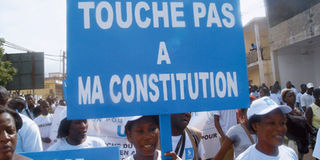
A demonstrator holds a banner reading “Don’t touch our Constitution” on November 21, 2014 in Lome, as opposition called for a protest asking for political reform to limit a president to a maximum two five-year terms of office. President Faure Gnassingbe is serving third term of office -- the current maximum allowed by the constitution.
PHOTO | FILE
What you need to know:
Protesters want him gone, and accuse his government of being insincere with its passing of proposal to amend the country’s constitution and institute term limits. They argue that the current arrangement leaves the door wide open for the current president to run for office again and virtually be president until 2030.
For almost a month now, Togo has seen some of its biggest political protests in its history aimed at ending the half century rule of a single family in their country. At the heart of the ongoing protests is restoring some clause in the 1992 constitution which had placed term limits to the presidency. The current president, Faure Gnassingbe, inherited power from his father in 2005 and is in his third term in office now.
Protesters want him gone, and accuse his government of being insincere with its passing of proposal to amend the country’s constitution and institute term limits. They argue that the current arrangement leaves the door wide open for the current president to run for office again and virtually be president until 2030.
In 2015, when the regional body, Ecowas of which Togo is a member, tried to institute term limits to all its member states, the proposal failed because of the resistance from Yahya Jammeh’s The Gambia and Togo. Jammeh was forced from power after he lost an election, promised to respect the results before a u-turn.
Togo’s story of dynastic control is not unique in Africa. Gabon has a similar story where its president inherited power from his long-serving father. Equatorial Guinea takes the cake as power has always belonged to the same family since its independence from Spain. All these are just part of the many other long-serving presidents in Africa with some of them ruling their countries like personal properties.
The question of term limits has been part of the political discussion in Africa especially since the return of multiparty politics in the early 1990s. Given the many decades of misrule of the continent by its political leaders who delivered political independence, presidential term limits came to be seen as the necessary antidote to this trend.
Term limits offer predictability, political stability, and avoiding the pitfalls of creating political dynasties, and a sense of entitlement for the select few at the apex of power. They offer a way to allow new, different ideas to lead the country for a certain period of time.
Those opposed to term limits argue that each country’s political context should be considered in debating the merits of term limits as a panacea to all that ails Africa from poor leadership.
The examples of Paul Kagame’s Rwanda and Yoweri Museveni’s Uganda are offered to show how the two countries have thrived under these long serving presidents after decades of madness from previous rulers.
This means that perhaps what troubles Africa is not so much about term limits but the quality of the job done by those in power.
A commentator observed that during 38 years in power, Gnassingbe Eyadema could not even build a hospital to treat his heart condition and died on a plane on his way to France for medical treatment. The implication here is that had the Gnassingbes done a better job in managing their country, we would not be witnessing the current anti-government protests.
While it is true that the debate about term limits tends to ignore other issues relevant to the political contexts of individual countries in Africa, what is not disputed is the fact that the stability provided by these strongmen is at the expense of strong, independent state institutions and the question of succession forever occupies the minds of even the supporters of those in power.
Without such legal and constitutional assurances, you end up with a Zimbabwe-like scenario where you hear such obnoxious statements like that of Grace Mugabe saying that his husband, President Robert Mugabe can run for president from his grave if need be as there is no one better to rule the country.
Term limits means elections which have delivered mixed outcomes when it comes to political stability in Africa, but they offer a far better prospect for the continent’s long term political and economic stability compared to the opposite reality.
In country’s with term limits, citizens are sure to replace a leader when her time is up, and in some cases where those in power failed to realize the perfect time to show their back on their way to the exit, the end to some of them has been terrible, leaving behind countries faced with civil wars, struggling to rebuild or total collapse in some cases.
Despite the different political contexts, African countries need term limits to their presidents to allow the continent to focus on other pressing issues like fostering common goals and national building projects.