If you’re not in a position to verify it, you should not bother saying it
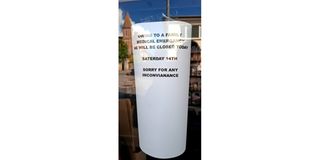
SATERDAY? Definitely, no! The word is SATURDAY. What about “EMERGANCY”? It’s supposed to be “EMERGENCY”. And, what does “INCONVIANANCE” mean? Nothing, at least in English. What the medical facility proprietors assigned the artiste to pen, we’re sure, is INCONVENIENCE. Trust signwriters! PHOTO | COURTESY
Some of us in the scribbling profession tend to fall in the trap of publishing what we’re told by our sources without acknowledging it categorically.
Yes, you need to tell your reader, for instance, that, “so-and-so told me he travelled to Arusha to meet his beloved mother-in-law.” Don’t say that as if it were an undisputable fact that the woman who begot the young lady Abdi married is beloved to him.
Or, report by saying: “Abdi told me that he was on a trip to Moshi to meet what he REFERRED TO as his beloved mother-in-law.” You could also quote Abdi as telling you: “I am travelling to Arusha to meet my beloved mother-in-law.”
What we are saying here is: Do not state as a fact what is not practically verifiable by you.
There is a caption appearing on the front page of a daily, in which a scribbler writes (we are altering the text somewhat for ethical reasons): “The host presents a SPECIAL gift to the visiting leader…”
We don’t think the caption scribbler had the licence to refer to the package as “special” since a gift is just that, a gift, unless the scribbler has an insider’s knowledge of what the specialness is all about.
If that is not divulged, then using the qualifier “special” is sheer waste of print paper space.
In another story from the same publication, there is a story entitled, ‘Government pushes for local investment to realise Vision 2025.’ In Para 7, the scribbler writes: “Priority projects include the expansion of the standard railway gauge increasing electricity generation capacity from MORE THAN 4,000 megawatts to ABOUT 8,000…”
If you ask us, we will insist that “more than 4,000” means anything from four thousand and one (4001) to eight thousand (8,000). So, we would rather the scribbler penned: “…from around 4,000 megawatts to about 8,000.”
In another recent publication, there is a story whose headline reads, ‘EALA endorses $4.7 supplementary EAC budget’ and therein, our scribbling colleague writes: “Following scrutiny, the Assembly approved expenditure amounting to $4.74 million. Of the additional ALLOCATION, $2.26 million was ALLOCATED to the EAC Secretariat…”
Take note of “allocation” and “allocated to…” renders the sentence monotonous, doesn’t it? Here is our rewrite that mends it: “Of the additional ALLOCATION, $2.26 million was SET ASIDE FOR East African Community Secretariat…”
Finally, in another daily published on Monday, July 6, we bump into an opinion piece whose headline is written thus, ‘Mining causing deforestation? It calls for alternative solutions.’
In Para 3 and 4 of the piece, the opinion scribbler tells his readers: “Activists now set other goals, like bringing mining sector companies to assess their activities, track the pace of deforestation on their own sites and in adjacent zones, mining communities.” (sic!)
“This kind of AFFIRMATION or APPEAL is packed as an APPEAL to mining firms in what resembles a dialogue with governments and communities.”
There are numerous issues to raise in regard to the two paragraphs. For instance, the conjunction “and” is missing between the word “zones” and “mining…”
Then, by saying “This kind of affirmation or appeal,” in the context of Paras 3 and 4, there is a suggestion that the two nouns mean the same thing, but that is not true. Even the verbs “to affirm” and “to appeal” do not mean the same thing.
What is more, using the word “appeal” twice is—you guessed right—to entertain indulgence in monotony!
We will fix the sentence as follows: “This kind of AFFIRMATION is packed as an APPEAL to mining firms in what resembles a dialogue with governments AND communities.”