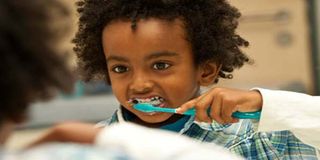
The condition of a child’s teeth depends on what he or she eats and what he or she does to take care of them. PHOTO | FILE
What you need to know:
From a random survey of 19 such children the dental surgeon (DS) made a list of his findings… Two outstanding features were carious anterior milk teeth, mostly central incisors, lateral incisors and first molars. The focus was on deciduous teeth.
Mothers coming into the dental clinic with their children who happen to be in the age range of five to seven years mostly do so to seek attention and advice with regard to chronological phase of eruption and shedding of deciduous milk teeth.
From a random survey of 19 such children the dental surgeon (DS) made a list of his findings… Two outstanding features were carious anterior milk teeth, mostly central incisors, lateral incisors and first molars. The focus was on deciduous teeth.
Those around 6 or + 6 age group had variations in terms of the presence of permanent central incisors, permanent lateral incisors and first permanent molars. All permanent teeth which had emerged were intact without any indication of caries. The majority of the mothers, 12 of out of 19, had come to register a complaint on the black appearance of the front teeth of their children.
Upon examination and probing it was discovered that 7 children out of 12 had given up their habit of milk bottle in the mouth while sleeping during the night after they had reached the age of about five years. Five out of the same lot were drinking milk during the night, out of which none even thought that brushing of teeth was imperative following the drink of a glass of milk. The coating of milk around the surfaces was an invitation to the bacterial invasion –with every passing night – causing ultimate dissolution of the enamel with cavities in teeth.
The DS took his time to educate the mothers as well as their intelligible children on the needs to cleanse their teeth after the intake of milk or any food item prior to retiring for the night. The most common query from these mothers was: Will the permanent teeth which follow be similarly black and decayed? The DS gave a fitting answer: It is what your child eats and what he does to take care of his teeth. Partaking in a dessert which may have a loaded content of sugar at night and then going to sleep savouring the taste of the dish in bed and passing the morsels of the sweet dish around the mouth and dozing off without brushing is a recipe for disaster.
The enzymatic action coupled with bacterial incursion on such food is bound to result in an acidic medium of the saliva. This heralds the initiation of caries. It so happens that if the nocturnal habit of consumption of sugars without proper toileting of the mouth continues, it is found to affect the status of permanent teeth which erupt from 6 to 12 years.
The mothers were told to act as watch-guards and oversee the habits of their children. With cessation of pernicious habits and substitution of a mind-set with a “MUST CLEAN MY TEETH BEFORE I GO TO BED” attitude, mothers will bring about revolutionary dental health changes in their children. The introduction of drinking half or quarter or full glass of water after brushing is a good change before bed time.
Accompanied by mothers
Ironically all 19 children were accompanied by their mothers. All the fathers had conferred “carte blanche” to their wives, probably so because the children had a clear leaning toward their mothers. Another peculiar feature was the response of mothers to the question: Do you brush your teeth before retiring for the night? Eight of them said that they brushed their teeth and rinsed their mouths with water or a mouth wash.
The rest were taciturn probably not wanting to give the game away in front of their children. It follows that parents who set an example will have children following their footsteps. In order to create health awareness for their children, mothers will have to shed their insincerity. Mothers with minimal decayed, missing or filled teeth are likely to create a better rapport with their progeny in relating the significance of good oral health care.
Characteristic feature
The second characteristic feature was the awe or dismay in which the mothers viewed the way the lower anterior permanent central and lateral incisors emerged into the mouth. Out of 19 mothers, 13 felt strongly that “there was something very wrong” with the way these showed up.
They were seen in the presence of lower anterior deciduous incisors which had become quite mobile. The DS, in order to convince them that there was nothing bizarre about the ‘inside out’ placing of the permanent incisors, said: “You and I all have gone through similar stages. The teeth happen to erupt from an inside position and with shift achieved by eruption and force of the tongue, finally take the actual front position on the alveolar ridge once the milk teeth in the front give way.”
Wonderstruck mothers
Some of the wonder-struck mothers who observe this phenomenon even begin to associate the permanent central incisors (with their emerging portions partly seen on the inner side) as some kind of major complication. Statements such as: “This looks horrible or the face of my child appears terrible or is it some kind of a disease my child is having?” Or, “This is very abnormal, I hope my child is not going to have any speech impediment”.
The DS educated the mothers about the eruption of teeth and their chronology. This way they would also rid themselves of exaggerated anxiety and fear. With knowledge will come a disposition to rationalize and not emotionalise or blow things out of proportion. A young mother who was 27 had a son after 9 years of marriage. It was a hard task for the DS to convince her that it would be in the interest of the child to have his mobile lower deciduous central incisors removed so that the underlying teeth would subsequently achieve the natural front position in the arch.
Refused to budge
The mother refused to budge. Finally the father arrived. He had to calm his wife (who was hysterical), get her out of the area of the operatory. The DS then carried out the extraction of the two loose teeth under lignocaine spray. The mother seemed reassured when the two milk teeth, after cleansing them with soap and water, were handed over to her. The DS said: “You will see God’s miracle shaping up when the two permanent incisors finally come up front with your child`s aesthetics like any other child`s”.
Disfigurement is what all mothers dread—rightfully so. However, with the explanation provided by the DS, it follows that these mothers should devote more time and attention in supervising the eating and brushing habits of their children when it is opportune to do so.
*****
A boy at school was assigned a project on childbirth. He asked his parents: “How was I born?”
“Well, honey,” said the slightly prudish parent, “the stork brought you to us.” “Oh,” said the boy, “well, how did you and daddy get born?” he asked. “Oh, the stork brought us too.” “Well, how were grandpa and grandma born?” He persisted.
“Well darling, the stork brought them too!” said the parent, by now starting to squirm a little. Several days later, the boy handed in his paper to the teacher who read the opening sentence with some confusion: “This report has been very difficult to write due to the fact that there hasn’t been a natural childbirth in my family for three generations”.
It goes to show that children, however little they may seem to be, need to be provided with actual biological facts.
Dr K.S. Gupta is a dental surgeon engaged in private clinical dental practice