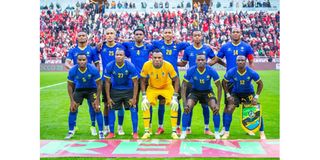
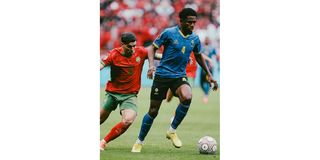
As the clock ticked down, controversy took centre stage. Deep into injury time, Tanzanian midfielder Idd Suleiman was clearly pushed and fouled inside the penalty area by Moroccan defender Adam Masina during a chaotic scramble
Dar es Salaam. Morocco booked their place in the quarter-finals of the CAF Africa Cup of Nations 2025 with a narrow 1–0 victory over Tanzania in Rabat on Sunday, January 4, 2026, but their progression was clouded by intense debate over refereeing decisions that left the Taifa Stars feeling deeply aggrieved.
Brahim Diaz’s second-half goal proved decisive at a packed Prince Moulay Abdellah Sports Complex, yet the match will be remembered not only for Morocco’s patience and quality but also for a series of controversial calls by Malian referee Boubou Traore, particularly a late incident in the penalty area that denied Tanzania a possible equaliser.
From the opening whistle, it was evident that Tanzania had arrived with belief and a clear tactical identity.
Organised, disciplined, and fearless, Miguel Gamondi’s side sat deep, compressed spaces between the lines, and frustrated the tournament hosts throughout a tense and tactical first half.
In fact, it was Tanzania who carved out the first clear chance of the night. In just the third minute, Seleman Mwalimu released Simon Msuva clean through on goal with Moroccan goalkeeper Yassine Bounou caught out of position.
With the net gaping, Msuva headed wide, a miss that would later loom large in a match decided by the finest of margins.
Morocco responded by asserting control through possession. The Atlas Lions dominated the ball, circulated it confidently from side to side and pushed their fullbacks high up the pitch.
However, they repeatedly ran into a well-drilled Tanzanian defensive block that closed passing lanes and limited space in the final third.
Captain Achraf Hakimi, leading Morocco for the first time at this edition of the tournament, attempted to inject urgency from the right flank, while Azzedine Ounahi and Bilal El Khannouss probed centrally.
Still, clear-cut chances remained scarce, with Tanzania’s backline holding firm and goalkeeper Hussein Masalanga calm and assured whenever he was tested.
Morocco believed they had finally broken the deadlock in the 24th minute when Ismail Saibari tapped in from close range.
The celebrations were short-lived, however, as VAR intervened and ruled the goal out for offside.
The decision heightened the tension inside the stadium and underlined the hosts’ frustration as the first half ended goalless.
After the restart, Walid Regragui’s men emerged with renewed urgency.
Diaz forced a corner with a glancing header early in the second half, and moments later El Khannouss fired narrowly over the crossbar in the 52nd minute as Morocco began to turn the screw.
Yet Tanzania again threatened to shock the hosts. In the 56th minute, Feisal Salum “Toto” found himself unmarked inside the Moroccan penalty area following a swift counter-attack.
With time and space, the Azam FC midfielder blazed his effort over the bar, squandering what could have been a historic goal on the biggest stage.
The decisive moment arrived in the 64th minute. Diaz, Morocco’s most creative and dangerous player, produced a moment of individual brilliance, cutting inside and squeezing a precise finish from a tight angle past Masalanga.
The goal was the fourth of the tournament, sending the Rabat crowd into raptures and lifting him clear at the top of the AFCON scoring charts.
Despite going behind, Tanzania refused to fold. They pushed higher up the pitch, committed more bodies forward, and searched relentlessly for a way back into the contest.
Morocco, meanwhile, struggled to kill the game and increasingly felt the pressure of protecting their slender lead.
As the clock ticked down, controversy took centre stage. Deep into injury time, Tanzanian midfielder Idd Suleiman was clearly pushed and fouled inside the penalty area by Moroccan defender Adam Masina during a chaotic scramble.
Replays suggested undeniable contact, prompting furious protests from Tanzanian players and the technical bench.
Referee Boubou Traore waved play on and, to the disbelief of many, declined to consult VAR.
The decision sparked widespread debate, with accusations that key calls throughout the match appeared to favour the hosts.
Several fouls and marginal decisions also seemed to go against Tanzania, adding to a growing sense of injustice among the East Africans.
While refereeing errors are part of football, the refusal to conduct a VAR check in such a decisive moment left Tanzania feeling robbed of a potential lifeline and cast a shadow over an otherwise gripping AFCON encounter.
Morocco eventually held on to secure their place in the quarter-finals, where they will face the winner of the Round of 16 clash between South Africa and Cameroon at the Stade Al Madina in Rabat.
For Tanzania, the defeat marked the end of a courageous and historic AFCON campaign. Reaching the knockout stages for the first time, the Taifa Stars earned respect across the continent with their organization, resilience, and fearless approach against Africa’s top-ranked side.
Speaking after the match, Diaz, who was named Man of the Match, acknowledged the scale of the challenge.
“The competition is growing in intensity, and we have just faced our toughest opposition so far against this Tanzanian team,” he said. “Not everything worked, but fortunately we managed to secure our qualification.”
Tanzania head coach Gamondi echoed that pride despite the heartbreak. “I am so proud of what my team produced,” he said.
“So proud of my players, both in their attitude and tactically. They showed that the gap between Morocco and us is not as big as people think. We will come back stronger; I am convinced of that.”