Vodacom Corporate Masters gives golf development a boost
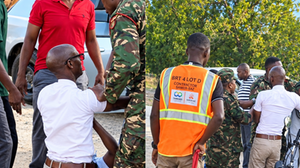
Vodacom Tanzania PLC Director of Vodacom Business, Nguvu Kamando (in red hat), celebrates with winners of various categories at the Vodacom Corporate Masters golf tournament, PHOTO | courtesy
Dar es Salaam. The real winner at this year’s Vodacom Corporate Masters may not have been the golfer who lifted the trophy, but the child who picked up a golf club for the first time and discovered that the game could belong to them too.
While Khalid Shemndolwa and Yvonne Ondari emerged as the overall men’s and women’s champions after each carding 42 points at TPDF Lugalo Golf Club, the tournament’s bigger story unfolded away from the leaderboard.
A golf clinic, led by professional golfers Pro Daudi Helela and Pro Iddi Mzaki, brought together children, young people and adults eager to learn the basics of a sport that has traditionally been seen as difficult to access.
That deliberate shift from simply staging a competition to creating new golfers could prove to be one of the most important developments around the Vodacom Corporate Masters.
For the organisers, the tournament is increasingly being viewed not only as an annual contest for corporate golfers, but also as a platform through which the sport can attract new participants and build a stronger future.
Tournament organiser Kelly Simon said the thinking behind the initiative was simple: golf cannot grow if development is measured only by the number of tournaments played or trophies won.
“Beyond producing winners, we have to ask ourselves what we are leaving behind for the next generation. A tournament lasts for a day, but a player we introduce to golf can remain in the sport for decades, “said Simon.
He said the decision to include people of different ages in the clinic was deliberate, given the unusual nature of golf compared with many other sports.
“Golf gives us an advantage that many sports do not have. A young player can compete with an older player and win, while an older player can continue competing long after athletes in other sports have retired. So age should not be a barrier to participation,” he said.
That philosophy was visible at Lugalo, where the clinic became an informal meeting point for aspiring golfers. Under the guidance of Helela and Mzaki, participants were introduced to basic techniques while getting a closer understanding of the discipline, patience and precision required to play the game.
For organisers, such activities are important because the future of golf depends on expanding the player base rather than simply improving the quality of those already involved.
The challenge is not unique to Tanzania. Golf development programs around the world have increasingly focused on making the game more accessible to children and beginners, recognising that a broader participation base creates a larger pool from which elite players can eventually emerge.
In Tanzania, the same logic has increasingly shaped efforts by the Tanzania Golf Union and other stakeholders to introduce young people to the sport through training programmes, junior competitions and access to equipment.
Against that background, the Vodacom Corporate Masters clinic takes on a significance beyond the tournament itself.
“The question is not only who won today. We should also be asking how many people were inspired to start playing today,” Simon said. “If we can introduce 10, 20 or 50 new people to golf, that is also a victory for the sport.”
That broader definition of success ran alongside a fiercely contested competition involving about 150 golfers from Tanzania and neighbouring countries, including business leaders, company directors, executives and golf enthusiasts. Shemndolwa finished at the top of the overall standings with 42 points to claim the men’s title, while Ondari posted an identical score to take the women’s overall crown.
Godfrey Abel won Division A with 42 points, finishing one point ahead of Likuli Juma. Sigfrid Urassa claimed Division B with 40 points, edging Godfrey Kilenga on countback after the two players finished on the same score. Boniface Japhet took Division C with 39 points, while Abdallah Singano was second on 37.
In the women’s competition, Neema Job also finished on 42 points to claim her category, with Leticia Kapalia second on 40.
The corporate contest added another layer to the tournament, with KQ emerging as the winning team after competing against nine other corporate sides. Michael Norbert won the men’s Longest Drive award, while Kapalia took the women’s prize. Harshid Barmeda claimed the men’s Nearest to the Pin award, with Vaileth James winning the corresponding women’s prize.
Yet the scores and prizes tell only part of the story
For Vodacom, the tournament has become an opportunity to bring together sport and business in a setting where relationships can be developed away from conventional boardrooms.
Vodacom Tanzania Director of Vodacom Business, Nguvu Kamando, said that was increasingly becoming one of the tournament’s defining characteristics. “Business relationships are not built only around conference tables. Sometimes they begin with a conversation on a golf course, over a cup of coffee or while watching a young player learn the game,” Kamando said.
He said the tournament was designed to create an environment where companies could interact while also supporting a sport with wider social and developmental value.
“We want this to be more than a corporate event. We want it to create connections, but also create opportunities.
If a business relationship is formed, that is good. If, at the same time, a young person discovers golf, that is equally valuable,” he said.
For Vodacom Business, the event also provided an opportunity to showcase digital and connectivity solutions aimed at corporate customers. But the company’s involvement has increasingly placed the tournament within a broader conversation about the role of private-sector investment in sport.
That is a conversation Tanzania’s sporting sector needs
Chairman of the Corporate Masters Committee, Ken Kariuki, said the partnership with Vodacom demonstrated how business and sport could create value for each other while supporting wider development.
“We have seen strong competition on the course, but what happens outside the course is just as important. Companies are meeting, relationships are being built and the sport is gaining visibility,” Kariuki said.
He added: “If we can use a tournament to connect businesses while also introducing a new generation to golf, then we are creating something that has a life beyond the final score.”
That is perhaps the most compelling argument for the tournament’s continued growth. Golf needs competitions that challenge established players, but it also needs pathways for beginners. It needs professionals such as Helela and Mzaki who are willing to pass on their knowledge. It needs junior programmes, accessible facilities and parents who see the sport as an opportunity rather than an activity reserved for a particular social class.
The presence of children at the clinic offered a glimpse of what that future could look like
A child learning how to grip a club today may not look like a future national champion. But elite athletes rarely emerge fully formed. Their journeys usually begin with someone giving them an opportunity, a coach teaching them the basics and a competition providing a reason to keep going. That is why the development element of Corporate Masters could ultimately prove more important than its trophies.
“We want more people playing golf. We want children to start early, adults to feel welcome and experienced players to help those coming behind them.
That is how you build a sport,” Simon said. He believes the sport should also challenge the perception that golf is exclusively for older or wealthy people. “If someone says golf is only for a certain group, then we have a responsibility to change that perception. The more people we introduce to the game, the more naturally that barrier disappears,” he said.
The third consecutive edition of the Vodacom Corporate Masters therefore ended with more than champions being crowned. Shemndolwa had his 42 points. Ondari had hers.
Abel, Urassa, Japhet and the other divisional winners had their moments of celebration. KQ had the satisfaction of emerging as the best corporate team.
But beyond the trophies, Lugalo hosted something potentially more significant: an attempt to widen the doorway into golf.
That is the real test for the tournament in the years ahead
Its success should not be judged only by the quality of competition or the number of corporate players it attracts, but by whether it can help create more golfers, particularly young players who can carry the sport into the future. Because taking Tanzanian golf to the
next level will require more than producing champions. It will require creating a bigger pool of players, investing in coaching, making the sport more accessible and ensuring that every tournament leaves something behind.