From Potential to Progress: World Vision Tanzania’s blueprint for youth economic transformation

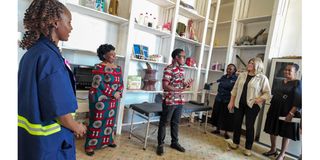
World Vision Canada President and CEO Allison Alley (second, right), with her hosts during a visit to the resource library at the Kiwohede Training College in Bunju Ward.

In today’s world, where employment challenges and social changes are accelerat­ing, World Vision Tanzania has emerged as a true partner for Tanzanian youth.

Through its ambitious AHADI, BLOOM, and Youth Ready projects, implemented with the partnership with; the government of Tanzania, Niajiri Africa, Babawatoto, KIWO­HEDE, TAHEA, The Barett Fami­ly Foundation and Government of Canada, the organization has been implementing strategies aimed not only at providing youth with job skills but transforming them into heroes of change within their com­munities.

Young people engage in discussions during a youth forum organized by World Vision Tanzania.

As Tanzania joins the world in cel­ebrating International Youth Day, World Vision Tanzania is show­casing the significant milestones achieved through these initiatives. Currently active in Dar es Salaam, Dodoma, and Tanga, these projects highlight the immense potential of young people to contribute to national development.

The organization is fully prepared to use various platforms to show­case the significant milestones of development and transformation achieved by young people through the implementation of the AHADI, BLOOM, and Youth Ready projects.

The Youth Expo: Bridging the skills gap

A cornerstone of this strategy is the Youth Expo, a unique platform that connects young people with development stakeholders, employ­ers, and training institutions.

The expo serves as a critical forum to address labor market challenges while providing direct employment links for youth who have passed through World Vision Tanzania’s programmes.

Foundations of health and informed choices

World Vision Tanzania operates on the principle that a healthy youth is a productive citizen. Through the AHADI project, approximately 294,438 young people have received vital reproductive health education.

This education has been a cata­lyst in helping youth understand themselves, protect themselves against unintended pregnancies, and make informed decisions about their future lives. Furthermore, the AHADI Impact Model (AHADIIM) has been a pillar of change for ado­lescents (aged 10-24), emphasizing peer-to-peer learning.

Youth learn freely about sexual and reproductive health and rights (SRHR), gender equality, protection against violence (GBV/SGBV), and life skills. The confidence of these young people has increased because they now recognize ways to protect themselves from violence and know where to access services.

Youth participants of the AHADI project, being implemented by World Vision Tanzania, engage in discussions.

These positive results have been achieved for youth both in and out of school, fostering a sense of safety and confidence among them.

Economic empowerment and breaking stereotypes

The Youth Ready project has become an engine for econom­ic liberation. To date, 17,211 young people have undergone vocational training, with 8,490 successfully securing jobs or starting their own businesses. Additionally, 610 youth have graduated from TVET and entrepreneurship courses under the AHADI project.

Likewise, through the AHADI project, 610 youth have graduated from vocational training (TVET) and entrepreneurship, which has bolstered their confidence to com­pete in the job market due to the certificates and skills they acquired

Beyond skills, the organisation is successfully dismantling gender stereotypes. Youth are now choos­ing professions from mechanics to culinary arts based on passion and ability rather than traditional gender roles. Financial literacy has also seen a boost, with 51 Savings for Transformation (S4T) groups established, managing a total of Sh 12,417,600

Strategic partnerships for impact

Collaboration remains key. World Vision Tanzania works closely with the government through Youth Integration Forums to facilitate access to loans and opportunities. In the private sector, partnerships with entities like Niajiri Africa pro­vide essential internships, while the Youth Ready Leadership Academy alumni network offers a bridge to the professional world.

World Vision Tanzania also works with local partners includes; Babawatoto and TAHEA to imple­ment these projects. as well as The Barett Family Foundation for Youth Ready and Government of Cana­da for AHADI and Bloom who are funding these projects.

Furthermore, 11 health facilities in Dodoma and Dar es Salaam have been refribshmented to provide youth-friendly, stigma-free services, equipped with digital tools for con­tinued learning.

Service providers have been trained to offer services without stigma or judgment, which has increased youth confidence in vis­iting these centers for reproductive health and nutrition services. These centers have also been equipped with communication tools to enable youth to engage in digital learning.

In technology, a partnership with Apps and Girls has seen 25 girls in Dar es Salaam master coding and web design, who are now training their peers.

Although the challenge of rural infrastructure persists, World Vision Tanzania continues to provide training using a hybrid approach (digital and analog) in approximately 16 regions, following government guidelines.

The MenCare champions the environment

The MenCare Champions mod­ule has brought about a significant transformation in mindsets. Now, men participate fully in domestic duties such as cooking and washing, tasks that were previously viewed as being for women only.

These men have become protec­tors of girls’ rights, opposing child marriage and gender-based vio­lence. Regarding the environment, youth in the Tanga region are using the Citizen Voice and Action (CVA) module to influence environmental policies.

The Empowered Worldview (EWV) module has helped youth move away from a culture of dependency and start using their own resources for entrepreneur­ship. This courage led youth to international platforms like COP27 to represent the voice of Tanzania.

Voices of success

One of the living examples of change brought by World Vision Tanzania is the story of Hussein Rajab Mathayo (22), a young man from Kivule Ward in Dar es Salaam, whose life has transformed from the streets to becoming a respected pro­fessional Chef, along with Mariam Iddi Athumani (22) from Mnadani Ward, Dodoma, who overcame a period of darkness after being una­ble to continue her studies in 2022.

Mariam Iddi: A second chance in life

Mariam Iddi Athumani is a 22-year-old young mother from Mnadani Ward who lives with her 2 visually impaired parents and her younger sibling. After completing her secondary education at Miyuji Secondary School in 2022, Mariam was unable to continue to Advanced Level because of her family’s finan­cial hardships.

Her dream of becoming a doctor came to an end, leaving her hope­less and discouraged. With her par­ents unable to earn a stable income, the family relied on support from relatives and the local mosque to survive.

Feeling frustrated and without direction, Mariam became involved in negative peer groups, where she started smoking, drinking alcohol, and engaging in risky sexual behav­ior. In 2024, she gave birth to a baby boy, Abdul-Aziz Athumani, after her partner denied responsibility for the pregnancy. The experience left her emotionally distressed and struggling to care for both herself and her child.

In early 2025, Mariam’s life began to change when a community ambassador introduced her to the AHADI Project. She was linked to the project’s promoter, Mwaija, who encouraged her to attend the AHA­DI learning sessions.

Through these sessions, Mariam gained knowledge on maternal and child health, positive decision-mak­ing, and life skills. She began attend­ing regular child welfare visits and monthly clinic visits at Mipango Dispensary and followed the advice of healthcare providers, which led to significant improvements in her son’s health.

The youth participants of World Vision Tanzania projects share knowledge and skills at Bunju Health Centre.

“The AHADI Project gave me a second chance in life. It transformed me from a hopeless young mother into a confident and independent woman. Today, I can provide for my child, support my family, make informed decisions, and inspire other young people to believe that change is possible,” Mariam said with a smile.

From a Street to a chef: Hus­sein Mathayo’s journey

Hussein, who has only a primary education, went through a difficult period after dropping out of school due to his family’s poor economic situation. Raised by a single parent, Hussein found himself losing hope, spending much of his time on the streets under the influence of direc­tionless friends.

“I had no direction, I had no job, and I had no faith that I could fulfill my dreams,” Hussein explains. The change began when he met a Youth Ready project animator.

Despite initial doubts about the opportunity, Hussein decided to join and received life skills training through modules like “Who am I and Who are We”, “Ready for Work”, “Ready for Entrepreneurship”, and “Ready for Citizenship”

These training sessions helped Hussein understand himself, build confidence, and see his value as a young person capable of fulfilling his dreams. Following the training, Hussein joined vocational training at the KIWOHEDE TVET center in Bunju, where he chose to study Hotel Management due to his pas­sion for cooking

Despite being discouraged by some in the community who claimed that cooking is not a man’s job, Hussein remained firm. “I believed that success comes from passion and hard work, not from societal expectations,” Hussein says.

His efforts led him to the South Beach Resort Hotel in Kigamboni for practical training (field). Due to his discipline and hard work, Hus­sein succeeded in being employed as a professional Chef immediately after his training.

Today, Hussein not only earns an income but also supports his family, parents, and siblings while serving as a source of inspiration for other youth in his neighborhood. Hus­sein now has even bigger dreams of becoming a world-class inter­national chef and opening his own restaurant that will provide jobs for other young people.

Jubilee Strategy FY2026–FY2030: Towards 2030

The “Jubilee Strategy FY2026–FY2030” has been specifically designed to reach even more youth, particularly those in urban areas.

This strategy aims to ensure youth can liberate themselves eco­nomically through vocational train­ing, improvements in reproductive health services, and by addressing youth policy reforms

By the year 2030, this strategy aims to have enabled many urban youth to achieve their economic and social goals. Through this strat­egy, Tanzania is cultivating a new generation of youth who will not only be employed but will be lead­ers, innovators, and catalysts for change in the nation.

International Youth Day, com­bined with the vision of World Vision Tanzania, serves as a remind­er that when a young person is given the opportunity and skills as Hus­sein and Mariam, they can turn darkness into light and transform their community and the nation as a whole.

World Vision Tanzania grate­fully acknowledges the Govern­ment of Canada and The Barrett Family Foundation for making this life-changing work possible. Through their generosity and com­mitment to youth empowerment, thousands of young people are gaining the tools, opportunities, and support needed to unlock their potential, build sustainable liveli­hoods, and shape a more hopeful future.