Zanzibar to replace government vehicle fleet with electric cars
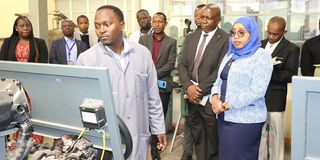
Zanzibar's Deputy Minister for Works and Transport, Bandria Masoud (right), listens as a student at Arusha Technical College (ATC) explains the operation of a training machine during her visit to the institution. Looking on is the ATC Principal, Professor Mussa Chacha.
Arusha. The Revolutionary Government of Zanzibar plans to replace its entire fleet of fuel-powered government vehicles with electric vehicles as part of a clean energy transition aimed at reducing carbon emissions and tackling climate change.
The government also intends to strengthen driver training programmes to improve road safety, reduce traffic accidents and build a more skilled transport workforce.
The announcement was made by Zanzibar's Deputy Minister for Works and Transport, Bandria Masoud, during a visit to Arusha Technical College (ATC), where she toured the institution's advanced driver training facilities and transport education programmes.
Ms Masoud said the transition to electric vehicles had already been approved by the President of Zanzibar and Chairman of the Revolutionary Council, with implementation expected to begin soon.
She said the shift had started with electric public buses, which are currently undergoing pilot trials ahead of their official launch.
"We are preparing for a major transformation in government transport by replacing fuel-powered vehicles with electric ones. The President has already approved the plan, and we have begun with electric public buses that are currently undergoing trials," she said.
"Once the programme is officially launched, we will gradually extend it to all government vehicles."
Ms Masoud urged ATC to expand its training in electric vehicle technology, saying Zanzibar plans to send government drivers to the college in phases to acquire practical skills in operating and maintaining electric vehicles.
She said Zanzibar was undertaking major infrastructure reforms to support economic growth but acknowledged that road safety remained a significant challenge due to the rising number of traffic accidents.
Despite existing road safety laws and policies, she said crashes continue to claim lives and cause injuries, underscoring the need for more effective interventions.
"Road accidents remain one of our biggest concerns. We have identified areas that require improvement, which is why we came here to learn better ways of producing highly skilled and responsible drivers," she said.
Ms Masoud praised ATC's practical approach to driver training, saying it equips trainees with a thorough understanding of vehicle systems before they begin driving on public roads.
"In Zanzibar, practical lessons often begin with starting the vehicle and driving. Here, trainees first learn about the engine, braking systems, warning indicators and other vehicle components. This produces drivers with stronger technical knowledge and better driving skills," she said.
She added that the Zanzibar government had introduced smart traffic cameras to monitor road offences as part of broader efforts to improve road safety.
According to Ms Masoud, the government will continue working with ATC and Zanzibar's Ministry of Education to strengthen professional driver training and enhance road safety.
ATC Principal, Prof Musa Chacha, said the college was continuously updating its curriculum to keep pace with technological developments, particularly the growing adoption of electric vehicles.
He said a delegation from the college visited Japan in March this year, where it established partnerships with Toyota and institutions in Kobe to gain practical experience in the latest electric vehicle technologies.
"Most vehicles manufactured in Japan and many other countries are now electric. Following our visit, we updated our curriculum by introducing courses on electric vehicle technology, and the training is already underway," said Prof Chacha.
He said that the college was investing in modern facilities and equipment to produce professionals capable of meeting the evolving needs of the transport sector.
Prof Chacha also said ATC had introduced a specialised capacity-building programme for driving instructors and drivers across different licence categories after identifying poor driving practices and inadequate technical knowledge as major contributors to road accidents.
He said the Deputy Minister's visit had strengthened cooperation between ATC and the Revolutionary Government of Revolutionary Government of Zanzibar, paving the way for enhanced driver training and wider adoption of modern transport technologies.
Register to begin your journey to our premium contentSubscribe for full access to premium content