Zanzibar VP Hemed says blue economy emerging as growth engine
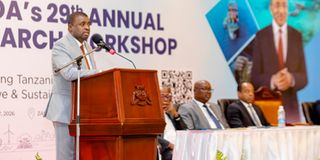
Zanzibar’s Second Vice-President, Mr Hemed Suleiman Abdulla, addresses government leaders, private sector representatives and members of the public during the opening of the 29th Research Workshop 2026 in Unguja, Zanzibar. PHOTO | COURTESY
Unguja. Zanzibar’s Second Vice-President, Mr Hemed Suleiman Abdulla, has highlighted major investment opportunities in the blue economy, inviting local and foreign investors to tap into the sector’s growing potential.
He said Zanzibar offers promising opportunities in aquaculture, marine product processing, marine biotechnology, and eco-tourism, alongside maritime transport, blue carbon initiatives, circular economy solutions, and marine digital technologies.
Mr Abdulla made the remarks on Monday, May 25, 2026, while opening the 29th workshop on the blue economy, which brought together policymakers, researchers, and private sector leaders from across Africa.
The forum was organised by Repoa in collaboration with the Ministry of Blue Economy and Fisheries, the Tanzania Planning Commission, and CRDB Bank PLC.
“We welcome investors who are ready to invest in this sector because Zanzibar has already created a conducive environment with significant opportunities,” he said.
Mr Abdulla said young people in Zanzibar are increasingly establishing innovative businesses in seaweed products, aquaculture, eco-tourism, marine technology, sustainable handicrafts, and marine digital services.
He said the trend demonstrates that the blue economy extends beyond fishing and maritime transport and has become an important space for innovation, technology, and entrepreneurship.
According to him, the government is investing in maritime training, drone technology, modern aquaculture, and marine systems development to equip young people with skills aligned with future economic demands.
“I urge all stakeholders to recognise that the blue economy is more than just an economic sector. It is a shared national journey that requires accountability, innovation, strong research, collective responsibility, and regional and international cooperation to succeed,” he said.
Deputy Minister for Industry and Trade in the Union government, Mr Denis Rondo, said the conference comes at a critical time as Tanzania continues implementing its Development Vision 2020–2050, whose success depends heavily on private sector participation.
“One of the greatest resources we possess is our lakes and oceans. Tanzania is blessed with vast marine resources, and these must be utilised effectively to support development plans and reduce poverty through the blue economy,” he said.
Repoa executive director, Dr Donald Mmari, said the blue economy is increasingly being viewed as a potential driver of economic transformation across Africa through regional cooperation and sustainable use of marine resources.
“The key issue is ensuring these resources are utilised responsibly. We are aware of major challenges, including climate change and carbon emissions, which are contributing to rising temperatures and sea levels and creating various impacts,” he said.
Dr Mmari added that researchers are working to identify priority areas and generate evidence that can guide policies aimed at ensuring the blue economy remains sustainable, inclusive, and beneficial to communities.
Zanzibar’s Minister for Blue Economy and Fisheries, Mr Masoud Ali Mohamed, said investment in research is crucial to the sector’s growth, noting that the ministry has continued collaborating with Repoa to strengthen environmental sustainability through research-based initiatives.
CRDB Bank Board Chairman, Prof Neema Mori, said the bank remains one of the major financiers of blue economy activities, with more than 50,000 beneficiaries already supported through different programmes.
“We are working closely with stakeholders to prioritise financing for value chains and infrastructure while continuing to support projects within the sector,” she said.
The Tanzania Planning Commission deputy executive secretary, Ms Blandina Kilama, said development planning cannot succeed without strong research and evidence-based data.
“We have worked together to emphasise the importance of research because planning cannot be undertaken without evidence-based studies. You must first identify priority areas and appropriate interventions, which is why research remains essential to the growth of the blue economy,” she said.