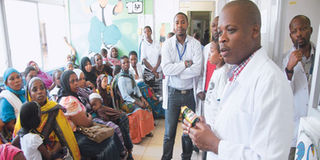
Muhimbili sickle cell specialist doctors address patients during a recent clinic for children. Specialists are located in cities and major towns. PHOTO | EMMANUEL HERMAN
What you need to know:
Speaking at a graduation ceremony at the weekend in Moshi, the don called on the government to improve the remunerations of the doctors in order to attract more experts.
Dar/Moshi/Mwanza.Tanzania spends between $40,000 (Sh66million) and $60,000 (Sh99million) to train a single medical doctor, but four out of every ten who finally graduate soon abandon their calling to pursue less exacting or better paying undertakings.
The cost of producing a medical doctor doubles if one goes for training abroad, especially in Europe and the US where medical education is still very expensive.
A recent study has revealed that slightly over 40 per cent of doctors who graduate in Tanzania ditch their profession in search of greener pastures. This is not about the infamous brain drain, whereby individuals trained at the expense of the taxpayer in a poor nation like Tanzania leave the country and go and serve abroad for better pay. Tanzania and other sub-Saharan African countries are amongst the countries that are worst hit by brain-drain, subjecting it to a massive economic loss, a new study shows.
According to a research by Canadian scientists in 2011, in nine African countries, Tanzania included, taxpayers are losing the equivalent of US$2 billion per year as their expensively trained healthcare professionals leave to seek jobs in wealthier countries.
The trend of doctors abandoning their profession is among the key factors that lead to shortage of doctors in the country, stifling efforts to improve the health sector, a report by civil society organisation indicates.
The revelations come amid a growing concern over the trend in which patients are routinely being flown abroad for treatment.
A survey conducted this year by a health NGO, Sikika, and the Medical Association of Tanzania (MAT), indicates that in addition to the abandonment of the profession by over 40 per cent of graduate doctors, a further 42 per cent are of the graduates chose to stay in major urban areas such as Dar es Salaam, Arusha, Mwanza, Mbeya and Moshi.
“Dar es Salaam alone accounts for 32 per cent of all tracked medical doctors in the country,” Irenei Kiria, executive director of Sikika said at the weekend in a statement, quoting the report in Dar es Salaam.
Tanzania has a one of the world’s poorest doctor:patient ratio, with one doctor serving about 26,000 patients. The WHO recommended ratio is 1:1,000.
Generally about 60 per cent of all medical experts trained locally turn down job offers and leave the country to seek better paying hospitals and other health facilities outside the country, according to Kilimanjaro Medical University College Principal, Prof Egbert Kessy.
The two factors – brain drain and quitting the profession – explain why the country continues to face a shortage of medical experts despite an increase in their training institutions, according to Prof Kessy.
Speaking at a graduation ceremony at the weekend in Moshi, the don called on the government to improve the remunerations of the doctors in order to attract more experts.
“The government is yet to make the medical profession truly attractive to those aspiring to join it,” he said, noting that many doctors work “in very difficult conditions”.
Tanzania has five major medical institutions that produce graduates, namely: Catholic Church University of Health and Science (CUHAS) in Mwanza, Kilimanjaro Medical University n Moshi, Muhimbili University of Health and Allied Sciences, International Medical and Technological University (IMTU) and Hubert Kairuki Memorial University in Dar es Salaam.
These institutions produce an average of 1,000 medical graduates annually. Tanzania had 48,637 workers in the entire health sector by 2010, according to Sikika.
The country has a shortage of 89,000 medics, says the report. By 2019, without intervention, the gap is expected to exceed 100,000. This being the situation today, the question is whether Tanzania can afford losing all these trained at a very high cost
Meanwhile, medical students who graduate at CUHAS are heavily indebted by the institution due to failure to access loans. About 1,038 students graduated at the weekend at the university.
The sixth graduation since the university’s inception, this year’s event had a total of 1,038, two among them attaining PhDs, while 98 graduands attaining Master’s degrees, with 369 students attaining medical science degrees.
Others 571 out of 1,038, attained Diplomas in Medicine, while 21 students were certified in nursing education and 24 others graduated as lab technicians.
“Some of these graduands are heavily indebted by the college because they have not cleared the remaining 75 per cent of the tutorial cost,” explained the university’s vice chancellor, Professor Jacob Mtabaji.
Speaking to reporters ahead of the graduation on November 16, Professor Mtabaji said CUHAS management was not happy with the way the way the government treats medical students in privately-owned universities.
He said the big number of students the college enrolls annually have failed to afford the tutorial cost which is over Sh30million.
“The amount is too big and hardly affordable for the majority of students especially from poor rural,” he added.
Adding he said the government loans also cripples students in a way that the 3.8 million the students pay annually, the government meets Sh2.6 million while letting a student to foot the remaining Sh1.5 million.
He said students from private institutions deserve rights to get government’s assistance since both types of students are trained to serve the same nation.
“I think it is a time the government should change this discriminative attitude,” he said.