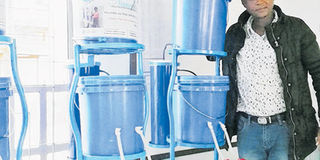
Dr Askwar Hilonga with the water filter Nanofilter PHOTO | CORRESPONDENT
What you need to know:
It is estimated that 7,000 children die every year in Tanzania due to waterborne diseases and according to the World Health Oeganization, this results in the death of one child every 20 seconds.
Dar es Salaam. Access to safe and clean water has remained a major challenge facing many communities in northern part of Tanzania for decades. This problem has caused number of health complications, especially children, as many families in northern regions are forced to drink dirty water for survival.
It is estimated that 7,000 children die every year in Tanzania due to waterborne diseases and according to the World Health Oeganization, this results in the death of one child every 20 seconds.
Globally, WHO estimates 844 million people lack clean and safe water and at least 2 billion people use drinking water from contaminated sources; resulting in 502,000 diarrhoea deaths each year. To reduce the problem, some inventors are trying to come up with innovative solutions that will help to reduce the health complications caused by consuming contaminated water.
In 2014, a Tanzanian intellectual Dr Askwar Hilonga came up with Nanofilter, innovative low-cost water purification system, which will help millions of families to access clean and safe water, starting in northern regions of Tanzania.
Through the innovation, at least 250,000 people have been reached with clean and safe water and 90 Nanofilter water points have been established, where people can buy clean and safe water at affordable price. Speaking with The Citizen yesterday, Dr Hilonga, the Nelson Mandela Institute (NM-AIST) senior lecturer said he came up with the solution to mitigate challenges facing the communities by lacking safe and clean water.
“While the invention will help communities to access clean water, I came up with the invention because it is also a business opportunity,” he said.
He said Nanofilter is sold directly to households and institutions; but for many, who cannot afford to buy the whole filter, can purchase water at any of established stations where water is sold at a price that is five times cheaper than the market price.
The water stations are run by trained operators. The process of water station establishment starts with location identification, soliciting government permit, testing water quality, kiosk installation, recruitment and training of operators, daily data and revenue collection.
Through the Human Development Innovation Fund (HDIF), the project is targeted to reach 100,000 people. An average income from one station is 15 times better than any of the 1,000 water stations that would have been operated by local entrepreneurs.
He said filters that are currently available in the market are hollow fibre membrane filters that are not customised and they solve only specific problems which include removal of bacteria. Most of them are sophisticated, expensive and there parts cannot be replaced easily because they are imported from outside Tanzania.
However he noted that Nanofilter innovation has achieved commendable results in various aspects and the sustainability is guaranteed. It has also won the World Health Organization (WHO) Health Prize 2019 award.
Further, 517 households access Nanofilte and at least 73 Institutions with Nanofilter including schools in rural Tanzania have already installed the Nanofilter system. At the same time, ten Nanofilter water stations are in Kenya – through Savemod Earth Link Company as Franchise.
Nanofilter innovation has achieved commendable results in Tanzania, and the team is now ready to take the product to other countries. At present there are requests from 12 different African countries and seven other countries outside Africa.
At the beginning the intention was to establish 1000 water stations to be rented to local entrepreneurs.
He noted that it was done through calls for application or announcement of the opportunity through physical public meetings and media, recruitment of the local entrepreneurs, training on how the filter works, how to send data, marketing, installation of filter, data collection via Mobile App, revenue collection via M-Pesa, and monitoring and evaluation.
Unfortunately, he said, the approach failed in the first year of the project after establishing 238 water stations. “It was evident that the local entrepreneurs were not adhering to the issues of hygiene, timely repayment, effective marketing. But under HDIF consultation, a new business model was proposed and implemented,” he explained.