Women urged to invest early to avoid long-term financial losses

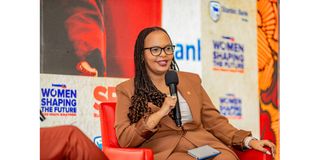
Ms Esther Manase, Head of Corporate and Investment Banking at Stanbic Bank Tanzania speaks at Women Shaping the Future 2026 in Dar es Salaam,

Dar es Salaam. Women who delay investment decisions risk undermining their long-term financial security, a senior banker has warned, citing hesitation and limited financial literacy as key barriers to wealth creation.

Speaking at a recent forum dubbed Women Shaping the Future 2026, held in Dar es Salaam, Stanbic Bank Tanzania’s Head of Corporate and Investment Banking, Ms Esther Manase, said postponing investment often carries hidden costs that many women underestimate.

The event, organised by SRC Agency as part of Women’s Month activities, brought together more than 200 women leaders and professionals. Stanbic Bank Tanzania was the exclusive title partner.

Ms Manase delivered a keynote fireside chat, where she combined personal experience with nearly two decades of advisory work to underscore the urgency of early investment.

She said that while more women in Tanzania and other developing economies are participating in income-generating activities, relatively few are converting earnings into long-term wealth.

“Most people think there is a right moment to invest but waiting is what creates the biggest loss,” she said. Drawing from her own life, Ms Manase recounted how the sudden death of her father, the family’s sole breadwinner, when she was 13, reshaped her understanding of money.

“What I learned early is that money is not only about comfort but also about protection against uncertainty and dependency,” she said.

She noted that many women remain active in financial systems but are often hesitant to take investment decisions due to fears of risk, misconceptions about the need for large capital, and the belief that there is always more time to start.

According to her, such delays have measurable consequences, particularly due to the impact of compound interest, where small, consistent investments grow significantly over time.

“A delayed start means you must contribute far more later to achieve the same results,” she said, citing the example of a client who began investing in her mid-40s and eventually built substantial wealth after being encouraged to start without delay. Ms Manase also challenged negative perceptions around borrowing, arguing that when used strategically, debt can serve as a tool for wealth creation rather than a liability. “Fear without knowledge leads to inaction, and inaction has its own cost,” she said.

She emphasised that wealth accumulation depends less on income levels and more on financial behaviour, noting that many women already demonstrate strong saving habits through informal mechanisms such as rotating savings groups.

“The gap is not capability—it is intentionality,” she said, urging women to treat investment as a routine practice rather than a one-off milestone. She recommended starting with simple financial instruments such as fixed deposits, money market funds and government securities, while gradually building investment knowledge.

Ultimately, she said, the difference between earning and building wealth often comes down to a single decision—to start investing.

“Time, once lost, cannot be reinvested,” she said.