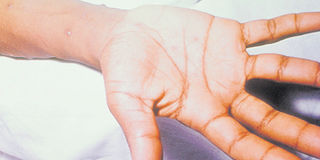
Chicken pox infection is one of the most common childhood infections. It can reoccur in cases where someone has low immunity. PHOTO|FILE
What you need to know:
As I tried to examine him, I realized that the rashes were located more and easily seen around the neck, the chest and parts of his thighs.
They were fluid-filled blisters since the boy was scratching himself. I could see that they were very itchy indeed, and he complained when I enquired.
A case of an eleven year old boy greatly captured my attention recently. He had come to the hospital accompanied with his mother, major complaint—a sudden and acute onset of small rashes scattered all over his body.
As I tried to examine him, I realized that the rashes were located more and easily seen around the neck, the chest and parts of his thighs.
They were fluid-filled blisters since the boy was scratching himself. I could see that they were very itchy indeed, and he complained when I enquired.
Some of the rashes had already turned into a dry, rough crust. In medicine we say they had turned scab.
When I further inquired on the history of his condition, I came to realize that in the previous three days, the boy had lost appetite and he had a sense of generalized body weakness and fever. Guess what? There were other children who had similar symptoms and signs at his school.
“This is a typical case of chicken pox,’’ I said to myself as I penned down the history and filled various forms for medical tests. The child’s mother heard me as I muttered to myself. Then, she also threw in her thoughts, saying, “I also thought so.”
While carefully scrutinizing her son’s arms, my eyes automatically gazed at the boy’s arms too. His left arm had lost its typical smoothness and was now replaced by uncharacteristically rough and evidently multiple reddish-like fluid-filled spots.
The mother sighed for a second, and then looked at me again. She appeared confused. She asked, “Doctor, is it not that when someone gets infected with chicken pox, they become immune to it for life?”
“It is usually so,” I replied, as I handed over some insurance forms that I had been signing. I took some more time, listening to her patiently.
“But… but! Doctor, this is the second time my son has contracted chicken pox. How is that possible?” she queried, her eyebrows raised as she gazed at me. As a doctor, I had to make her understand something about chicken pox.
Chicken pox infection is one of the most common childhood infections. Also known as “Matete-Kuwanga” in Kiswahili, it accounts for about 140 million infections yearly in developing countries.
The pattern and presentation of the infection is usually discernable among people, making it one of the very easily diagnosed medical conditions.
Chicken pox is caused by a virus called Varicella Zoster Virus (VZV). It is usually not life-threatening, although it is a highly infectious disease that is commonly transmitted through sneezing, coughing or watery fluid within the blisters that one might put on; and through contact with clothing, bed linens or oozing blisters of an infected person.
Most people have reported to have contracted the disease during their school days; notably primary school or kindergarten.
And, when the boy’s mother was narrating to me about the son’s illness, the same thing popped up. She said, “My son had not been in school for four days. He was sick. He is now in standard one.”
The rashes had erupted all over his body. And if the mother wouldn’t apply some lotion, the boy would be crying uncontrollably.
Chicken pox typically occurs as a sudden eruption of itchy blisters all over the body—usually 200 up to 500 blisters on the face, neck, chest, stomach and back.
Some may also be found on the hands and legs too. Fever, general body weakness and loss of appetite are commonly the accompanying symptoms.
Following infection with chicken pox one usually develops immunity against chicken pox re-infection in the future exposure. And, as you can recall, this was the concerned mother’s question in our conversation.
Medically, I will tell you that reccurrence of chicken pox infection do occur. These challenges the generally known facts. Some studies have shown that it can happen in people who are healthy, even those who do not have immunodeficiency syndrome.
About 4.5 to 13 per cent of the children who had prior established diagnosis of chicken pox were observed to have second reinfections in a study titled: “Second Varicella Infections: Are They More Common than Previously Thought?” conducted by Susan Hall and her team some years back.
Reasons for the reinfection are not so clear yet but these findings were found more among children who had very mild form of chicken pox infection.
Doctors usually relieve the itching by prescribing the lotion called calamine and medication, anti-itching tabs, like cetrizine.
Antibiotics can be given to prevent bacterial infection around the infected skin. Other drugs like anti-viral may also be given based on doctor’s assessment.
In developed countries, a chicken-pox vaccination regimen has markedly reduced incidences of the disease and consequently averted the complications of the disease. Such policies are yet to be enforced in developing countries probably due to lack of funds and prioritization, making mass chicken pox immunization programs a dream.
It is usually wise to isolate people with chicken pox so as to prevent infection among those who had never contracted the infection particularly young children.
Furthermore, though not so common, chicken pox can lead to complications including death, especially when contracted in adulthood, thus it is prudent to seek for medical opinions whenever one sees changes on his/her skin.
Dr Ludovick Lopa is medical doctor based in Dar es Salaam. [email protected]