INSIGHT: Placement: Why appoint DPP as High Court Judge?
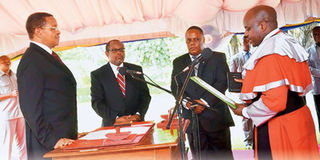
President Jakaya Kikwete swears in Dr Eliezer Feleshi as Director of Public Prosecutions in Dar es Salaam on August 15 this year. PHOTO | FILE
What you need to know:
Director of Public Prosecutions is an official in charge of criminal prosecutions in the country
Dar es Salaam. On August 15, 2014, President Jakaya Kikwete swore-in 20 newly appointed High Court judges. The number included Dr Eliezer Feleshi, who before this new appointment, was the Director of Public Prosecutions (DPP), a very powerful office in which he served for almost seven years since his appointment in 2007.
On the swearing-in day, The Citizen came up with a story with a provocative headline: “Feleshi loses powerful post, becomes High Court Judge”. No doubt that was a very eye-catching heading to who-so-ever came across that paper on that particular day. The headline also drew my attention and it was from there when I curiously developed interest in writing this article as a way of reviving a persistent debate on why the DPP office is such a powerful government department, when it comes to the administration of criminal justice in the country.
It is true that the DPP is legally accorded superior authority in the dispensation of criminal justice. May be what has been perplexing the general public in particular legal professionals is why such powers are concentrated in one office, which cannot easily be questioned by any person or other authorities, including courts of law!
However, my concern in this article is not to question the DPP powers, rather it is try to contrast the DPP’s office to that of the High Court judge. I am developing this article by searching for answers of small questions like, why appoint the DPP in the office of the High Court? Which office is superior to the other? Are these two offices not on the same level – horizontally established?
Currently, both offices are constitutionally established, although the DPP office was made a constitutional office in recent years compared to the High Court, which is inherently constitutionally established. Our current Union Constitution (1977) establishes the DPP office in Article 59B, which was brought in vide the latest constitutional amendment of 2005.
That amendment also constitutionally created the Deputy Attorney General’s office, as stipulated in Article 59A. These two recent constitutional amendments have directly elevated a relationship with the Attorney General’s office so we can explicitly say the holders of these two offices are deputies under the Attorney General although for the DPP there is a reasonable distance in between.
Now let me logically bring out my point. Before the DPP became a constitutional post, the same drew its most unquestioned powers from the Criminal Procedure Act, 1985 [Cap 20 RE 2002] mainly from Part IV of the statute commonly abbreviated as the CPA.
The most serious is section 91 in the CPA, which inherently makes the DPP the most powerful creature in the control of criminal proceedings by allowing him to enter what is called nolle prosequi, an act that cannot be questioned by any authority, including courts of law. The words ‘nolle prosequi’ legally in criminal actions mean an unconditional withdrawal of criminal proceedings against an accused and marks a finality on the proceeding.
While in the old law, the CPA did not elevate the DPP post to the same level as that of the High Court judge, a newly enacted piece of legislation, known as the National Prosecutions Service Act, 2008, has elevated the DPP post to that of the High Court judge in terms of tenure and conditions of service. Section 19(1) reads: “The Director of Public Prosecutions shall have terms and conditions of service as those of a High Court Judge”.
Even qualifications for the DPP post are the same as those of the High Court Judge. The new law mentioned above says in section 19(2): “A person shall not be qualified to be appointed the Director of Public Prosecutions unless that person is qualified to be appointed judge of the High Court”.
Furthermore, the conditions of removing the DPP from office as are in section 20 are almost the same as those of the High Court judge. Literally, what the law says here is that the status of DPP is the same as that of the High Court judge. If that is the case, then Dr Feleshi has been serving the nation as DPP equally as a High Court judge for seven years now since his appointment in 2007. Now is the new appointment for Dr Feleshi or who ever would be holding the office of DPP a promotion or demotion? In my opinion, I see it as a demotion. While the law equates the DPP with the High Court judge, the appointing authority lowers him below until he is promoted through the appointment to the level of a High Court judge. I think this is not fair and this creates a legal controversy.
While we have many High Court judges at a time, but we have only one person sitting in the DPP’s office and by implication, this person deserves much honour for he is not only handling a big and sensitive job, but also a tedious and more risky one than that of the High Court judge. The DPP is the only person, who controls criminal justice over all Tanzania Mainland, hence it doesn’t make much sense to make him practically inferior to the High Court judge.
The DPP is the one, who decides which case to take to court and which not to take to court. He is the one, who can decide anytime to enter nolle prosequi in any case. All government departments and agencies rely on the DPP’s decision in all criminal matters. The DPP is not directly responsible for someone, when it comes to decision making pertaining to his job. He is simply guided by three principles – i.e. the need to do justice, the need to prevent abuse of a legal process and public interest. Thus, the DPP must be a person of high integrity even more than the judge because most of his decisions cannot be questioned or even challenged through any means.
The entire country relies on the DPP and his staff scattered all over the country to coordinate a criminal justice system. While I am wondering why the appointing authority of the High Court judge considers the DPP as an inferior post to that of the High Court judge, the law establishing the DPP office puts it clearly that retirement benefits of the DPP are similar to that of the High Court judge. Section 20 of The National Prosecutions Service Act, 2008 says: “The Director of Public Prosecutions shall retire from office upon attaining the age of compulsory retirement with retirement benefits, which are similar to those of a Judge of the High Court”.
Literally, after a person is appointed into the DPP office it should be assumed he will serve until retirement and become eligible for the same benefits the High Court judge enjoys. If I am to recommend a new status of the DPP, I would say that this office should be made more superior to that of a Judge of the High Court, and the whole DPP institution be improved by paying all the staff a better pay so that they can execute their duties with high integrity.
A powerful office like the DPP’s must be protected from corruption by improving the working environment and emoluments and not used as a stepping stone to a High Court judge’s position. We should not forget the words of Lord Acton that: “power corrupts and absolute powers corrupts absolutely; thus man must be protected from himself”.
The author is a lawyer/journalist based in D’Salaam. He can be reached at [email protected], 0756 440 175.