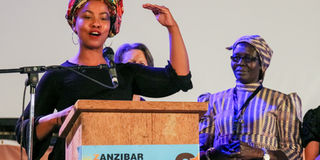
Kemiyondo Coutinho has been writing and acting for the African woman since she was 16. She toured her one-woman show that focused on gender inequity in Swaziland and proceeded to tour a second one-woman show that focused on HIV in Uganda. She is the founder of Kemistry Klass, a content company geared at producing content for film and TV that changes the narrative of stories about The Continent.
Kemiyondo Coutinho has been writing and acting for the African woman since she was 16. She toured her one-woman show that focused on gender inequity in Swaziland and proceeded to tour a second one-woman show that focused on HIV in Uganda. She is the founder of Kemistry Klass, a content company geared at producing content for film and TV that changes the narrative of stories about The Continent. Kemiyondo was featured on CNN for her work in the arts in the segment African Voices.
Frustrated with the lack of African female directors in the industry she decided to take on the role to inspire other potential African female filmmakers to do the same. Kyenvu marked her debut as a Film Director. Last week while at ZIFF she spoke to Seif Kabelele and below are excerpts of the interview.
Congratulations on winning SIGNIS – East African talent award at this year’s Zanzibar International Film Festival. Why did you make your film?
I made Kyenvu because I was tired of seeing our issues discussed through the western lens. Yes we have issues, yes we have problems but the story is way more complex than that. I knew I could either complain or do something. I decided to write the script. Furthermore I wanted to show that Ugandan filmmakers could make world class industry films and so I set out to have a 100 per cent Ugandan cast and crew with a full Ugandan soundtrack to show that.
Was this your first time to be at Zanzibar International Film Festival? What type of feedback have you received so far?
It was! I always wanted to come to this amazing festival but time was never on my side. When I made Kyenvu, I had put ZIFF as the first festival on my “dream list” and so to be accepted and screen and finally win an award that was so magical. It was interesting to screen at ZIFF because it was our African premiere so a lot of things hit differently than in the US for example. The humor landed faster which also meant that the tragedy would hit harder.
What is Kyenvu about, how did you come up with this?
The Anti-Pornography Act was set in Uganda in 2014. Parliament passed it into law, which blamed pornography for the sexual crimes committed against women and children. The Law, at its introductory stage had a clause prohibiting women from wearing the mini skirt, hence the media label “Mini skirt bill.” However, when the final bill was passed, it held no clause on the banning of the mini skirt. The media, who had picked the nickname, failed to inform the public that that particular clause was struck out. This was the driving force behind KYENVU
Imagine I’m a member of the audience. Why should I watch this film?
I don’t set out to have a goal for a viewer to get something. That may seem unorthodox but it is always how I have created and found it to be the most truthful version of art I can bring. For instance, I was inspired and compelled to tell this story because of sexual harassment and violence against women; had I decided “oh I want audiences to know that this is wrong and they must change this” then I am willing to bet that all the other issues you have mentioned that you saw in the film would have either been watered down and or not existed at all. See when you simply reflect what you are seeing in your world, you reflect it ALL. Our days are not one thing. Our lives are not one thing. Our country is not one thing. I am not just a woman who experiences violence from men, I also don’t understand Luganda, I am light skinned. I am all those things. I must present all those things because a mirror reflection would too.
What have been the biggest challenges you’ve faced making Kyenvu?
Funds! We made Kyenvu on a $3300 budget and mostly because I had a lot of production companies back the project with in-kind value. That said, because it was my first film I was unaware of the costs of post-production. Entering it into festivals, publicity and such things . That said, I always say do the best with what you have
Has the feedback surprised or challenged your point of view?
Depends on who is giving it. I think everyone is entitled to their own opinion about the film, my only request is that if someone interviews me they don’t silence my contrary opinion. Other than that I think art should trigger strong responses in people and create debate and discussion. IF it is just in line with how I think then I delivered a lecture and not a piece of art.
Why did you decide to become a filmmaker?
Because there was not enough African Women behind the cameras. There is power in us being in front of the cameras but there is a lot a different kind of power with us being behind it. We know how to see us best. Through our lens we can do that.
Do you have any advice you would offer any up and coming filmmakers?
Just do! Create create create. The more you create the better you get. Hire people smarter than you. It keeps you on your toes and force you to stay humble.
And finally, what do you hope people will take away from this film?
I hope people see themselves in the main characters. I hope people hate the ending of the film and find out ways in their own lives and circles to change that ending.