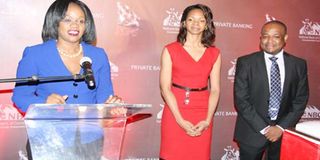
NBC Bank managing director Mizinga Melu (left ) addresses participants at a ceremony to re-launch the bank’s Women Network Forum in Dar es Salaam this week. Looking on is Network Forum chairperson Cynthia Ponera and NBC head of Liabilities and Affluent Customers Andrew Massawe. PHOTO | ‘BUSINESSWEEK’ CORRESPONDENT
What you need to know:
It is simply God’s grace! I did not even see this coming. I first won Southern Africa Business Woman of the Year and to me that was enough, but God blessed me with an Africa award. That is big for me and I am so humbled and I really thank God.
Interview. National Bank of Commerce managing director Mizinga Melu was named the Business Woman of the Year 2013 at the All Africa Business Leaders Awards in South Africa recently. This interview explores more about her.
I was educated at Roma Girls Secondary School and later went to the UK to do my Associateship in banking and Masters in Business Administration.
What did you do after you completed school?
I was first a nurse before I became a banker. So I can actually inject medicines and look after a patient.
I joined Standard Chartered Bank soon after completing my banking studies and I was there for 20 years.
I recently moved to the Barclays Group and I am running one of the banks under the Barclays Africa Regional Management called the National Bank of Commerce. It is the third biggest bank in Tanzania. It is also the oldest, biggest bank.
On Friday November 8, you won the African Business Woman of the year during a gala dinner organised by ABN360 and CNBC Africa in Durban, South Africa. What does that mean to you?
It is simply God’s grace! I did not even see this coming. I first won Southern Africa Business Woman of the Year and to me that was enough, but God blessed me with an Africa award. That is big for me and I am so humbled and I really thank God.
This means a lot for me and my family. I have dedicated the award to the women on the continent especially operators of SMEs who have a great vision but have no financial support or affordable finance. It’s also for the women who look after our children when we are at work.
They play a big role in helping us manage our careers. It’s for the girl child who thinks they cannot achieve. In a nutshell, it means a lot to me and the girl child.
I have received several other awards and they are all important and exciting in their own way. I think the Africa Business Leader of the Year is big as it cuts across the borders.
The judges actually said it was for the exemplary woman who has worked in different organisations and countries and have excelled amongst all the male-domineering sectors. This, to me, summed it all up.
As a youth, did you have a role model?
I always looked up to my mum and sisters. They were my only role models and women figures in my life. My mum worked so hard to bring us up despite not having a formal education. I always vowed to do better so that I could make her proud. Sadly, she passed on when I was only 13.
From then on, my sisters were my role models. One of my sisters is a lawyer in Kitwe and she has done so well.
Can you single out people who have shaped you as a person or your career?
My dad and mum will always be my angels. I love Michelle Obama. I guess that’s why I always carry my hair like her. I really do emulate her.
I look up to our chief executive for Barclays Africa, Maria Ramos. She has done so well and is held in high esteem as a business leader not only in Africa but globally.
She has transformed companies and is now transforming Barclays Africa. Working with people like her makes me look forward to work every single day.
You spent over 20 years at Standard Chartered Bank. Could you describe some of the major challenges you faced, particularly after you were appointed managing director? And what were some of the successes and moments you are most proud of?
My journey as managing director of Standard Chartered Zambia was extremely fruitful. Even challenges had a way of turning into opportunities. I was appointed MD during the recession when copper prices had tumbled.
Leading through this crisis made me grow as a leader as it was not a business as usual kind of leadership.
It was one where I knew I had to be extra ordinary. People expected more, but as a company, things had to be done differently and we attained a market position of being the most profitable bank in the country. I was most proud to be voted CEO of the year during my time.
Any defining moments that could have helped you decide to take the direction that your life has taken over the years? From Standard Chartered, you are now as CEO of NBC Tanzania. How do you make it?
In life one needs to know when to bow out. It is even more difficult to bow out when you are at the top. After leading the most profitable bank, being part of a great team and being recognised as CEO of the year, I thought the time had come for me to bow out and take on a new challenge.
So I joined the Barclays Group. National Bank of Commerce is the oldest bank in Tanzania owned by Barclays Africa Group Limited (formerly Absa Group), the IFC and the host government of Tanzania. It is the oldest bank in Tanzania and has a lot of pride to East Africa. Tanzania itself is a well-diversified economy with a GDP of $30 billion.
Barclays is a big brand in Africa and has a rich history on the continent, dating back more than a century in some of our markets like Egypt where we first opened nearly 150 years ago! With the combination of Absa and eight Barclays operations earlier this year,
Barclays Africa Group Limited is now one of the leading banking groups in Africa. The bank is transforming itself very well and is well positioned to be the bank to go to on the continent.
It also prides itself in a visionary leadership comprising, among others, Maria Ramos and Kennedy Bungane who look after businesses outside South Africa and Craig Bond who looks after our retail and business banking across Africa. I am humbled to be part of the journey.
Banking has recently come under a lot of scrutiny largely due to what has been termed as unethical practices. With all the unending criticism against the industry, do you still walk with your head high? Why?
There can be no denying of the fact that the banking industry has come under the spotlight regarding some of its practices in the recent past. Most of the issues that have cast aspersions on the industry have been well documented in the press.
I know for a fact that the industry has undergone a lot of reflection as a result. Specifically for Barclays which I am part of, I know that the bank has taken responsibility for putting things right.
This commitment is demonstrated in the bank’s common purpose and values that are now serving as a foundation for everything else that we want to achieve as a bank. With all the measures being undertaken to make things right, I am very proud to be a banker, and most importantly to be a member of the Barclays family.
You also serve as chairperson of the Zambia Daily Mail. What are your views on the media industry in Zambia, and what do you think needs to be done to enhance the standards of journalism?
The media in Zambia has come a long way. It has progressed much along the lines of the country’s political evolution.
It faces its own unique challenges while at the same time the public has a lot of expectations in terms of what would be considered as acceptable or professional standards of the industry. Meeting such expectations is going to be a journey and not just a one off event.