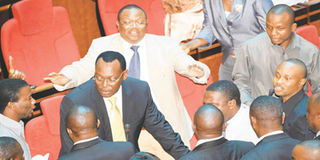
The Leader of Official Opposition in Parliament, Mr Freeman Mbowe, leads fellow opposition Members of Parliament in one of numerous stand-in protests the back bench staged in the debate chamber. PHOTO | FILE
What you need to know:
Apparrently reacting to the Ukawa walkout, the President was quoted as remarking that “challenges facing the country required unity among all MPs to overcome them to the people’s expectations”.
Dar es Salaam. President John Magufuli inaugurated the 11th Parliament with a speech in which he spelt out priorities for his administration, yet the House’s inaugural ceremony was marred by dissention as opposition MPs loudly protested the presence of the Zanzibar President, Dr Ali Mohammed Shein.
Apparrently reacting to the Ukawa walkout, the President was quoted as remarking that “challenges facing the country required unity among all MPs to overcome them to the people’s expectations”.
“Parliament is an important vehicle in the development of the country. Challenges ahead of us are many and people have a lot of expectations.
“People want to see the country develop to a new level. After five years, all of us will face tests. I felt it was important to talk about this because I was once an MP for 20 years. People want to get water and schools in their respective areas. If we walk out of Parliament, we will not be assisting those who sent us here,” President Magufuli said.
The Opposition said it would boycott the Budget session in the National Assembly, accusing the government of hijacking their parliamentary privileges.
Leader of the Opposition camp, Mr Freeman Mbowe, said last week that some vexing legal issues had to be addressed first before they consider participating in the marathon Budget session.
In an apparent shift from its walkout approach, the Opposition said it would apply a sit-in form of protest in Parliament, setting the stage for a chaotic session if the government decided to go ahead with proceedings.
In his reaction, Parliament Chairman Andrew Chenge said he would not be drawn into the Opposition’s boycott because it was not part of the House’s agenda.
Last week, Prime Minister Kassim Majaliwa, who is the leader of government’s business in the National Assembly, tabled the 2016/17 Budget estimates for his office and the Leader of the Official Opposition, Mr Mbowe, was supposed to table alternative estimates for the same office.
However, he took a swipe at the government over “gross violation of laws of the land” and announced that the Opposition would not participate in Budget debates.
He said the first major issue they wanted addressed was formation of ministries. The opposition leader noted that unlike in the US or Kenya where the number of ministries was provided for in their constitutions, the President in Tanzania enjoyed discretionary powers under the Ministers—Discharge of Ministerial Functions—Act, 1980, to form his cabinet.
The Opposition claimed that Dr Magufuli had changed the face of Cabinet, saying Regional Administration and Local Government was under the Prime Minister’s Office, but it has now been moved to the President’s Office.
They questioned the point for the alternative budget estimates of the Prime Minister’s Office with this legal flaw in place. The Opposition also questioned the reallocation of budget funds by the government without seeking Parliament’s approval and the ban imposed on Bunge live coverage.
Whether or not all these concerns have been addressed and sirted out after the boycott, or whether the ruling party will continue with Bunge sessions in the absence of the Opposition, it remains to be seen. But the answers to these vexing questions would be found in a people-centred constitution, which is yet to be promulgated in Tanzania.
Indeed, the road to a democratic culture is still fragile and tortuous in Tanzania, as many caveats exist. Twenty four years after the end of single party rule, the road is riddled with a web of legacy, contextual, constitutional and operating challenges. In short, there remain serious obstacles on the way to liberal politics.
Twenty four years after the dawn of liberal democracy, Tanzania is still suffering from the hangover of a single party rule. Many indicators show Tanzania is still largely a one party state within a multiparty political system.
Politics is still dominated by the one party generation most of them in their late sixties and above. Political leadership in both the ruling and opposition political parties is still in grip of the old guards with the ‘dot.com generation’ waiting in the periphery.
For example, Dr Raphael Chegeni (Busega - CCM) has recently defied the Opposition saying they were enjoying Bunge live coverage for a mere showoff, and that the live broadcast ban would have outspoken MPs muzzled. He added that the Opposition should now have all reasons to keep silent in Bunge.
Whatever the reasons are, in the absence of its Opposition, Parliament can neither deliver the fruits of democracy nor consolidate the system. No democratic politics is possible without transparency and accountability.
In order to achieve democratic politics, there must be a limited government which calls for existence of various formal and informal mechanisms to restraint the arbitrary powers of the government.
Even MPs from the ruling party, who are pro-electorate, should silently praise the Opposition camp for unearthing mega corruption scandals like the Escrow and Richmond saga whose solutions are now placing the country in good hands.
According to John Locke “in a system like ours (parliamentary system), in which state power is somewhat defused, there can be no limited government unless and until the Executive remains subordinate to the legislature so that the law making organ can detect and prevent arbitrary behaviour or illegal and unconstitutional conduct of the government and hold executives to account.”
On a lighter note, the legislature bears major responsibilities of oversight activities of the Executive. The constitutional provisions, rules of procedure, role of individual MPs and most importantly, the role of Opposition is crucial in ensuring Parliament’s oversight and other responsibilities such as offering a credible alternative to the majority in power, defending civil and political rights of the citizens and demonstrating that minority has the constitutional rights to disagree and citizens resolve conflicts in a peaceful manner in a parliamentary system.
As such, a recognised, legal and constructive Opposition has been invented in a parliamentary system to uphold basic principles of a democratic system. The bottom line is that there can be no democracy without a critical and constructive role of Oppostion.
Some people argue that since President Magufuli showed an unwavering stance against graft, the Opposition had lost its value, as their concerns were now met unwittingly. I, to a great extent, shudder to disagree with them that we still need the Opposition to check and balance the role of the government.
In a country where only loyalists are granted political posts, lacking the Opposition would put the entire country into a ‘yes’ group. One of the most important jobs of the Opposition is to constantly question the government. Any government has to remain answerable to the public at all times, and a good Opposition can put the spotlight on serious issues and have them resolved quickly.
Active opposition
An active Opposition will also vigirously debate legislations in the House and during the select committee process to ensure the laws receives careful consideration. Being in Opposition is not just about opposing the government only. There are occasions when the Opposition agrees with the government. If the solution proposed by the government has wide support and is soundly based, it is only natural for the Opposition to agree.
For example, we have seen all MPs showing their stand against albino killings. The call for trimming school fees among private schools has enjoyed massive support from both the ruling party and the Opposition. This is how we go.
Opposition parties do not have the same resources as the Executive, they have to work twice as hard to get the same results.
The government has access to departments and advisers to form their policies, but the Opposition has to go down different avenues to source the same information, that’s why it has never been possible for the Opposition to inject funds in some proposed government projects. They have normally been chided to enjoy demonstrations on tarmac roads constructed by the incumbent government.
It is also really important that the leader keeps a close eye and ear on what the public is saying, needs and wants because problems are often caused by the government’s ffailure to deliver.
Issues caused by the government’s negligence become the Opposition’s main platforms, includin on tax relief, law and order. The ban on Bunge live coverage, for example, is considered as one of the means for the Opposition to enjoy people’s accolades.
To round off the discussion, it is worth noting that the Opposition is responsible for giving continuous attention to development of policies in Parliament and before the people.
The major challenge facing the Opposition in Tanzania’s politics, however, is the need for creating a credible image in its role. The camp must be responsible, respected, united and create relevant policies to the day-to-day lives of the people rather than merely walk out of Parliament. Bunge provides a good platform for an effective Opposition and it must be used as such.