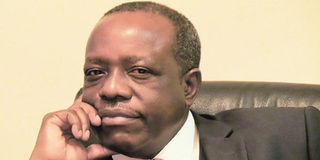
ABOVE. Analysts say the Energy and Minerals portfolio is too big. Left, Kigoma North MP and PAC chairperson Zitto Kabwe in Parliament. The PAC report unveiled gross irregularities in the ministry. PHOTO I FILE
What you need to know:
In May 2012 President Kikwete was again forced to reshuffle his Cabinet after fierce debates that emerged in Parliament over the performance of the various ministers including the ministers for Energy and Minerals and Finance.
Dar es Salaam. As the nation waits for an imminent Cabinet reshuffle and possible dismissal of the Attorney General and Permanent Secretary of the ministry of Energy and Minerals, the big question that lingers in the minds of many Tanzanians is whether this will be the last reshuffle in President Jakaya Kikwete’s administration.
It should be noted that in the last nine years of Kikwete’s presidency, every major Cabinet reshuffle has always been forced or taken after Parliamentary action.
Only minor reshuffles have been executed by the President without any parliamentary pressure. Interestingly, however, most of the reshuffles have involved the Energy and Minerals ministry. In the four major cabinet reshuffles in the last nine years three involved the replacement of the Energy and Minerals ministers after pressure from Parliament.
President Kikwete carried out his first Cabinet reshuffle in October 2006 which resulted in ten ministers swapping portfolios. The ministry of Energy and Minerals had come under fire in Parliament and from the public for failing to handle the crisis well. This saw the then minister for Energy and Minerals Dr Ibrahim Msabaha being replaced by Mr Nazir Karamagi.
In February 2008, the then Prime Minister, Mr Edward Lowassa and two cabinet ministers resigned in the wake of the Richmond scandal. A parliamentary special committee chaired by Dr Harrisson Mwakyembe had carried out an investigation that implicated Mr Lowassa, Dr Msabaha and Mr Karamagi. This prompted an overhaul of the cabinet in accordance with the Constitution.
In May 2012 President Kikwete was again forced to reshuffle his Cabinet after fierce debates that emerged in Parliament over the performance of the various ministers including the ministers for Energy and Minerals and Finance.
Those who were dropped in the major April 2012 reshuffle included Mr William Ngeleja (Energy and Minerals), Mr Mustafa Mkulo (Finance), Mr Omar Nundu (Transport), Mr Ezekiel Maige (Tourism and Natural Resources) and Dr Hadji Mponda (Health). Prof Sospeter Muhongo was appointed as the new minister for Energy and Minerals.
Most of these ministers were sacked or dropped in line with the principle of political responsibility and accountability.
When a fresh Cabinet was named in May 2012, many expected that since the non-performers as well as graft-linked ministers and their deputies were sacked, the new team would be “permanent”. But just 19 months down the line in January 2014, there was another reshuffle. This time the Energy and Minerals minister Prof Muhongo remained.
In the looming reshuffle expectations are that the current minister for Energy and Minerals Prof Muhongo, who has been seriously implicated in the Tegeta escrow account scandal would be replaced. He would be the fourth minister for Energy and Minerals to be replaced.
The ministry of Energy and Minerals, whose importance to economic growth and development of the country are obvious has been the subject of serious crisis and scandals for the last nine years, as indicated by the numerous reshuffling of its ministers.
Experts have analysed the situation in the ministry and many have concluded that the ministry is too big for one minister to handle. Tanzania has abundant extractive resources. It is Africa’s fourth largest gold producer attracting the world’s biggest gold miners. It has diamond and rare gemstones such as Tanzanite. Natural gas reserves have exceeded 40 trillion cubic feet, attracting global oil majors.
In fact even as there are genuine cases of lack of integrity on the part of some ministers in the Energy and Minerals portfolio, others are simply overwhelmed by the sheer size of the ministry.
Analysts say weak institutions and inadequate internal watchdog mechanisms make it easier for politicians and senior government officials to steal public funds and enter into lopsided contracts.
In August 2011 former Attorney General Mark Bomani penned an open letter to President Kikwete calling for the dividing the ministry into two.
Judge (rtd) Bomani who headed a presidential committee formed in 2007 to review the Minerals sector noted that a number of countries including Tanzania’s neighbours have separate Energy and Mines ministries.
Kenya has a separate ministry of Energy. Zambia, South Africa, Botswana, have a separate Ministry of Mines and Mineral Development.
“The Ministry of Energy and Minerals is too big to function as a single ministry, bearing in mind that the two sectors energy and minerals are each extremely complex and involving. There is need to split the ministry into two ministries,” Judge Bomani noted.
A socioeconomic commentator Karl Lyimo has been advocating the split of the two ministries since 2008 on the wake of the Richmond scandal. Mr Lyimo wrote in one of his weekly columns in local newspapers in March 17, 2011;“… I’m surprised the relevant authorities haven’t seen the real need to split the ministry into two distinct entities. I’m aware doing so’ll increase costs… But, real efficacy does have its costs, too!
“As it happens, Energy and Mining continue to hog the news and other public forums of discussion – mostly negative – not only in Tanzania, but also beyond the country’s borders. The two, therefore, pose an unduly heavy burden upon a single minister and a single permanent secretary. And, as Mwalimu would’ve said (or Harvard Professor Derek Bok before him): ‘If you consider Efficacy expensive, try Inefficiency’!”
Again on August 17, 2011 Mr Lyimo noted; “Why President Kikwete hasn’t split the ministry baffles me. Nearly three years after I suggested this, matters in the two wings of the ministry – Energy and Mining – have grown from bad to worse... and are heading for worst scenario cases in the not too distant future. Both sectors are cross-cutting and, putting them like so many eggs in one basket is too risky to risk!”
Again on January 2, 2010 Mr Lyimo wrote; “Inexplicably the Mining and Energy sectors are joined like unlike twins at the same ministerial portfolio… Not only does that make the ministry cumbersome and ungainly…It also means that mistakes made by the ministry in Mining are replicated in high fidelity in the Energy sector and vice versa.”
Some analysts concur with Judge Bomani and Mr Lyimo. Mr Richard Kasesela said it would help to split the ministry into two, arguing that it will make them more efficient. He also suggests that the ministry of Information, Youth and Sports should be redirected to the Prime Minister’s Office, Agriculture should be merged with livestock development.
Others disagree. Dr Benson Bana from University of Dar es Salaam said he doesn’t believe that the scandals and problems that are afflicting the energy and mineral sector emanate from the structure of the ministry.
“Transparency and openness in decision making processes and actions are essential pre-requisites for the ministry to be able to execute properly its mandate. Some of these prerequisites may not be adequately available in the ministry.
We need to carry out our diagnosis properly before prescribing the appropriate medicine,” he sad
But Mr Rakesh Rajan from Twaweza said there may be good policy and management basis to split the ministry. But that has little to do with preventing scandals and corruption. Leadership with integrity, transparency and accountability is what will end corruption.
But Mr Faraja Kristomus from University of Dar es Salaam said he is not supporting the idea, on argument that would not be the lasting solution for the problems facing the ministry of energy and minerals is to split it into two different ministries.
He insisted that people should understand that this ministry is not such a big ministry.
He said the ministry of energy and minerals has few sectors to deal with if compared to other big ministries like ministry of Education and Vocational Training; ministry of Livestock and Fisheries, ministry of Industry and Trade and ministry of Regional Administration and Local Governments under the office of Prime Minister.
There is also another ministry of Natural Resources and Tourism that faces a lot of scandals and once a minister finishes five years in that ministry without scandals he/she becomes a hero.
“This ministry has many scandals not because it is uncontrollable but because it has many resources that attract grand corruption, fraud and embezzlement of project funds and revenues……Since it is one of the major sources of revenues, many government officials even from other ministries or departments will collude with the officials of the ministry of energy and resources into various scams,” Mr Kristomus said
President Kikwete had got wind of the debate on dividing the Energy and Minerals ministry and appointed two deputy ministers in a reshuffle in May 2012 one dealing with Energy and the other dealing with Minerals. But analysts still said that was not enough.