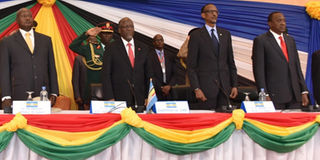
President Magufuli, Paul Kagame, Uhuru Kenyatta and Yoweri Museveni during a heads of state meeting recently. Their governments have been faulted for not doing enough to go beyond rhetoric in prioritising regional integration. PHOTO | FILE
What you need to know:
The ministers and their deputies as well as senior government officials like the permanent/principal secretaries would often troop to the EAC headquarters for different meetings, including those preceding the Heads of State summits.
Arusha. Slightly over a decade ago, the pace of integration in the East African Community (EAC) bloc took a notch higher when the partner states agreed to establish full-fledged ministries dedicated to EAC Affairs in their respective countries.
The ministers and their deputies as well as senior government officials like the permanent/principal secretaries would often troop to the EAC headquarters for different meetings, including those preceding the Heads of State summits.
There is no contention that the EAC ministries have a key role to play in the broader integration process. For instance, the ministers - by virtue of their positions - are ex officio members of the East African Legislative Assembly (Eala).
They are obliged to attend the House sessions and respond to questions from the legislators. These include the budget sessions and regular sittings where new Bills Committee reports are tabled for debate.
EAC ministers also constitute the EAC Council of Ministers, which is the policy organ of the Community mandated to make decisions for the efficient and harmonious functioning and development of the Community.
The Council shall promote, monitor and keen under constant review the implementation of the programmes of the Community and ensure the proper functioning and development of the EAC in accordance with the Treaty that established it.
Until about three years ago, all the five partner states - Tanzania, Uganda, Kenya, Burundi and Rwanda - had full-fledged ministries responsible for EAC Affairs and who were regular visitors to Arusha and regional capitals accompanied by scores of officials for all manner of meetings.
With the exception of Burundi and to some extent Uganda, this is not entirely the case today although the dockets still exist. What used to be EAC ministries in Tanzania, Rwanda and Kenya have been merged with other ministries, making them not as visible enough like in the past.
The change of things has drawn mixed reactions from policy analysts and observers in the region, with some saying the move has pushed what used to be key ministries as far regional integration is concerned away from the limelight.
Reduction of bureaucracy
But others, especially those in governments and their parastatals, attribute the new developments to a raft of cost-cutting measures and, may be, reduction of bureaucracy in the public service.
Yet some observers have gone to an extreme view. They allege the down-grading of the once high profile ministries was a wake-up call that the governments of some EAC states have started to lessen their focus on the regional integration issues.
Kenya became the first EAC member of the bloc to down-size the EAC docket upon the coming into power by President Uhuru Kenyatta in 2013. In fact, Uhuru came with his own system of picking technocrats to head ministries.
He merged the then EAC Cooperation ministry with the Tourism and Commerce docket. This was criticised by stakeholders in the hospitality industry, in particular, who felt it could lose focus despite its role in the Kenyan economy.
Ms Phyllis Kandie was the cabinet secretary responsible Tourism, Commerce and EAC Affairs. She still holds the docket to date but the powerful tourism sector has been removed and she now heads the Labour and EAC Affairs ministry.
As had been expected, Tanzania followed suit with the coming in of the cost-conscious President John Magufuli in late 2015. The ministry for East African Cooperation was soon to be merged with that of Foreign Affairs and International Cooperation.
That ended up with the ministry of Foreign Affairs and East African Community. In practice, however, it is still referred with the combination of titles which refer to the former ministry, with the EAC docket taking the last lap.
Rwanda became another country to merge what used to be the EAC ministry with other dockets with the regional integration docket taking a lessened role; if the naming arrangement of the ministries is anything to go by.
At an Eala plenary in Kampala recently, Mr Francois Kanimba was sworn in as the country’s minister for Trade, Industry and EAC. By holding the latter docket, the minister automatically becomes an ex-officio of the regional Assembly.
He replaced Amb Valentine Rugwabiza, the former minister of EAC Affairs for Rwanda, who was recently appointed Rwanda’s Permanent Representative to the United Nations in New York.
Uganda, one of the three founders of the current Community, has had no ministry on EAC Affairs. The docket had been headed by ministers of state all along although for some years it was under the once powerful first deputy prime minister the late Eriya Kategaya.
Burundi now remains the only EAC partner state with a full-fledged ministry responsible for EAC Affairs currently headed by Ms Leontine Nzeyimana while in South Sudan, the docket is under the Foreign Affairs and International Cooperation ministry.
A publisher based in Arusha, who spoke on condition of anonymity, says he does not see anything sinister with the move. “They are cutting down costs after realising that EAC issues can be handled by the foreign ministries”, he said.
He added that the move was enough indication that the costs of running of separate ministries for EAC was high and that the expenditure can be cut down by taking the docket under the Foreign Affairs ministries.
An Eala member from Rwanda Martin Ngonga shares the same view and has disputed the perception that some EAC member states were now not giving any priority to regional integration issues.
“We should not view this as EAC issues losing priority. Some countries, especially Tanzania and Kenya, have been undertaking cost-reduction measures and this has seen the merging of ministries”, he told Political Platform in Kigali recently.
The articulate legislator, who was once the Prosecutor General in Rwanda, said the EAC dockets can still function efficiently under the new ministries, provided the concerned officials were serious with the integration agenda.
But Simon Mapolu, a regional analyst based in Arusha, sees the matter differently, hinting that it was one of the latest setbacks for the regional organisation and integration process in general.
“This is a sign of lack of seriousness. Some countries have pushed EAC matters to the back stage. These are symptoms to the betrayal of the Treaty”, he said, urging member states to go back to the drawing board to ensure the Treaty is adhered to.
The outspoken business consultant also criticised the donor dependency syndrome by the EAC, saying the future was gloomy. He argued for the amendments of some clauses in the Treaty to make it conform to the current developments.