Prevent religious tensions from ripping country apart
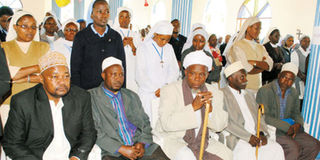
Muslim leaders join their Christian counterparts during the funeral of three Roman Catholic killed in a bomb blast a Olasiti church in Arusha. Leaders and followers of the mainstream religous have been peacefully coexisting. Home Affairs minister Emmanuel Nchimbi says foreign elements were using religions to divide the country. PHOTO | FILE
What you need to know:
Instead of paying attention to poverty eradication and other development issues, Tanzanians have been engrossed in religious conflicts taking the toll on the country’s stability lately.
Dar es Salaam. Mixed reactions have greeted the ban imposed on interreligious debates with some calling for even more austere actions to restore calm.
A cross section of those who talked to the Political Platform said they were worried over rapidly waning harmony among Tanzanians.
Home Affairs minister, Dr Emanuel Nchimbi, directed police officers at all levels to take appropriate measures against any person caught instigating chaos in the name of spreading religion.
He threatened to fire any police officer who will fail to implement the directive in his area of jurisdiction. Dr Nchimbi issued the directive in Dar es Salaam when closing a two-day meeting.
The meeting brought together some 200 religious leaders in the city to deliberate on the fate of the country’s peace and stability last Wednesday.
He admitted that the government has been a bit lenient on people who have been disturbing peace on the pretext of spreading religion.
“We should not be blamed for our stern actions against these elements this time,” cautioned Dr Nchimbi, blaming external forces he did not disclose allegedly for their involvedment in dividing the country along religious lines.
The forces, he said, first thought they could have divided Tanzanians through political parties when the country embarked on multiparty democracy.
They then tried to capitalise on economic hardships facing citizens to that effect, but failed. “They are now using religion,” he stressed.
The Tanzania Constitutional Forum (TCF) chairman, Mr Deus Kibamba, has, however, criticised the government’s directive, saying it is a plot to infringe on people’s freedom.
Mr Kibamba observed that a lot of incitement has been going on not necessarily through religious meetings. He called on the government to adopt a holistic approach in tackling the problem instead.
The TCF chairman ruled out the possibility of stopping people from discussing religious issues, saying: “There is a man who claims to have converted to Islam here in Pemba. He tells of “a Christians’ plot against Muslims” in broad daylight, yet nobody takes action against him,” Mr Kibamba said over the phone from the spice island.
Dar es Salaam Muslim leader Sheikh Alhad Mussa Salum argued, saying the government did not err in the ban.
“We will be deceiving ourselves if we think there is a substitute for peace under the sun,” he told the Political Platform over the phone, adding: “Jokes apart when it comes to peace we’ll lose all our freedoms along with this treasure trove.”
The Christian Council of Tanzania (CCT) chairman Peter Kitula welcomed the government’s decision saying it was long overdue.
“This is a positive gesture, but the government should go beyond rhetoric because the problem, which is deeply rooted, may completely divide the country soon,” he cautioned, urging the government to closely monitor social media.
The Chama Cha Kijamii (CCK) secretary, Mr Renatus Muabhi, concurred with him, saying: “This should be just the beginning of a lasting solution for the evil that is slowly but steadily eating the country.”
The government’s laxity is to blame for allowing religious temper to flare to the extent of threatening the country’s cherished peace. “Such disputes were unheard of during the era of Mwalimu Nyerere,” he recalled.
The government’s directives come less than a month since Christian leaders went to State House to express their concerns over widespread interfaith debates.
They accused the government of failing to condemn religious related chaos in the country.
Efforts to get a response from the head of the Presidential Communication Directorate, Mr Salva Rweyemamu, proved futile lately as his mobile phone could not be reached.
However, the directorate issued a statement on Monday refuting reports which quote the Chadema secretary-general, Dr Willibrod Slaa, as accusing President Jakaya Kikwete of capitalising on religious sentiments during the 2010 General Election campaigns.
“The President had never carried out a campaign in neither a church nor a mosque,” said the statement in part to the astonishment of some critics who query whether the government or CCM was responsible for responding to Dr Slaa’s assertion.
During the State House meeting, bishops raised serious issues they claimed might jeopardise national peace if the government does not handle them accordingly.
They said conflicts among followers of the mainstream religions were simmering for over three decades now without the government publicly condemning them.
It all started in the 1990s with public debates attacking both Christianity and Islam. The push for Tanzania to join the Organization of Islamic Conference (OIC) fuelled the tension.
A group of Muslims met at Diamond Jubilee hall in Dar es Salaam on January 15, 2011, asserting that Christianity was calling the shots in the government leadership.
It insisted that the leadership based on Christian tenets dated back to the first phase government when the Father of the Nation, Mwalimu Julius Nyerere, appointed Christians alone to strategic leadership posts.
Appointees were sworn in in churches by bishops and given money to build schools and hospitals as per Memorandum of Understanding (MoU) secretly entered between churches and the government.
The group cited Weil Bugando Medical Centre based in Mwanza and a tarmac road from Dar es Salaam to southern regions whose construction was financed by a group of business people from Kuwait.
The group, according to the bishops, went on convening similar meetings countrywide from January to October in 2011, spreading its hate speech and inciting Muslims to be “prepared for killing and being killed”.
Why has the government not reacted to assertions and declarations of the group or arrested those behind them since, it remains to be seen.