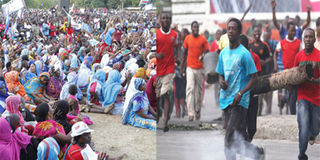
Civic United Front (CUF) members and supporters attend a rally in Zanzibar ,From right is Protesters hold a demonstration in Zanzibar.PHOTO | FILE
What you need to know:
While the ruling CCM candidate for the union presidency Mr Benjamin Mkapa won easily after scoring 61.82 per cent of the votes against his close contestant NCCR Mageuzi’s Mr Augustine Mrema who scored 27.77 per cent of the votes, the situation was different in Zanzibar.
Dar es Salaam. In 1995 Tanzania held its first multi-party General Election since the system was re-introduced in 1992. A total of four politicians contested for the Union presidency while 13 took part in Zanzibar presidential contest.
While the ruling CCM candidate for the union presidency Mr Benjamin Mkapa won easily after scoring 61.82 per cent of the votes against his close contestant NCCR Mageuzi’s Mr Augustine Mrema who scored 27.77 per cent of the votes, the situation was different in Zanzibar.
Since the first multiparty election Zanzibar presidency has been a two horse race between the ruling CCM and their bitter rival Civic United Front (CUF) under its secretary general Maalim Seif Sharif Hamad.
In 1995 CUF reluctantly accepted the presidential election result which gave CCM candidate, Dr Salmin Amour narrow margin over Mr Hamad. The CCM candidate polled 165,271 votes (50.2 per cent) against Mr Hamad who garnered 163,706 votes (49.8 per cent) of the votes.
But the situation in Zanzibar politics took a turn for the worse in the 2000 General Election. The 2000 pre and post-election was marred by chaos which claimed tens of people’s lives, leaving hundreds more seeking refuge in a neighbouring Kenya.
Political tension between CCM and CUF supporters reached a boiling point after announcement of election results in October 2000. Opposition supporters clashed with police in Zanzibar on October 29 2000, after thousands of people failed to vote because ballot papers either arrived late or did not arrive at all in some polling centres.
Police had to use tear gas and live ammunition to disperse hundreds of opposition protestors. Scores of people were reportedly injured in the skirmishes.
Despite the condemnation by local and international observers, who called for fresh elections, CCM candidate Mr Aman Abeid Karume was announced the winner and was sworn in on November 8.
During the sworn in ceremony at Amani stadium president Karume announced an amnesty for all suspects held by police in connection with election related chaos.
Mr Karume also called for reconciliation, stating: “We are ready to cooperate with anybody who is ready to work with us for the good of the nation. We want to banish all forms of discrimination.’’
The amnesty included the release of 18 CUF members who were jailed for over three years on treason charges. However, the spirit of reconciliation by the victor wasn’t received well by CUF as the political situation in the Isles remained tense.
As the situation remained tense for the remainder of 2000 there were several explosions and arson attacks on government institutions, including a December 26 bomb attack on Zanzibar Electoral Commission (ZEC) offices in Pemba.
CUF leadership continued to reject the election results, with then party vice chairman the late Shaaban Khamis Mloo saying the ruling party had broken laws, trampled the constitution and used maximum force from the police and the military to make it win.
But the situation got even worse on January 27, 2001 when CUF staged demonstration to reject the election results as well as calling for a new United Republic Constitution and independent electoral commissions which include members from the opposition parties.
But the peaceful demonstration turned chaotic as police clashed with CUF supporters. At least 37 deaths were reported following the clash. However, government and opposition parties differed over the toll.
The January 27 demonstrations took place in Pemba and on the Mainland. During the week prior to January 27, the government banned countrywide demonstrations by CUF and police arrested the then CUF national chairman, Prof Ibrahim Lipumba. An already tense situation thus became even more explosive.
The violence in Zanzibar also forced more than 400 Zanzibaris to flee to Kenya seeking political asylum. All of them claim to be members of CUF, and they include 14 MPs and 10 local councillors.
Just like after the 2000 General Election, the government was strongly criticized by local and international observer over police brutality.
The Legal Aid Committee of the University of Dar es Salaam strongly criticised the government ban on the demonstrations, arguing that the Constitution guarantees the right of peaceful assembly and in no way is premised on police permits.
Human Rights Watch and other international organisations condemned the killings. Said Peter Takirambudde, executive director of the Africa division of Human Rights Watch, accused the government of “seeking to silence the political opposition through terror and violence.”
On February 7, 2001 opposition parties held a peaceful rally in Dar es Salaam from which they condemned police brutality.
Opposition party leaders present at the rally included Prof Lipumba, Tanzania Labour Party chairman, Mr Augustino Lyatonga Mrema, United Democratic Party (UDP) national chairman, Mr John Cheyo and the then Chadema national chairman Mr Bob Makani.
Mr Mrema said the blood spilt in Zanzibar during the January 27 demonstrations should be a catalyst to speed up the quest for democracy in the country.