Smiles, frowns of 50 years of Union of Tanganyika, Zanzibar
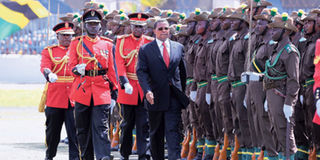
President Jakaya Kikwete inspects guard of honour during the 50th anniversary of the Union of Tanzania at Uhuru Stadium in Dar es Salaam on Saturday. PHOTO | FILE
What you need to know:
There are positive sides to every deed done on good will. This Union was possible because each side trusted the other. It is for this reason that it has endured many trials and pitfalls ...
Dar es Salaam. Tanzanians have just celebrated 50 years – Golden Jubilee -- of the Union of Tanganyika and Zanzibar. Formerly, the two entities were independent of each other. However, on April 26, 1964 they agreed to form what was known then as the United Republic of Tanganyika and Zanzibar.
Tanganyika, which was under British trusteeship, became independent on December 9, 1961. Zanzibar, for its part, got its independence from the British on December 10, 1963. However, just a month later, the majority people ousted the Sultan on January 12, 1964 in the famous Revolution.
Existing literature shows that the Union was agreed upon between the Founding Fathers, Mwalimu Julius Nyerere, the first President of the Republic of Tanganyika, and Sheikh Abeid Aman Karume, the first President of the People’s Republic of Zanzibar.
The concept of union connotes a sense of solidarity, cooperation and belonging. This is evidenced by people moving, residing, working and marrying in either side of the Union because they have mutual relationships that have cemented them together for years.
This is what has been for Tanganyika and Zanzibar for over 50 years. Now we can boast of seeing that the people of these two entities live in peaceful co-existence with one another because above everything else they have blood relationships albeit some reservations over the so-called ‘unjustified’ Union structure.
There are views that, the Union should be analysed and redefined to resolve existing challenges. A new one, which is more open and less secretive, should be formed. It was alleged that, as matters stand, talking about the mistakes that Nyerere and Karume allegedly committed is likened to committing treason.
All the same, critics maintain that the current Union is not open enough and lacks both legal and political legitimacy for lack of public participation. They, thus, prefer a federal type of Union under the three-government.
Adding salt to injury is lack of the political will for the part of top political leaders to address existing Union frictions in the last 50 years now, so critics claim.
“If for the past 50 years, there has never been the political will to address all Union frictions once and for all, how many more years do we need to have them addressed?” this is question often asked by critics of the current Union format. It is obvious that the sustainability of the Union depends on good will from the peoples of both sides. Each party must be made to feel being at home and as benefiting from the Union.
After President Jakaya Kikwete formed the Constitutional Review Commission (CRC) and commissioned it to collect and review public opinion, it came up with the proposal of a three-government structure to replace the existing two-government system. The latter is what the ruling Chama Cha Mapinduzi is in favour with.
According to the CRC analysis, as things stand, the federal type of government would help to solve the problems that have marred the Union in the past 50 years.
The CRC finally submitted the second Draft Constitution to President Kikwete in Dar es Salaam on December 30, last year. It later presented it to the Constituent Assembly (CA) for debate in Dodoma on March 19, this year. Then, President Kikwete, for his part gave an inaugural speech in the CA and talked at length about the Union structure and why he would not accept the three government structure proposal during his tenure. Critics quickly lashed at the President’s speech claiming that he did not address the CA as the Head of State but rather as chairman of the ruling party, CCM. They went on to criticise saying by taking aides in such an important matter, he was dividing the people, whether intentionally or not.
This later criticism seems to have been supported by the developments in the CA, whereas almost every assembly member who is from the ruling CCM, has been aligning with the President’s stand, with some to the extent of declaring themselves as ‘believers’ of the two-government system.
The remaining members, who are the minority, have continued to support the proposal in the second Draft Constitution of a three-government structure.
At the same time, the so called Coalition of the People’s Constitution in the CA (Ukawa) opted to walk out of the assembly claiming that they were being slandered against, attacked with abusive language, and that they were protesting against discriminatory statements by some senior CCM members in the CA.
For its part, CCM claims that adopting a federal Union would only serve to break it.
So, the matter has remained the bone of contention between the opposing sides, with each not showing any signs of compromising to reach a consensus. Critics of CCM’s stand say changing CRC proposal is illegal for lack of jurisdiction. They contend that the ruling party cannot decide at will what should be removed and added to the Draft Constitution to suit their interests.
CCM says a three-government structure is costly and has negative security implications. Critics of CCM’s stand argue that, there is no substantial evidence to back the ruling party’s submission for nothing new will be created apart from some restructuring, which is even effected from time to time in the current Union structure. They also propose diversified sources of income to support the Union government of which CCM is not willing to accept either.There are also views that the current government is too expensive to manage because it is too big. Critics say although there have been proposals to reduce its size and cut down unnecessary expenses, including frequent travels abroad and purchasing expensive government vehicles, CCM has not been very supportive. So, they ask, how come CCM seems concerned with the country’s poverty while it is the very one that has been at the helm for so many years? When it says that people lack basic social services, is it not the one that is reining? Isn’t this a contradiction?
No doubt Mwalimu and Karume tried their best to ensure Tanzanians remained united and this is a great achievement for their part in a world which often experiences frequent episodes of political tensions, social unrest, violence and bloodshed.
Mwalimu especially frequently challenged those, who wanted to break the Union so that each entity – Tanganyika and Zanzibar -- takes care of its own affairs as was before the Union. In one of his speeches, Mwalimu warns disunity would lead to costly consequences to the people of Tanganyika and Zanzibar: “Once this sin is committed in either side it will eat you up.”
He says since the world is moving towards political and economic integration and regional groupings, how come there were others touting disunity? In Mwalimu’s mind, unity is needed in Africa to create collective bargaining power in regional and international politics and be able to resist imperialism.
When Tanganyika agreed to form a Union with Zanzibar, the idea was to have one country – the United Republic of Tanzania. This model succeeded for many years during Nyerere’s presidency, but, according to the CRC chairman, Judge (rtd) Joseph Warioba, this is no longer the case. He says, we now have two countries and two governments. This development has been systematically undermining the Union.