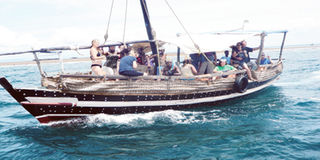
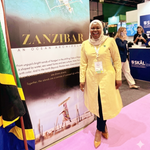
A tour boat with tourists near the Wasini Chanel from where dolphins can be viewed swimming in groups. (Inset) Journalists from Dar es Salaam pose with a Kenya Tourism Board staff at Shimoni Peninsula. PHOTOSI ELISHA MAYALLAH.
What you need to know:
The boat ride was enthralling as we motored away, and the scenery hypnotising.
Inspired by our beach experience in Diani, Kenya’s South coast recently, we left after breakfast heading out to Wasini Island to begin our tour.
The one-hour trip to Shimoni, where we were to obtain the necessary permits, took us through a quirk of local Swahili villages and coconut trees. There were also stretches of sugar cane plantations believed to have been started during the slave trade.
In the villages, as we drove away, men chatted in groups outside their makuti thatched houses, dressed in white kanzus, while women were clad in black long dresses.
It was a bright and humid morning when we arrived at the Kenya Wildlife Service (KWS) office at Shimoni Peninsula. Visitors to the Wasini Island pass through the Kisite Mpunguti marine national park and reserve, in which a special fee is charged for visitors.
Shimoni is one of the ancient villages located nearly 45 kms from Ukunda (Diani); 20 kms to Lunga Lunga, Tanzanian border and 55 kms to Tanga city along the Indian Ocean. It is here, where the Arabs used the popular caves in the village as slaves holding areas awaiting the arrival of ships to transfer them to the famous slave market in Zanzibar, and for onward shipment to the lands of captivity.
The caves are a fascinating historic site which was previously used as Kaya shrines and hiding places for the Wadigo, the natives in the village. Other local tribes living in the village are the Wa-Chakwa and Wa-Kyuyu, according to our guide.
After obtaining the permits we headed to the Shimoni jetty to board our boat. We were introduced to our captain, Mwalimu Abdala and his crew, Tsumo Salim, Pandu Ali and Omar Ruta. Mwalimu welcomed us onboard and assured us of a safe and comfortable ride.
As the boat roared into action, a slight breeze picked tempo and was soon lost as gusts of gushing air hit our faces. The boat ride was enthralling as we motored away and the scenery hypnotising. The swish of the water as the boat raced against the waves was tempting to touch just to get the wild sensation.
We chatted with the captain whose only gesture of steering was lightly moving a wooden plank with his foot. We were served with tea and coffee with some nuts and maandazi. It’s a four-to eight kilometre boat ride from Shimoni to the reefs in Kisite-Mpunguti marine reserve and park. The reserve is known as a home of dolphins and it has coral gardens and three small coral islands surrounded by reef making snorkelling and diving rewarding. The reserve consists of the inner and outer Mpunguti Islands and Kisite Island.
Kisite has a fantastic variety of fish species and coral reefs. Over 250 fish species have been recorded, as well as sea turtles, whales’ octopus, clams, starfish, and sea cucumbers. The Island is designated as an Important Bird Area, vital for the conservation of habitats favoured by birds and is particularly known as a breeding site for Roseate and Sooty Terns.
Near the snorkelling area, tens of dolphins rollicking in the water came into view and before long, we were circled by several of these graceful creatures, which apparently swimmed in groups. Within the Wasini Channel, the rare hump-backed dolphins are often sighted.
Finally the boat docked in the middle of the water with other boats and dhows passing nearby with tourists exploring the treasures of the Indian Ocean. And soon a small canoe picked some of us off to the fringing reef of a large rocky islet and a sand bar, which appeared out of the blue ocean at low tide.
The bounty of the ocean was right there for us to take in. Tropical fish in psychedelic colours dived in and out of the coral polyps, which themselves are picturesque and diverse, with some plain, others streaked and yet others boasting intricate ruffles.
After nearly an hour, we were all back into the boat heading to Wasini Island for lunch. Here we found an airy seaside Makuti structure where tables were already set for us. The view of the ocean and Shimoni, from here, in the distance was breathtaking.
Abdul-hakim Hemed, the manager, welcomed us and we were served sea weed filling, crab with ginger sauce and chapati as an accompaniment. And the main dish of Swahili steamed rice and fish with coconut sauce was flavourful.
After lunch we walked into the Wasini cultural village which is divided in three villages: Mkwiro; Nyuma Maji and Wasini itself. It was easy to notice the village has no cars or bikes and houses are surrounded by one another, like in a slum.
The locals known as Wavumba are surrounded by ancient Swahili ruins, the coral gardens, a landscape of exposed coral reefs, the mangrove forests and ancient tombs of the slave masters of the 18th and 19th century which makes this island a beautiful spectacle for one to explore. They walked us around the crab rearing areas, old historical buildings, and invited us to buy their fish catch of the day, before heading back to our hotel in Ukunda (Diani).
As we left, the following day, I couldn’t help but think of the tranquil Kenya’s South Coast and its beautiful sea breezes that kept me refreshed and relaxed.