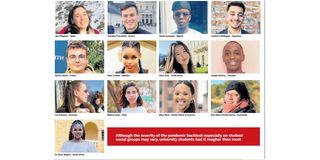
Many university students worldwide felt the brunt of the pandemic harsher. These thirteen explain how their respective countries helped them progress
With plenty of people infected worldwide, and more deaths than we can count, the Covid-19 pandemic impacted our planet on a large scale since December 2019.
Over time, different countries adapted more or less to cope with the major health crisis. In fact, each person has had to deal with new health issues affecting their lifestyle.
A lot of talk about how the pandemic affected different groups and other risen issues such as mental health crisis were exhausted.
There was a group of individuals who found themselves in a rather tight and uncertain spot; university students. They are financially insecure, students, jobless, unsure of how to navigate a pandemic ridden world, expected to cope with new learning methods and at the end, have absolutely no means of finding jobs or that little experience from their expected field work assignments.
This is also an age where the natural demand to socialise is rather high and the pandemic had many in isolation.
Compared to individuals in working life, they have a specific statute in the society and symbolize the future generation.
To better understand their situations, we spoke to 13 students from different parts of the world to understand how the pandemic impacted their way of life and how they moved on with their academics and social lives.
First impressions
A common feeling may be underlined for every student around the world. The appearance of Covid-19 in Wuhan seemed to be unreal for most of them.
It seemed to be something far away that will not take on such a large scale.
Garan Lintanf, a French student said “the first events in China looked really spectacular and we thought that it will not happen in France.”
Rosa Maria Peralta Garcia from Guatemala echoes similar sentiments stating that, “at the beginning of 2020, there were some rumours regarding a particular disease that was spreading throughout Asia and Europe.”
As most of the known cases were on the other side of the world, she did not really pay much attention to it. “The main shared idea was that the disease seemed to be unreal and far away, not able to reach us,” she stated.
“In the beginning I never imagined that it would impact our lives this deeply and for such long time,” stated Léa Schinzel from Germany.
It should also be noted that in the early stages, very little information was available from China, reinforcing the difficulty in awareness for other countries.
It then got worse…
After a while, the pandemic eventually reached other countries too, provoking first reactions with some populations being in a serious state of panic.
Mahera Imam from India described that as a “completely strange” time. It was a period of panic and anxiety for many people.
Similar observations came from Christos Psaradellis in Greece who says that; “As soon as Covid-19 hit my country, we were terrified of the state of emergency that came with the situation. In the first weeks, I did not go outside at all.”
In many countries, governments were taken by surprise and found themselves dismayed.
Measures were then taken more or less quickly, such as social distancing, wearing of masks and using sanitizers. This may have led to shortages of these products in some countries.
Jiwon Park in South-Korea describes that during the initial outbreak, even though people did care about the virus, they were not really scared about it.
She explains that this was due to the low number of infections in South Korea compared to other countries. That was also due to the fact that the South Korean government closed their borders rapidly.
Different governments worldwide responded to the pandemic in very different ways, impacting students’ contexts unequally.
In Tanzania, even though people feared the pandemic and the government eventually acknowledged its presence, there were no extreme measures such as lockdown. That was mostly due to economic reasons because a total lockdown would have hurt a large portion of the population too hard.
School at home
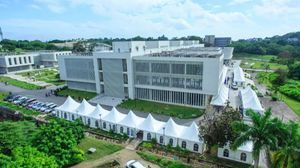
During the Covid-19 pandemic, Joseph Geofrey from the University of Dar es Salaam explained that life was still normal even though he had to switch to online learning.
Contrary to Joseph’s experience, Federico Rodriguez in Argentina explained that his government decided to impose a quarantine despite the already perilous economic situation.
He also had to switch to distance learning from home. This is also the case for Ana Vilaplana in Spain who went through a lockdown of 3 months with her family and a friend.
As we have seen worldwide, students faced different Covid-19 sanitary regulations according to their country. That inevitably affected their way of work.
A lot of students went through a period of online courses. For some, it was much harder to follow and keep up the courses using online tools.
Garan felt he was more distracted at home by friends or family which made it hard to focus on the screen all day.
Moreover, Dr Silver Magara from South-Africa underlined the fact that remote courses were also hard to follow as digital tools are not always accessible for everyone. “It was a difficult transition for a lot of students mostly due to the lack of internet and equipment,” she said.
For Ana, the Covid-19 transition had been a difficult time too.
Her university did not really know how to manage the volume of work given to students, and that generated a lot of stress.
With online courses, she felt she was learning less and she was not as engaged in the lessons.
According to Daniel Ayanwola in Nigeria, most of students were lazier at home, including him, due to the distractions around and the lesser interactions during courses.
He also did find it easier to learn due to the fact that he was able to move at his own pace.
Cut off from society
However, the pandemic did not only affect students on a work level, but also their social way of life.
Social distancing had been applied more or less everywhere.
In fact, that was one of the hardest things for Joseph because in many African communities, physical contact is a major part of social communication.
With the pandemic, physical contact was no longer possible and it impacted a lot social relationships.
In some countries, in addition to social distancing, social isolation had been enforced too.
Léa explained that she was not able to see her fellow students which made her feel very isolated and lonely.
The pressure she felt in her studies became even worse, because there was no social compensation like group studying, partying, or just having a coffee with friends, a feeling shared by Chris and many others. Mahera also pointed out the fact that these lockdowns blocked physical movements, and thus affected a lot their bodies and minds.
Federico describes that in Argentina, students faced many anxiety issues as well as depression due to the confinement during the winter months of 2020.
In fact, this period of social deprivation affected the mental health of many among the populations, increasing the number of suicides.
The felt impacts
All the students underlined that everyone had been impacted by the pandemic, and that several society groups were affected quite hard.
However, according to the students interviewed, the severity of pandemic backlash especially on student social groups may vary.
Rosa says that everyone was affected by the pandemic differently. Children needed to be supervised at home, adults were still with their jobs and the health professionals struggled in the front lines too.
Jiwon shares this idea too and highlighted that many of them lost their jobs while others closed their business. Garan believes that students are supposed to have a bigger social life, so they were more impacted by the social deprivations.
He felt a real injustice when the French government decided to let open huge open-spaces for workers while there was a forced closure of lecture theatres for students.
Lockdowns also severely impacted students’ finances, forcing some of them to do more than 3 hours of queueing in order to benefit alimentary distributions.
Moreover, Hope Tomeka from Namibia stated a similar situation. “Students have been more disadvantaged on an education level and on a social level too. The education system tried to introduce a new method with negative impacts on university learners,” she said.
Lessons learnt
Chris says the pandemic did help him learn new skills. He developed competent digital skills, improved his use of numerical tools and knows how to communicate with others remotely now.
“In this modern period it is really useful to know such things and this will possibly help one secure better job opportunities in the future,” he says.
On the other hand, many students underlined that they learnt more about themselves too. Daniel followed some online classes in order to do personal development.
Olivia West from the United States took the decision to allow herself grace and time to adjust to all that was happening in the world.
She spent more time outdoor disconnected from internet. In addition, she learned to be patient and to make the best of a bad situation.
Ana learned to appreciate the opportunities that come to be with people as much as possible. Furthermore, she is now also taking time for herself, by resting more.
For Jiwon, some elements brought by the pandemic are now anchored in societies and are here to stay. According to her, we will continue to use remote online tools for daily and professional life. From that point of view, she is considering seeking a job taking that into account.
Hope says she’s made peace with Covid-19. She expects that it helped people open their eyes about the importance of hygiene and about domestic violence.
For Joseph, it is really important that everyone pay attention to the disease.
People still need to wear masks when in crowded spaces and to be vaccinated if we want to get out of the situation. “The Covid-19 pandemic give us a new perspective that highlighted the idea that we should be cautious and that other global disasters could easily happen,” he said.
Federico also believes that we are going forward out of the pandemic and he hopes that we will come back to a normal life without forgetting what happened and the lessons we all learnt.