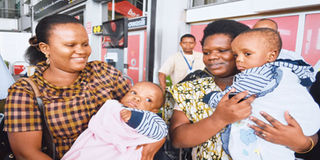
Free at last: Eliud and Elikana who were born conjoined at the pelvis can now see each other, touch each other and even smile at each other. On Wednesday they returned home from India where they were separated. PHOTOS | SALIM SHAO
What you need to know:
They went straight to Muhimbili hospital for observation after which they will travel back home. Apart from a few members of the press and the staff from Muhimbili hospital, there was no one from Grace’s family to meet them at the airport.
Eliud is in his mother’s arms suckling, enjoying the freedom of being held in her arms, all alone. He turns when he hears his twin-brother Elikana baby-talking. Elikana who is sitting on the bed talks louder when his brother turns. The two gaze into each other’s eyes and smile. Their mother Grace Rwesha, 20, smiles too.
For almost nine months since Eliud and Elikana were born joined at the pelvis, their mother would hold them both at the same time.
The government sent them to India in June last year, where doctors made their first-ever attempt at separating pygopagus twins (those joined at the pelvis). Such kind of twins account for 17 per cent of the conjoined twin population in the world.
The 12-hour surgery involved separating the spine, anus, rectum, penis and urethra. The babies had a single anus, urinary passage and rectum. Their penises were fused in what the doctors said was unlike anything they had seen before. About Sh 100 million was spent on the surgery that took place on December 16, 2013. The operation was successful to the joy of their mother, doctors in India and well wishers back home.
The boys who turned one on Thursday, Feb 20, saw each other’s face for the first time three weeks after the operation. Their mother says it was amazing to see them look at each other, a sight she says is still breathtaking for her. “It is a miracle,” says Grace who comes from Kasumulu village on the Malawi border in Mbeya. “It melts my heart to see my sons enjoying each other’s presence. I wonder if they know who the other baby is,” she says.
The twins and their mother returned to the country from India on Wednesday. They went straight to Muhimbili hospital for observation after which they will travel back home. Apart from a few members of the press and the staff from Muhimbili hospital, there was no one from Grace’s family to meet them at the airport.
The journey has been long for mother and sons. Grace met the twins’ father, Erick Mwakyusa, 28, in 2012 when her first born, William, was two. She completed primary school in 2009 when she was pregnant with William. Grace was only 16 when she gave birth to William in December 2009. Grace who lived with her maternal grandmother at the time started selling vegetables to earn an income. Her parents live in Malawi and Grace needed money for her upkeep, especially now that she had an extra mouth to feed. William’s father rejected both mother and son when he learnt Grace was pregnant.
Shocking news
When Grace realised she was pregnant for Erick, (the twins’ father), she decided to join her husband-to-be’s faith–Jehovah’s Witnesses. She used to worship at the Ngemara church. Grace had to shift to Jehovah’s Witnesses to save Erick from being ex-communicated. They had to be of the same faith to be joined in holy matrimony.
The two had planned to tie the knot in July 2013, five months after Grace gave birth. But her dream to say ‘I do’ to her prince charming was shattered when she delivered the twins.
Grace and her fiancée knew she was carrying twins and had been told she would deliver by C-section. She left her village Kasumulu at 10 am on the morning of February 20, 2013 and arrived at Kyela District Hospital two hours later. She was immediately taken to the theatre for delivery.
Relatives from both sides were all at the hospital waiting. Erick and Grace were going to have twins and that was great news. Grace came around at 4 p.m. after the operation.
It was her mother who broke the shocking news to her when she regained consciousness. “I wanted to see my babies and my mother said I could not hold them because they were conjoined. I did not understand what she meant. It was when they were brought to me that I understood what my mother had meant. I was shocked,” Grace says.
Erick was shocked as well and so was the rest of the family. “He openly rejected the children,” Grace recalls. “But I understand it was difficult for him. It was hard for all of us. I forgive him. I forgive all of them,” says the mother of three.
The excitement of walking down the aisle vanished when Grace travelled to Mbeya Referral Hospital a week later. Erick had accompanied her to the hospital and that was the last time she saw him. She was transferred to Muhimbili National Hospital a day later and travelled to India three months later.
“I haven’t seen Erick since I left Mbeya last March. I haven’t seen my family, our house; I miss the village so much. It is hard to imagine that it has been a year.”
“When I was in India, I was afraid he would marry someone else. I really longed for him. We spoke constantly over the phone. He knows that the boys are okay now. And he is coming over the weekend to take us home,” says the mother of twins excitedly.
Grace and her sons were still at Muhimbili hospital’s Paediatric Surgery Ward when I met her for interview on Thursday.
Partner’s pressure
At the paediatric ward, all the nurses who came to Grace’s bed asked about her husband. Although Grace and Erick are not legally married, the nurses referred to him as her husband. They called Grace ‘Mama Wawili,’ a Swahili term for mother of twins and smiled at the two boys all the time.
“They are used to seeing white skin,” one nurse joked referring to the months the boys spent in India. “It must be too hot for them here,” said another.
Another nurse asked Grace if she would have another baby with the twins father to which Grace was quick to say; “Of course not.”
Then another nurse remarked, “Ha! After all he did to you? You mean you are willing to go back to him? I am sure you will be pregnant again by August. Do you want to go back to India while pregnant?”
Grace laughed them off. “I will not get pregnant again. I don’t want any more babies. I have these two to care for,” she told the nurses.
During her three months stay at Muhimbili before she went to India, Erick, the twins’ father had tried to persuade her to abandon the boys at the hospital. “But I did not. I could not no matter what condition they were in. They are my children,” says Grace.
A senior nurse, who did not want to be named says they had noticed negligence in her. When they questioned her that is when she revealed the pressure she was receiving from her husband.
After counselling sessions, Grace was more relaxed and accepted her sons’ condition. The nurse says it wouldn’t be a surprise for Grace to go back to the father of her children and have more children with him.
“She is still young and she would probably get married to another man anyway. No one has the right to tell her not to reconcile with the father of her children. What needs to be done is to counsel her on family planning,” says the nurse.
Family planning counselling for Grace has already begun.
It has been a lonely year for Grace, no doubt. But her struggles have made her stronger. “It is amazing what I have gone through in the past year alone. I feel like I have grown a lot. I am grateful for every challenge,” she says.
“When we were in India, the doctors told me they wanted to make one of my sons a girl by changing his genital organs since they shared one penis. I was shocked to hear that it was even possible. But they said they were no longer looking into that option.
There had been a case in the past where the child whose sex was changed grew up resentful.”
“Although I am glad it didn’t get to that, I think I would have bought the idea. It would have been much better to have them separated no matter what it took than raise them as conjoined twins,” she says.
The twins now use colostomy bags, which are small bags used to collect their waste. The hospital in India gave Grace 50 colostomy bags for each boy. She changes the bags every three days.
“They told me that I can use kanga once the bags run out. I just have to wash them with hot water to avoid infection,” says Grace. The twins will return to India in six months time for further surgical procedures on the penis and for colostomy closure.