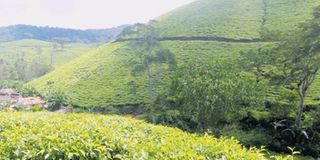
Land pattern in the upper plateau with tea estates. PHOTOI ELISHA MAYALLAH.
What you need to know:
On a return trip to Tanga region in the north coast of Tanzania from Arusha recently, I was once again mesmerised by the varied landscapes.
I have always been fascinated by the magical views of the natural beauties and landscapes from Mombo town along the highway that branches at Segera junction town heading to Tanga city.
There are always good reasons to travel by road, one being the fact that road trips connect travellers with nature.
On a return trip to Tanga region in the north coast of Tanzania from Arusha recently, I was once again mesmerised by the varied landscapes.
I have always been fascinated by the magical views of the natural beauties and landscapes from Mombo town along the highway that branches at Segera junction town heading to Tanga city.
The drive along Segera to Muheza towns passes through Swahili cultural villages, offering rare sightings of curious welcoming locals. They are mostly found either biking, walking or doing business by the roadside.
I took in the views of culture and heritage up to Amani Nature Reserve (ANR), a protected area.
Located in the East Usambara Mountains, ANR is a paradise of nature with unique flora and fauna. It has been termed as the “Last Paradise.” The flora species composition in the reserve is diverse with thousands of tree species with some over 60 metres high easily seen throughout the reserve. The expansive fertile land is also filled with different species of plants and flowers including tea farming.
Amani which is situated in the pockets in the East Usambara Mountains, is part of the huge natural entity that makes up the Eastern Arc Mountains. It was gazetted in 1997 with the main objective to involve the local communities to take part in the management of the reserve and forest conservation to increase income generating opportunities.
The ANR is one of the most important water catchment areas that through the Zigi River provides domestic water to Tanga town, associated industries, estates and adjacent local communities. In addition, it provides water to the Hale and Pangani hydropower stations in Pangani River, among other benefits.
The ANR has a total area of 8,380 hectares divided into ecological zones that are home to a collection of medicinal plants, biodiversity preservation, restoration and botanical garden.
According to Godfrey Msumari an official from the ANR, the reserve has anatomical and endangered plants, more than 340 bird species, including a few endemic; there are also 74 geniuses of animals, which include reptiles, mammals, amphibians and molluscs.
Tourists, Godfrey says, are likely to see the endemic chameleons, snakes such as cobras, amphibians particularly legless frogs, butterflies and other insects.
Land pattern and land use: Amani Nature Reserve extends from the lowland to the upper plateau. The upper plateau allows visitors to follow the land pattern of the East Usambara, and these are among the must-see attractions in the ANR. The land use in the upper plateau, including the local agricultural farming and tea estates adds the portfolio of attractions.
Viewpoints: There are three viewpoints, namely Kiganga Hill, Ngua and Mbomole Hill viewpoints.
Waterfalls: There are three waterfalls namely Derema, Ndola and Pacha and visitors like to hike to the waterfalls.
Farming: Tea farming is under the East Usambara Tea Company that has a few acres of cultivated tea plantations. Visitors are guided in the farm tour by an expert who explains the stages of tea farming in the area.
Nature trails: there are nine visitors trails which are signposted and mapped and well documented in the leaflets and trail guidebooks. The popular trails, according to Godfrey, are Mbomole Hill, Monga, Ndola, Turaco bird trail, Kwamkoro nature trail, Derema trail and Zigi trail
Butterfly and Spices project: The villagers run a butterfly project with a substantial quantity of live butterfly or larva that are exported to Germany, the UK and Switzerland. Locals through groups and individual arrangements produce different spices sold in Tanga region and beyond.
Picnic sites: The picnic sites are available for visitors fully supplied with sanitary equipment. These are: River site (Zigi), hill pick (Mbomole Hill) and situ forest site (Kiganga).Two campsites: One with fixed water closet (ANR HQ), the second one (Kiganga) allowing a mobile sanitary system.