World football body plunges into new corruption scandal
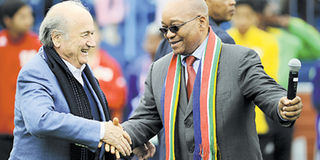
A file picture taken on July 4, 2010 at the opening ceremony of the "Football For Hope" in Alexandra Township near Johannesburg shows South African President Jacob Zuma (R) shaking hands with FIFA president Joseph S. Blatter.PHOTO|AFP
What you need to know:
Although vehemently denied by the German Football Federation (DFB), corruption claims made by Spiegel weekly newspaper on Friday would have felt like yet another body blow to world football’s governing body.
Berlin. Already reeling from the accusations surrounding the attribution of the 2018 and 2022 World Cup competitions, FIFA has been plunged into a new scandal relating to the 2006 edition.
Although vehemently denied by the German Football Federation (DFB), corruption claims made by Spiegel weekly newspaper on Friday would have felt like yet another body blow to world football’s governing body.
On top of the Swiss investigation into the attribution of the 2018 World Cup to Russia and the 2022 tournament to Qatar, and the surrounding bribery scandal that has seen 14 people arrested by American and Swiss authorities, now Spiegel have claimed that votes for the 2006 edition played in Germany were bought.
It’s another mess that FIFA can ill afford with its president Sepp Blatter having already been suspended for 90 days due to suspicions a two million Swiss franc ($2 million, 1.8 million euros) payment he made to UEFA counterpart Michel Platini was not above board.
Platini has also been suspended for the same period by FIFA’s independent ethics committee, as well as the organisation’s secretary general Jerome Valcke.
Seven former FIFA officials were arrested by Swiss authorities in May as the United States attempts to have them extradited to face charges of accepting bribes.
Spiegel claimed on Friday that the DFB had borrowed 10.3 million Swiss francs in 2000 from the now-deceased former CEO of German sportswear giant Adidas, Robert Louis-Dreyfus in order to buy the votes of four Asian members of FIFA’s 24-strong executive committee. Germany won the bid to stage the 2006 World Cup ahead of South Africa by 12 votes to 11, with one abstention.
Spiegel claimed the DFB then transferred 6.7 million euros (the equivalent exchange rate for the borrowed Swiss francs at the time) to a FIFA account in 2005 to reimburse Louis-Dreyfus.
The DFB preempted Spiegel’s claims by issuing its own statement on Friday admitting they had made that last payment to FIFA, but denying it had any connection to the 2006 World Cup.
On Saturday, DFB president Wolfgang Niersbach categorically denied any illegal activity by the Germans.
“There was no slush fund,” he insisted. “The World Cup was not bought.”
Niersbach added that the internal investigation had not been completed but said: “I can definitively exclude that this payment was linked to the World Cup.”
German media have jumped on the story, however, with popular daily Bild running the title: “Was the 2006 World Cup bought?”.
But for FIFA, it is yet another blow to the already waning confidence in an organisation that runs the world’s most popular sport.
The 2010 World Cup has not been spared suspicion due to a $10 million payment made by South Africa to then FIFA vice-president Jack Warner, who is currently fighting extradition from his Trindad and Tobago homeland to the US to answer corruption charges.
Both FIFA and South Africa deny any wrongdoing.
American authorities are also examining previous World Cup events after another former FIFA official, Chuck Blazer -- who, like Warner, has been banned for life from football-related activities -- turned whistle-blower and admitted to accepting bribes from Morocco and South Africa over the bidding process for the 1998 World Cup, eventually won by France.
The succession of scandals prompted FIFA in June to decide to suspend the nomination process for the 2026 World Cup.
Meanwhile, FIFA has removed the executive committee of Thailand’s football association from office, days after suspending its chief Worawi Makudi who is under investigation for breaching the ethical code of the sport’s ruling body.
Earlier this week Worawi, who has dominated the game in Thailand for years, was banned from all football-related activities for 90 days by FIFA’s ethics watchdog.
The 63-year-old was a FIFA executive committee member for 18 years until May -- including for its 2010 vote for the 2018 and 2022 World Cups -- and has faced multiple allegations of wrongdoing. The suspension prompted the Football Association of Thailand (FAT) to postpone elections for a new chief that had been scheduled for Saturday.
In a statement published Friday FIFA’s emergency committee said it had decided “to remove” the FAT executive committee and “to appoint a normalisation committee in its place”.
The new committee’s jobs will include revising the FAT electoral code and conducting the election of a new executive committee by February, it said.
In Bangkok FAT lawyer Narinpong Jinapak told AFP Saturday that the new committee was appointed “only to supervise” the association’s postponed elections.
According to him the previous FAT committee “has not been dismissed” and “is still running day-to-day Football Association affairs”.
In July Worawi was found guilty by a Thai court of forgery in his reelection as head of FAT -- a ruling he denies and is appealing.
His ban follows suspensions handed out to embattled outgoing FIFA president Sepp Blatter and European football boss Michel Platini.
Blatter won his fifth election in May, two days after US authorities charged 14 football officials and business executives over more than $150 million in bribes. But amid intense pressure over scandals engulfing the world body he announced four days later that he would stand down.
In another developments, Michel Platini’s wounded bid for the FIFA presidency suffered a new blow Friday when the English FA suspended support for the French football legend because of new information on his legal battle.
Suspended FIFA leader Sepp Blatter added to the turmoil surrounding football’s governing body when he said a two million dollar payment made to the UEFA president in 2011 was “a gentleman’s agreement.”
Pressure mounted on Platini, who was suspended by FIFA alongside Blatter, only a day after UEFA’s 54 members gave support.
The FA said it had been told of more information “relating to the issues at the centre of this case from Mr Platini’s lawyers” at the UEFA meeting on Thursday.
Because of the information the FA board has “concluded that it must suspend its support for Mr Platini’s candidature for the FIFA presidency until the legal process has been concluded and the position is clear,” said a statement.
It said the new information had to be “kept confidential”.
The French leader of UEFA and former football golden boy had been favourite to take over from Blatter in an election in February until he was named in a Swiss criminal investigation into Blatter’s management of FIFA.
- Gentleman’s agreement -
Swiss prosecutors are looking into a $2 million (1.8 million euro) payment that the 60-year-old Platini received from FIFA in 2011 for work carried out a decade earlier.
Platini has strongly denied any wrongdoing. But he and Blatter were suspended by FIFA’s ethics watchdog for 90 days because of the case.
“It was a contract I had with Platini, a gentleman’s agreement,” the 79-year-old Blatter told Swiss broadcaster RROTV in an interview.
He would not give more details because of the investigations.
Blatter and Platini are appealing their suspensions. But Platini’s presidential bid now faces major doubts, with talk mounting of alternative candidates coming forward.
The head of the Asian Football Confederation Shaikh Salman bin Ebrahim al Khalifa is on the verge of announcing a bid, a source told AFP.
Others could follow as the February 26 election goes ahead amid mounting turmoil.
FIFA’s executive committee will meet on Tuesday and is likely to discuss whether the date can be maintained.
UEFA’s 54 member nations on Thursday released a statement backing Platini’s “right to a due process and a fair trial and to the opportunity to clear his name.”
The European body called on FIFA’s investigators and appeal committees “to work very rapidly to ensure that there is a final decision on the merits of the case by, at the latest, mid-November 2015.”
The English FA and other leading federations in Europe have expressed increasingly cautious support for the Frenchman however in recent weeks.
The German, Dutch and Danish associations have all said Platini must clear his name.
UEFA secretary general Gianni Infantino said after Thursday’s meeting that discussions would take place about the possibility of supporting another candidate.
“It’s something that will be discussed by UEFA representatives with members of other confederations, as we’ve done in the past, and we’ll see if another candidate from another confederation or another European comes up.” (AFP)